
Free Safe Operating Procedure (Green Waste Transfer) Template
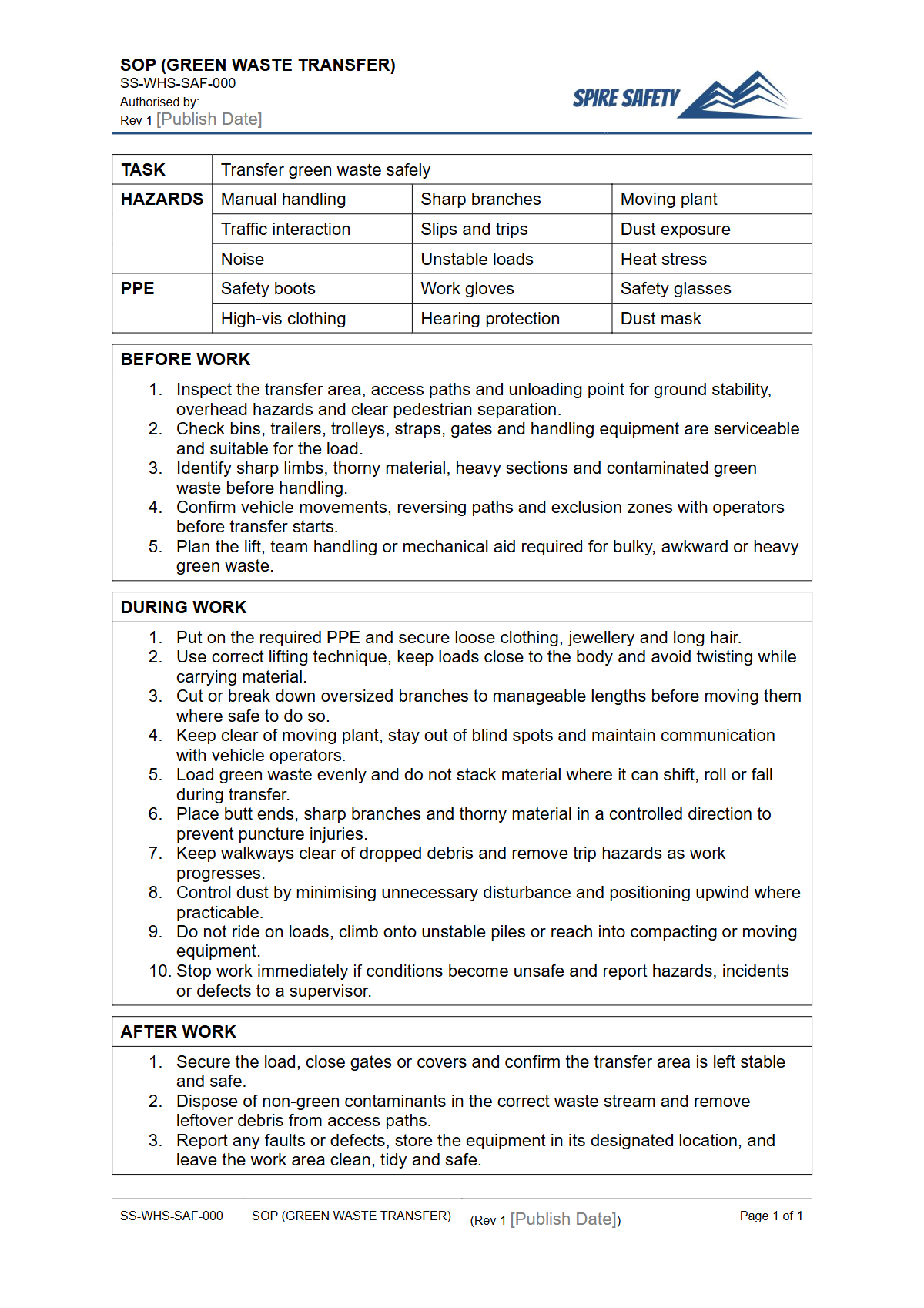
Download our free Safe Operating Procedure (Green Waste Transfer) template. This DOCX & PDF resource helps define safe work methods for handling green waste.
Free Safe Operating Procedure (Green Waste Transfer) Template
DOCX • 126 KB + PDF
Updated Oct 2026
No signup required
Purpose of the Free Safe Operating Procedure (Green Waste Transfer) Template
The primary purpose of this Safe Operating Procedure is to provide a clear, step-by-step guide for workers performing green waste transfer tasks. It aims to minimise the risk of injury or illness by standardising the process.
Documenting your procedures helps ensure that all tasks, from pre-operational checks on machinery to the final cleanup, are carried out consistently and safely by every team member.
A comprehensive SOP serves as a critical training tool for new and existing employees, reinforcing safe behaviour and expectations. It also forms an essential part of your overall safety framework.
For businesses looking to formalise their safety processes, integrating specific SOPs into broader WHS management systems is a fundamental step toward creating a robust safety culture. This document specifically addresses hazards common to green waste handling, including entanglement in machinery, musculoskeletal injuries from manual tasks, exposure to dust and bioaerosols, and vehicle interactions.
Video walkthrough
How to use the Free Safe Operating Procedure (Green Waste Transfer) Template
This template is provided in both DOCX and PDF formats for your convenience. The DOCX file is fully editable, allowing you to tailor the content to the specific equipment, environment, and processes used in your workplace.
Important: This is a template, not a finished document. You must customise it with your site-specific details.
We have no way of knowing your unique site conditions, the plant you use, the training your workers have, or the specific risks in your operation. You must consult with your workers and conduct a risk assessment to ensure the final document is relevant and effective for your business.
The procedure should detail the exact types of mobile plant used. For example, if your process involves loading with a telehandler, you should cross-reference a dedicated procedure like our FREE Telehandler SOP Template. Similarly, if a grader is used for managing stockpiles, our FREE Grader SOP (Safe Operating Procedure) Template can provide the necessary operational detail.
After customisation, the procedure should be approved by management and communicated to all relevant personnel.
When to use it
A Safe Operating Procedure for green waste transfer should be developed and implemented before any worker undertakes the task. It should be used as a primary reference during worker induction and task-specific training.
The SOP should also be reviewed and referenced:
- Before starting a green waste transfer job on any given day.
- During refresher training sessions to reinforce correct procedures.
- As part of incident investigations to identify if procedural gaps contributed to the event.
- When planning changes to the work environment, equipment, or process. For instance, introducing a different type of earthmoving equipment might require referencing our FREE Dozer SOP (Safe Operating Procedure) Template and updating your core procedure accordingly.
Who should use it
This SOP is intended for use by Persons Conducting a Business or Undertaking (PCBUs), managers, and supervisors in industries that handle green waste. This includes sectors like waste management, recycling facilities, local councils, landscaping companies, and large-scale horticultural operations.
Frontline workers who physically perform the green waste transfer tasks are the primary end-users. They should be trained on the contents of the SOP and have easy access to it in their work area.
Engaging these workers during the development and review process is critical for ensuring the procedure is practical and reflects the realities of the job. Conducting regular reviews of your safety documents is a key part of maintaining a safe workplace, a process that can be verified through WHS compliance auditing.
The document also serves as a valuable resource for WHS managers and safety officers responsible for developing and overseeing the organisation's safety documentation. If you're building out your safety library, you may find other relevant documents in our complete free WHS resources library.
Common mistakes
Common mistakes to avoid
- Using the generic template without customising it for specific site machinery and conditions.
- Failing to train all relevant workers on the finalised SOP and document the training.
- Storing the SOP in an office, making it inaccessible to workers at the point of work.
- Neglecting to review and update the procedure after an incident or process change.
Legal references
Legal considerations
The following legal requirements may be relevant to this type of work.
- Work Health and Safety Act (Harmonised) — Provides the primary duties for protecting workers and other people from work health and safety risks.
- Work Health and Safety Regulations (Harmonised) — Sets out requirements supporting the management of workplace hazards and risks.
The following codes may be relevant to this type of work.
- Managing WHS Risks Code of Practice — Provides practical guidance on identifying hazards, assessing risks and applying effective controls.
- Work Health and Safety Consultation, Cooperation and Coordination Code of Practice — Provides practical guidance on consulting workers and coordinating with other duty holders.
- Managing the Work Environment and Facilities Code of Practice — Provides practical guidance on safe work environments, workplace facilities and related controls.
Did you know
Biological Hazards
Decomposing green waste can release airborne bioaerosols containing bacteria and fungal spores, such as Legionella longbeachae, which can cause a serious form of pneumonia.
Waste Industry Risks
The waste collection and processing industry consistently ranks among those with the highest rates of serious workplace injury claims in Australia, highlighting the need for robust safety procedures.
FAQ
Frequently asked questions
01What are the main hazards in green waste transfer operations?
02Is a Safe Operating Procedure a legal requirement for green waste transfer?
03How often should a Green Waste Transfer SOP be reviewed?
04What key information must be in a Green Waste Transfer SOP?
Share this resource
Free Safe Operating Procedure (Green Waste Transfer) Template
Browse Categories
How To Use It
- 1Download and open in Word or PDF.
- 2Replace the placeholders with your business details.
- 3Get it reviewed by a WHS specialist before rollout.
Need it customised?
Our WHS consultants can adapt this template to your site, run a gap analysis, or audit what you already have in place.
Book a Free Consultation WHS consulting servicesor call 1300 156 382
Related templates
- Free Safe Operating Procedure (Greenhouse Cleaning) Template
- Free Safe Operating Procedure (Greenhouse Shading) Template
- Free Safe Operating Procedure (Greenhouse Venting) Template
- Free Safe Operating Procedure (Grinding Wheel Change) Template
- Free Safe Operating Procedure (Grizzly Feeder) Template
- Free Safe Operating Procedure (Ground Crew Handover) Template