
Free Safe Operating Procedure (Grease Trap Cleaning) Template
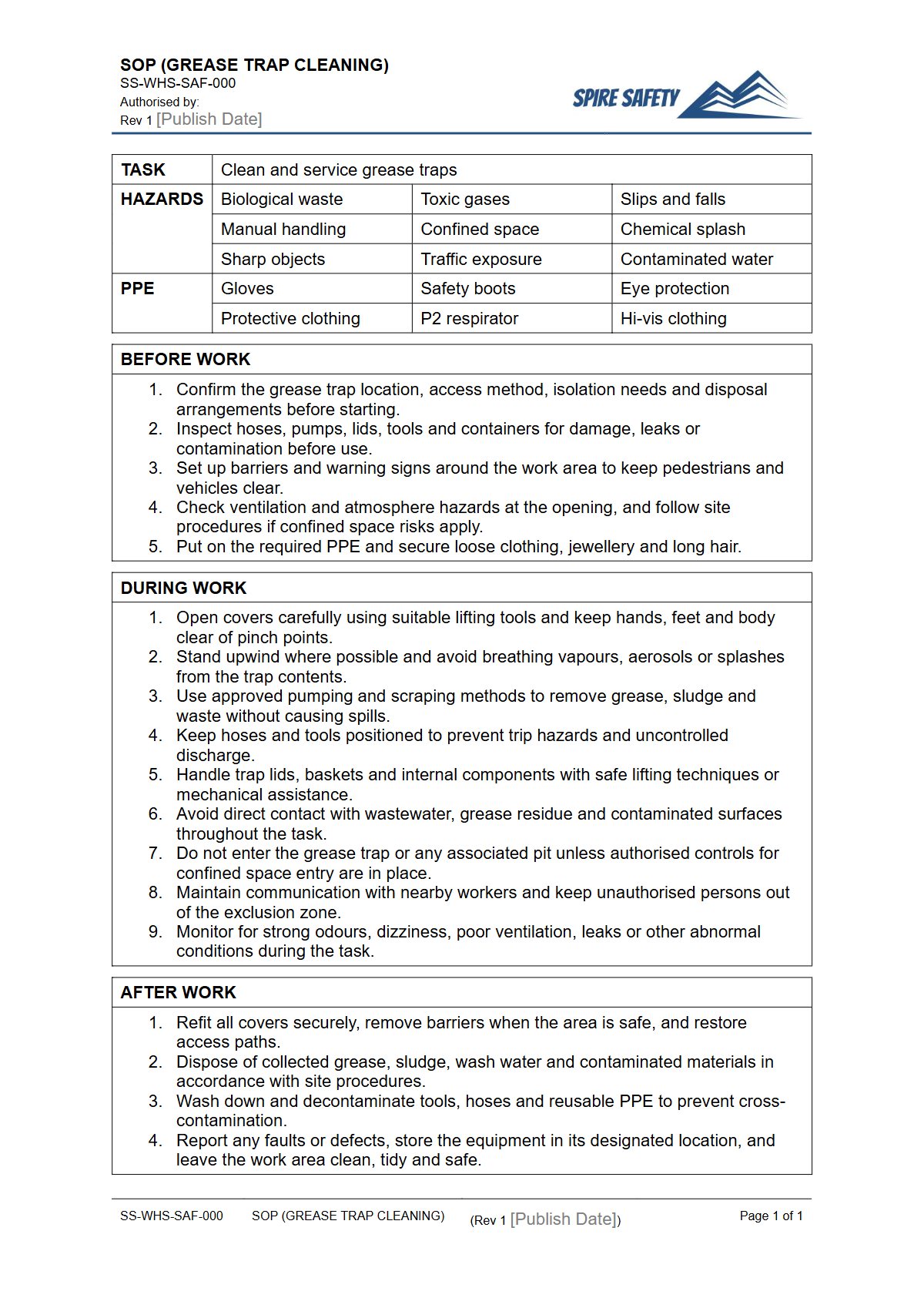
Download our free Safe Operating Procedure (Grease Trap Cleaning) template. This DOCX and PDF resource helps you outline safe work steps for this common task.
Free Safe Operating Procedure (Grease Trap Cleaning) Template
DOCX • 126 KB + PDF
Updated Oct 2026
No signup required
Purpose of the Free Safe Operating Procedure (Grease Trap Cleaning) Template
Grease trap cleaning is a vital but hazardous task common in hospitality and food service industries. This free Safe Operating Procedure (Grease Trap Cleaning) template provides a structured framework for documenting the step-by-step process, ensuring the task is performed safely and consistently.
It helps you identify and control significant risks, including exposure to biological hazards, slips, trips, and falls from greasy surfaces, hazardous manual tasks when lifting heavy lids or containers, and potential chemical exposure from cleaning agents. A well-defined SOP is a cornerstone of effective WHS management systems, demonstrating your organisation's commitment to worker safety.
Video walkthrough
How to use the Free Safe Operating Procedure (Grease Trap Cleaning) Template
To use this template, download the DOCX file and adapt it to the specific circumstances of your workplace. You will need to detail the exact type of grease trap system, the specific tools and equipment used, the required Personal Protective Equipment (PPE), and the emergency procedures relevant to your site.
This document is a starting point, designed to be aligned with Australian WHS principles.
Important: It is crucial to understand that this is a template, not a finished document. We have provided a structured guide, but you must customise it to reflect the specific equipment, chemicals, processes, and risks present in your workplace.
A generic procedure that doesn't account for site-specific conditions will not adequately protect your workers. For tasks that require working at height, a specific Safe Operating Procedure for step ladder use should also be developed and consulted.
When to use it
A Safe Operating Procedure for grease trap cleaning should be used consistently to guide behaviour and minimise risk. It is an essential document for several key activities within your safety framework.
Use this SOP as a primary training tool for new employees or for workers undertaking the task for the first time. It should also be readily available at the work area as a reference for experienced personnel.
Furthermore, SOPs are critical reference points during incident investigations and are reviewed as part of routine WHS compliance audits to ensure documented procedures are being followed in practice.
Who should use it
This template is designed for use by Persons Conducting a Business or Undertaking (PCBUs), managers, supervisors, and WHS professionals. It is particularly relevant for those operating in commercial kitchens, restaurants, cafes, hotels, food processing plants, and any facility with a trade waste system.
Workers who perform the cleaning task should be trained on the final, customised SOP and have easy access to it. Developing robust safety documentation can be complex; our WHS consulting services can assist in tailoring procedures to meet your specific operational needs.
Key elements to include in your customisation:
- Preparation: Steps for assembling tools, PPE, and signage, and for isolating any connected equipment.
- Procedure Steps: A sequential list of actions for safely opening, emptying, scraping, cleaning, and closing the trap.
- Waste Disposal: Clear instructions on the correct method for containing and disposing of the collected fats, oils, and grease (FOG) in accordance with local environmental regulations.
- Emergency Response: Procedures for spills, exposure to hazardous substances, or injuries. This should include the location of first aid kits, eye wash stations, and details on your emergency response plan, which might reference a separate SOP for defibrillator operation if one is available on site.
- PPE Requirements: A specific list, such as waterproof gloves, safety glasses or face shield, non-slip enclosed footwear, and potentially respiratory protection depending on the chemicals used.
By thoroughly customising this template, you create a valuable tool that not only supports compliance but actively contributes to a safer working environment. You can explore more templates and checklists in our free WHS resources library to build out your safety management system.
Common mistakes
Common mistakes to avoid
- Using incorrect or insufficient Personal Protective Equipment (PPE).
- Failing to de-energise or isolate connected equipment, such as pumps.
- Improperly disposing of collected grease and waste materials, violating environmental regulations.
- Not providing adequate ventilation, especially for indoor or poorly located traps.
Legal references
Legal considerations
The following legal requirements may be relevant to this type of work.
- Work Health and Safety Act (Harmonised) — Provides the primary duties for protecting workers and other people from work health and safety risks.
- Work Health and Safety Regulations (Harmonised) — Sets out requirements supporting the management of workplace hazards and risks.
The following codes may be relevant to this type of work.
- Managing WHS Risks Code of Practice — Provides practical guidance on identifying hazards, assessing risks and applying effective controls.
- Work Health and Safety Consultation, Cooperation and Coordination Code of Practice — Provides practical guidance on consulting workers and coordinating with other duty holders.
- Managing the Work Environment and Facilities Code of Practice — Provides practical guidance on safe work environments, workplace facilities and related controls.
Did you know
FOG Blockages
Fats, Oils, and Grease (FOG) are a leading cause of sewer blockages in Australia, often leading to costly overflows and environmental damage. Proper grease trap maintenance is a key preventative measure.
Biological Hazards
The contents of a grease trap can contain harmful bacteria like Salmonella, Campylobacter, and E. coli. This makes the correct use of personal protective equipment (PPE) non-negotiable during cleaning.
FAQ
Frequently asked questions
01What hazards are involved in cleaning a grease trap?
02Is a Safe Operating Procedure legally required for grease trap cleaning in Australia?
03How often should a grease trap SOP be reviewed?
04Who is responsible for developing an SOP for grease trap cleaning?
Share this resource
Free Safe Operating Procedure (Grease Trap Cleaning) Template
Browse Categories
How To Use It
- 1Download and open in Word or PDF.
- 2Replace the placeholders with your business details.
- 3Get it reviewed by a WHS specialist before rollout.
Need it customised?
Our WHS consultants can adapt this template to your site, run a gap analysis, or audit what you already have in place.
Book a Free Consultation WHS consulting servicesor call 1300 156 382
Related templates
- Free Safe Operating Procedure (Green Waste Inspection) Template
- Free Safe Operating Procedure (Green Waste Loading) Template
- Free Safe Operating Procedure (Green Waste Sorting) Template
- Free Safe Operating Procedure (Green Waste Transfer) Template
- Free Safe Operating Procedure (Greenhouse Cleaning) Template
- Free Safe Operating Procedure (Greenhouse Shading) Template