
Free Safe Operating Procedure (Green Waste Sorting) Template
Download our free Safe Operating Procedure (Green Waste Sorting) template. This customisable DOCX & PDF helps manage risks in waste management operations.
Free Safe Operating Procedure (Green Waste Sorting) Template
DOCX • 126 KB + PDF
Updated Oct 2026
No signup required
Purpose of the Free Safe Operating Procedure (Green Waste Sorting) Template
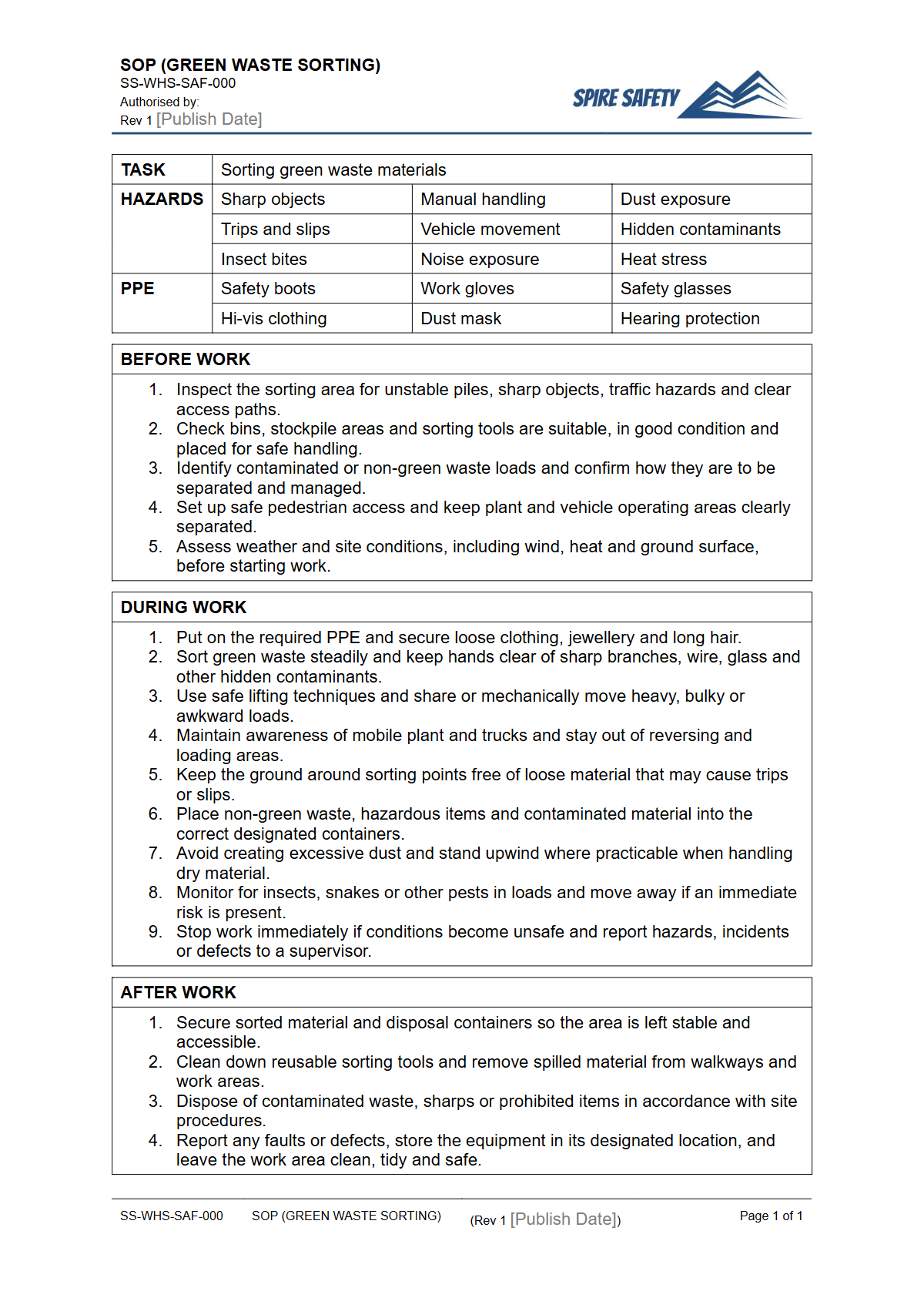
Managing the sorting of green waste involves significant health and safety risks. This free Safe Operating Procedure (Green Waste Sorting) template provides a structured starting point for your business to formally document safe work practices.
A well-drafted SOP is a critical tool for training workers and demonstrating how your organisation is meeting its duty of care. It outlines a systematic, step-by-step process to perform a task safely, helping to minimise the risk of injury or illness from hazards like machinery entanglement, manual handling injuries, biological contaminants, dust, and noise.
A Safe Operating Procedure, or SOP, is a fundamental component of a robust safety framework. It operationalises the findings of your risk assessments, translating hazard identification and control measures into clear, actionable instructions for your team.
Integrating SOPs like this one into your daily operations is a key part of developing effective WHS management systems that protect your workers and ensure operational consistency.
Video walkthrough
How to use the Free Safe Operating Procedure (Green Waste Sorting) Template
This resource is available for download as a DOCX file, which can be easily edited in Microsoft Word or other compatible software, and as a PDF for straightforward printing and distribution. To get the most out of this template, you should first conduct a thorough risk assessment of your green waste sorting tasks.
Use the findings to populate and adapt each section of the document, detailing the specific equipment, controls, and procedures used at your site.
It is crucial to remember that this template is a starting point. We have provided a solid framework aligned with Australian WHS principles, but you must customise the content to reflect the specific machinery (e.g., shredders, conveyors, loaders), processes, and hazards present in your workplace.
Involving your workers and their health and safety representatives in the customisation process is vital for creating a practical and effective document. You may also be using heavy machinery to manage waste piles; in such cases, having a specific FREE Telehandler SOP Template is also advisable.
Key Components of a Green Waste Sorting SOP
Your customised SOP should clearly outline all stages of the task. A comprehensive procedure will typically include sections covering:
- Required Personal Protective Equipment (PPE): Specify items like high-visibility clothing, steel-capped boots, heavy-duty gloves, safety glasses or goggles, and respiratory protection (e.g., P2 masks) to protect against dust and bioaerosols.
- Pre-operational Checks: Detail the safety checks required for any machinery used, such as inspecting guards on conveyors, checking emergency stops, and ensuring lockout/tagout equipment is available. If machinery is cleaned using compressed air, refer to your Free Air Compressor SOP for safe usage.
- Step-by-Step Operating Procedures: Break down the sorting task into a logical sequence of steps, from receiving the waste to separating contaminants and stockpiling the final product. Include instructions on safe manual handling techniques.
- Potential Hazards and Control Measures: List all identified risks (e.g., foreign objects, hazardous materials mixed in the waste, noise from shredders) and the specific controls to mitigate them.
- Emergency Procedures: Outline the steps to take in case of an incident, including emergency shutdown of machinery, first aid response, and reporting protocols.
When to use a Safe Operating Procedure
A SOP is a living document that should be used consistently throughout your operations. It serves as the primary training document for new workers being inducted into green waste sorting roles.
It should also be a go-to reference for existing workers and supervisors to refresh their knowledge of safe work practices. The SOP should be reviewed and used during incident investigations to identify any procedural gaps and is a key piece of evidence during safety audits.
Regular WHS compliance auditing can help ensure that the procedures outlined in your SOP are being followed correctly on the ground.
Who should use this template
This Safe Operating Procedure template is designed for anyone responsible for workplace health and safety in the waste management, recycling, or landscaping industries. This includes:
- Persons Conducting a Business or Undertaking (PCBUs): To help meet their primary duty of care under WHS legislation.
- Managers and Supervisors: To train, instruct, and supervise workers performing green waste sorting tasks.
- WHS/HSE Professionals: As a tool to standardise procedures and integrate them into the broader safety management system.
- Workers: To understand the safe and correct way to perform their tasks.
This document is just one of many we offer. For more templates, checklists, and guides to support your safety management efforts, browse our complete free WHS resources library.
Common mistakes
Common mistakes to avoid
- Using the generic template without customising it for the site's specific equipment and layout.
- Failing to adequately train workers on the SOP's contents and confirm their understanding.
- Neglecting to review and update the SOP after an incident, near miss, or process change.
- Underestimating or ignoring biological hazards and not specifying appropriate respiratory protection.
Legal references
Legal considerations
The following legal requirements may be relevant to this type of work.
- Work Health and Safety Act (Harmonised) — Provides the primary duties for protecting workers and other people from work health and safety risks.
- Work Health and Safety Regulations (Harmonised) — Sets out requirements supporting the management of workplace hazards and risks.
The following codes may be relevant to this type of work.
- Managing WHS Risks Code of Practice — Provides practical guidance on identifying hazards, assessing risks and applying effective controls.
- Work Health and Safety Consultation, Cooperation and Coordination Code of Practice — Provides practical guidance on consulting workers and coordinating with other duty holders.
- Managing the Work Environment and Facilities Code of Practice — Provides practical guidance on safe work environments, workplace facilities and related controls.
Did you know
Biohazard Risk
Decomposing green waste can generate bioaerosols containing fungal spores and bacteria, such as Legionella longbeachae, which can cause serious respiratory illness if inhaled.
Waste Industry Injuries
According to Safe Work Australia, the waste collection, treatment, and disposal industry has one of the highest rates of serious workers' compensation claims, with body stressing (manual handling) being a primary cause.
FAQ
Frequently asked questions
01What are the main hazards involved in green waste sorting?
02Is a Safe Operating Procedure a legal requirement in Australia?
03How often should our Green Waste Sorting SOP be reviewed?
04Can this template be used for sorting other types of waste?
Share this resource
Free Safe Operating Procedure (Green Waste Sorting) Template
Browse Categories
How To Use It
- 1Download and open in Word or PDF.
- 2Replace the placeholders with your business details.
- 3Get it reviewed by a WHS specialist before rollout.
Need it customised?
Our WHS consultants can adapt this template to your site, run a gap analysis, or audit what you already have in place.
Book a Free Consultation WHS consulting servicesor call 1300 156 382
Related templates
- Free Safe Operating Procedure (Green Waste Transfer) Template
- Free Safe Operating Procedure (Greenhouse Cleaning) Template
- Free Safe Operating Procedure (Greenhouse Shading) Template
- Free Safe Operating Procedure (Greenhouse Venting) Template
- Free Safe Operating Procedure (Grinding Wheel Change) Template
- Free Safe Operating Procedure (Grizzly Feeder) Template