
Free Safe Operating Procedure (Green Waste Loading) Template
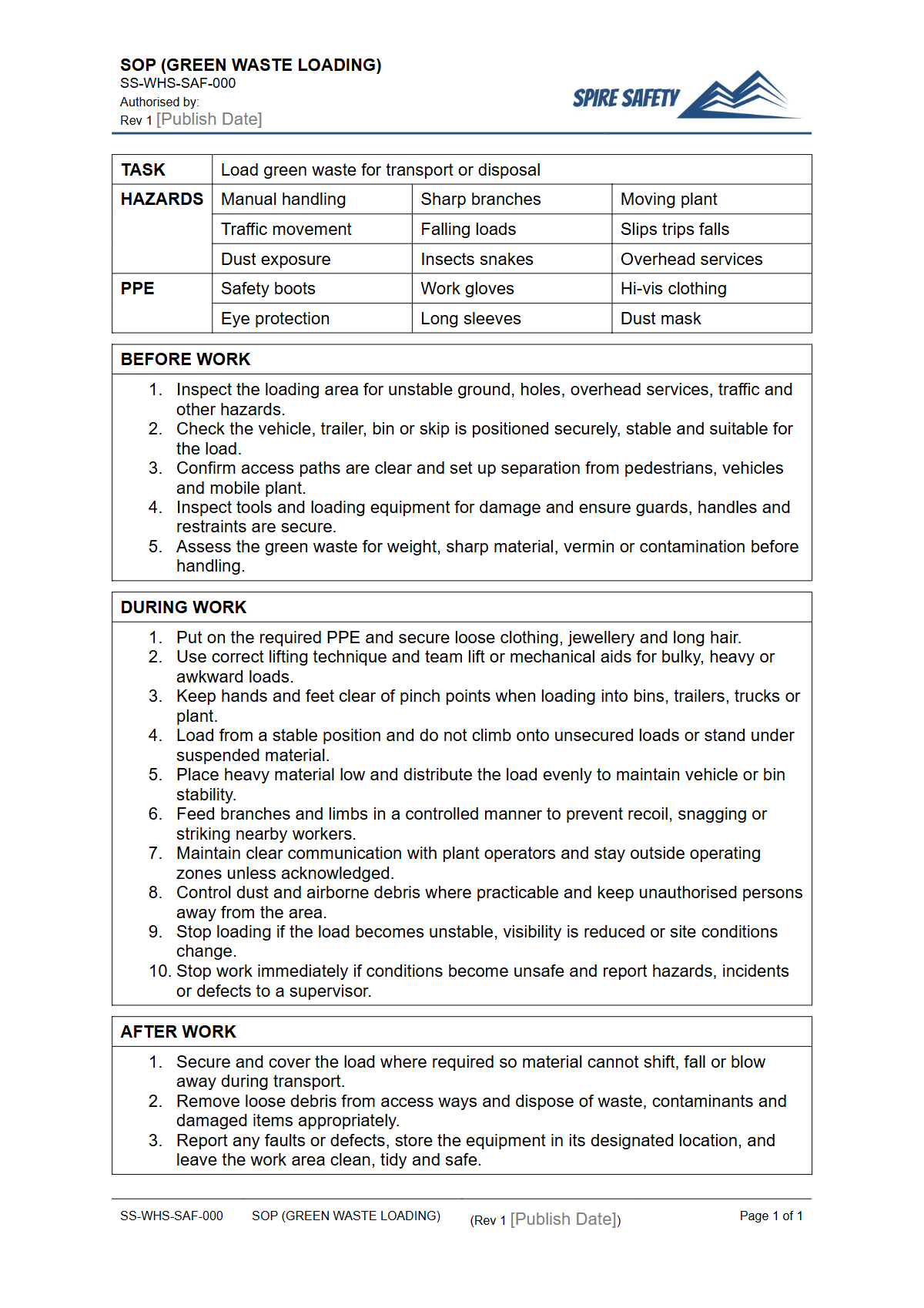
Download our free Safe Operating Procedure (Green Waste Loading) template.
Free Safe Operating Procedure (Green Waste Loading) Template
DOCX • 126 KB + PDF
Updated Oct 2026
No signup required
Purpose of the Free Safe Operating Procedure (Green Waste Loading) Template
This Free Safe Operating Procedure (Green Waste Loading) Template provides a structured framework for documenting the hazards and control measures associated with loading organic material. Using a standardised SOP helps your organisation meet its work health and safety obligations by ensuring tasks are performed consistently and safely every time.
It serves as a vital tool for worker training, risk management, and demonstrating due diligence. Properly implemented, this SOP can help prevent common injuries related to manual tasks, machinery operation, and exposure to biological hazards.
Video walkthrough
How to use the Free Safe Operating Procedure (Green Waste Loading) Template
You can download this Safe Operating Procedure as a DOCX file for easy editing in Microsoft Word or as a PDF for quick reference. The first step is to conduct a thorough risk assessment of your specific green waste loading tasks.
This procedure must then be adapted to reflect the unique environment of your workplace, including the types of machinery used, the site layout, the specific green waste being handled, and the workers involved.
Important: This document is a template only. To make it effective, we strongly advise that you consult with your team, including operators and supervisors, to ensure the content is accurate and practical for your operations.
You must customise this SOP to align with your existing safety management system and the specific risks present in your workplace.
Key Hazards in Green Waste Loading
Loading green waste, whether in a landscaping, council, or agricultural setting, presents several significant risks that must be managed. Your SOP should clearly identify these and outline robust control measures. Key hazards include:
- Musculoskeletal Disorders: Arising from hazardous manual tasks such as lifting bulky or heavy branches, bags of clippings, and repetitive movements.
- Machinery-Related Incidents: Risks of being struck by, caught in, or crushed by mobile plant like loaders, excavators, or tipper trucks. Using specific plant requires its own procedure, such as that detailed in our FREE Telehandler SOP template.
- Large-Scale Clearing Risks: For significant land clearing projects, larger equipment introduces greater hazards. Operations involving such machinery should be covered by specific documents, like our FREE Dozer SOP Template, to manage risks effectively.
- Biological Hazards: Green waste can contain bacteria, sharp thorns, mould, fungi (such as Legionella), and pests like spiders or snakes, leading to infection, allergic reactions, or envenomation.
- Slips, Trips, and Falls: Caused by uneven ground, scattered debris, and wet or muddy conditions.
Structuring and Implementing Your SOP
A logical structure is key to an effective SOP. Break the task down into sequential steps, from preparation to completion.
This may include sections for pre-operational checks on equipment, area setup, sorting and processing materials, the loading process itself, and post-task cleanup. For preceding tasks like breaking down larger items, you should reference other specific procedures, such as our FREE Circular Saw SOP Template.
Your SOP must also include clear instructions for emergency situations. This should cover first aid response for common injuries and procedures for machinery failure or fire. Training workers on emergency equipment is also critical, and can be supported by documents like our Free Safe Operating Procedure (Defibrillator Operation) Template.
Once customised, the SOP must be integrated into your overall safety framework. This involves training all relevant workers, ensuring supervisors enforce the procedure, and making the document readily accessible. The goal is to embed these safe practices into your organisation's culture, which is a core component of well-designed WHS management systems.
Review and Maintenance
Safe Operating Procedures are living documents that require periodic review to remain effective. Schedule reviews at least annually, or more frequently if there is an incident, a near-miss, or a change in legislation, equipment, or work processes.
Regular reviews ensure the procedure continues to control risks effectively and reflects the current reality of the task. These reviews can be part of a broader safety assurance program, such as WHS compliance auditing, which verifies that your safety systems are working as intended. For more templates and checklists to support your WHS program, you can browse our full free WHS resources library.
Common mistakes
Common mistakes to avoid
- Assuming the template is 'ready to use' without customising it for specific site machinery and conditions.
- Failing to train workers on the finalised SOP and verify their understanding before they perform the task.
- Neglecting to account for biological hazards like mould, fungi, and pests within the waste.
- Using machinery or vehicles that are overloaded or not rated for the weight and bulk of the material being loaded.
Legal references
Legal considerations
The following legal requirements may be relevant to this type of work.
- Work Health and Safety Act (Harmonised) — Provides the primary duties for protecting workers and other people from work health and safety risks.
- Work Health and Safety Regulations (Harmonised) — Sets out requirements supporting the management of workplace hazards and risks.
The following codes may be relevant to this type of work.
- Managing WHS Risks Code of Practice — Provides practical guidance on identifying hazards, assessing risks and applying effective controls.
- Work Health and Safety Consultation, Cooperation and Coordination Code of Practice — Provides practical guidance on consulting workers and coordinating with other duty holders.
- Managing the Work Environment and Facilities Code of Practice — Provides practical guidance on safe work environments, workplace facilities and related controls.
Did you know
Hidden Hazards
Green waste can harbour biological hazards like fungi, bacteria, and moulds (e.g., Legionella longbeachae from potting mixes and compost) that can cause serious respiratory illnesses.
Weighty Issue
A single cubic metre of fresh green waste can weigh between 250 to 500 kilograms, posing significant manual handling and machinery stability risks if not managed correctly.
FAQ
Frequently asked questions
01What should be included in a Safe Operating Procedure for green waste loading?
02How often should an SOP for loading green waste be reviewed?
03Is this green waste loading SOP template suitable for commercial landscaping operations?
04What PPE is typically required for loading green waste?
Share this resource
Free Safe Operating Procedure (Green Waste Loading) Template
Browse Categories
How To Use It
- 1Download and open in Word or PDF.
- 2Replace the placeholders with your business details.
- 3Get it reviewed by a WHS specialist before rollout.
Need it customised?
Our WHS consultants can adapt this template to your site, run a gap analysis, or audit what you already have in place.
Book a Free Consultation WHS consulting servicesor call 1300 156 382
Related templates
- Free Safe Operating Procedure (Green Waste Sorting) Template
- Free Safe Operating Procedure (Green Waste Transfer) Template
- Free Safe Operating Procedure (Greenhouse Cleaning) Template
- Free Safe Operating Procedure (Greenhouse Shading) Template
- Free Safe Operating Procedure (Greenhouse Venting) Template
- Free Safe Operating Procedure (Grinding Wheel Change) Template