
Free Safe Operating Procedure (Green Waste Inspection) Template
Download our free SOP template for Green Waste Inspection. This DOCX & PDF helps manage hazards in landscaping and waste management. Get your free template now.
Free Safe Operating Procedure (Green Waste Inspection) Template
DOCX • 126 KB + PDF
Updated Oct 2026
No signup required
Purpose of the Free Safe Operating Procedure (Green Waste Inspection) Template
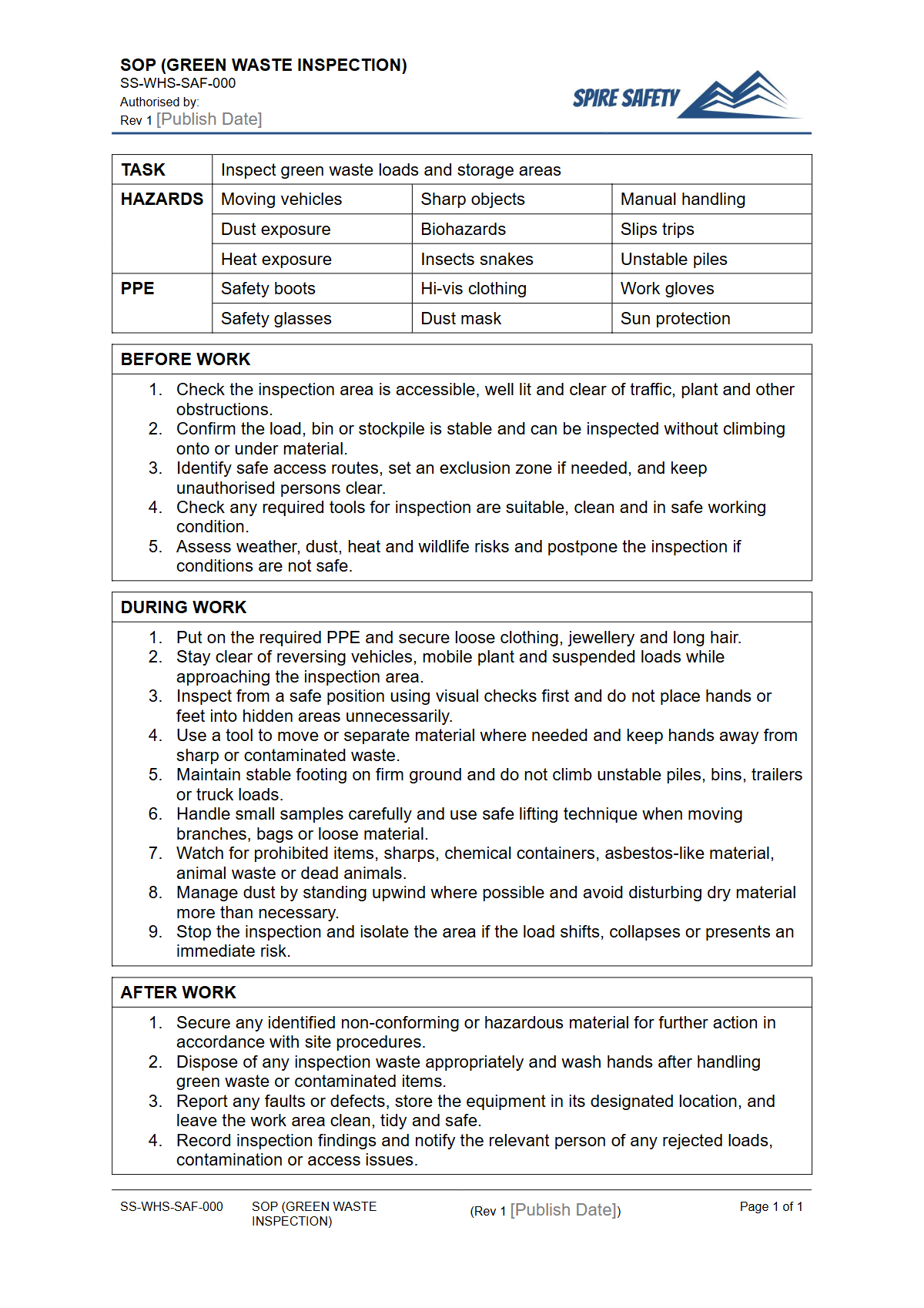
Effectively managing green waste is a common task in industries like landscaping, arboriculture, and municipal services. This Free Safe Operating Procedure (Green Waste Inspection) Template provides a structured starting point for documenting the steps required to safely inspect piles of green waste before processing, transport, or disposal.
The procedure helps identify and control common hazards such as biological contaminants, pests, sharp objects, hazardous materials, and musculoskeletal injuries associated with manual handling.
By implementing a clear SOP, you formalise your organisation's approach to safety for this routine but potentially hazardous task. Documenting the process is a fundamental part of developing robust WHS management systems, demonstrating a commitment to worker safety and regulatory obligations.
This template is designed to be adapted to your specific operational context, ensuring the controls are relevant and effective.
Video walkthrough
How to use the Free Safe Operating Procedure (Green Waste Inspection) Template
This resource is available for download in both DOCX and PDF formats. The DOCX file is fully editable, allowing you to tailor the content to your workplace's unique requirements.
It is crucial to conduct a site-specific risk assessment to identify all potential hazards associated with your green waste inspection tasks and integrate the corresponding control measures into the document.
This template provides a solid foundation aligned with Australian WHS practice. However, to be effective, we stress that you must customise it to reflect the specific hazards, equipment, and environment of your workplace.
Consult with your team members who perform the inspections to ensure the procedure is practical, accurate, and reflects how the work is actually done. Once finalised, use the SOP as a tool for training and competency assessments.
If heavy machinery is used to move waste piles for inspection, you may also need a FREE Telehandler SOP Template to cover its safe operation.
When to use it
A Safe Operating Procedure for green waste inspection should be used consistently as part of your daily operations. It is not a document to be filed away and forgotten. Key times to refer to and apply this SOP include:
- Before any worker begins inspecting or sorting a new or existing pile of green waste.
- During the induction and training of new employees or contractors involved in waste handling.
- As a reference tool for periodic refresher training to reinforce safe work habits.
- When reviewing safety protocols after a near-miss or incident involving green waste.
- As a key piece of evidence during safety reviews or audits. A systematic approach to WHS compliance auditing will often involve checking that documented procedures like SOPs are being followed correctly by workers.
Who should use it
This SOP is intended for any person or business involved in handling green waste. This includes a wide range of roles and industries:
- Workers: Landscapers, gardeners, council workers, and waste management facility operators who perform the physical inspection and sorting.
- Supervisors and Managers: Those responsible for overseeing work, providing training, and ensuring procedures are followed correctly. They play a key role in implementing the SOP on the ground.
- PCBUs (Persons Conducting a Business or Undertaking): Business owners and directors have the primary duty of care to ensure safe systems of work are provided and maintained. This SOP is a practical tool to help meet that obligation.
The scope of green waste processing can vary significantly. For operations that involve breaking down larger wooden debris found in green waste, a FREE Circular Saw SOP Template may also be necessary to manage machinery risks.
For smaller-scale manual inspections that require accessing the top of skips or large bins, controls outlined in our FREE Step Ladder SOP Template could also be relevant.
By clearly defining the safe method for this task, you help protect your team from injury and create a more consistent, safety-conscious work environment. If you need expert assistance in adapting this template or developing a complete safety system, our WHS consulting team can provide tailored support.
Common mistakes
Common mistakes to avoid
- Failing to customise the template for site-specific hazards and equipment.
- Neglecting to consult with workers who perform the task when drafting the procedure.
- Treating the SOP as a one-time document and not reviewing it after incidents or changes.
- Inadequate training, assuming workers will read and understand the SOP without instruction.
Legal references
Legal considerations
The following legal requirements may be relevant to this type of work.
- Work Health and Safety Act (Harmonised) — Provides the primary duties for protecting workers and other people from work health and safety risks.
- Work Health and Safety Regulations (Harmonised) — Sets out requirements supporting the management of workplace hazards and risks.
The following codes may be relevant to this type of work.
- Managing WHS Risks Code of Practice — Provides practical guidance on identifying hazards, assessing risks and applying effective controls.
- Work Health and Safety Consultation, Cooperation and Coordination Code of Practice — Provides practical guidance on consulting workers and coordinating with other duty holders.
- Managing the Work Environment and Facilities Code of Practice — Provides practical guidance on safe work environments, workplace facilities and related controls.
Did you know
Hidden Dangers
Green waste can contain more than just garden clippings. Discarded needles, broken glass, asbestos fragments, and containers with chemical residues are commonly found hazards.
Not Just 'Green'
The term "green waste" often includes "brown waste" like wood, branches, and dead leaves. These carbon-rich materials are crucial for balancing nitrogen-rich green materials to create effective compost.
FAQ
Frequently asked questions
01What are the main hazards when inspecting green waste?
02Is a Safe Operating Procedure a legal requirement in Australia?
03How often should a green waste inspection SOP be reviewed?
04Can I use this template for a commercial composting facility?
Share this resource
Free Safe Operating Procedure (Green Waste Inspection) Template
Browse Categories
How To Use It
- 1Download and open in Word or PDF.
- 2Replace the placeholders with your business details.
- 3Get it reviewed by a WHS specialist before rollout.
Need it customised?
Our WHS consultants can adapt this template to your site, run a gap analysis, or audit what you already have in place.
Book a Free Consultation WHS consulting servicesor call 1300 156 382
Related templates
- Free Safe Operating Procedure (Green Waste Loading) Template
- Free Safe Operating Procedure (Green Waste Sorting) Template
- Free Safe Operating Procedure (Green Waste Transfer) Template
- Free Safe Operating Procedure (Greenhouse Cleaning) Template
- Free Safe Operating Procedure (Greenhouse Shading) Template
- Free Safe Operating Procedure (Greenhouse Venting) Template