
Free Safe Operating Procedure (Grease Filter Cleaning) Template
Download a free Safe Operating Procedure template for grease filter cleaning. Customise this DOCX & PDF to document safe work practices for your kitchen staff.
Free Safe Operating Procedure (Grease Filter Cleaning) Template
DOCX • 126 KB + PDF
Updated Oct 2026
No signup required
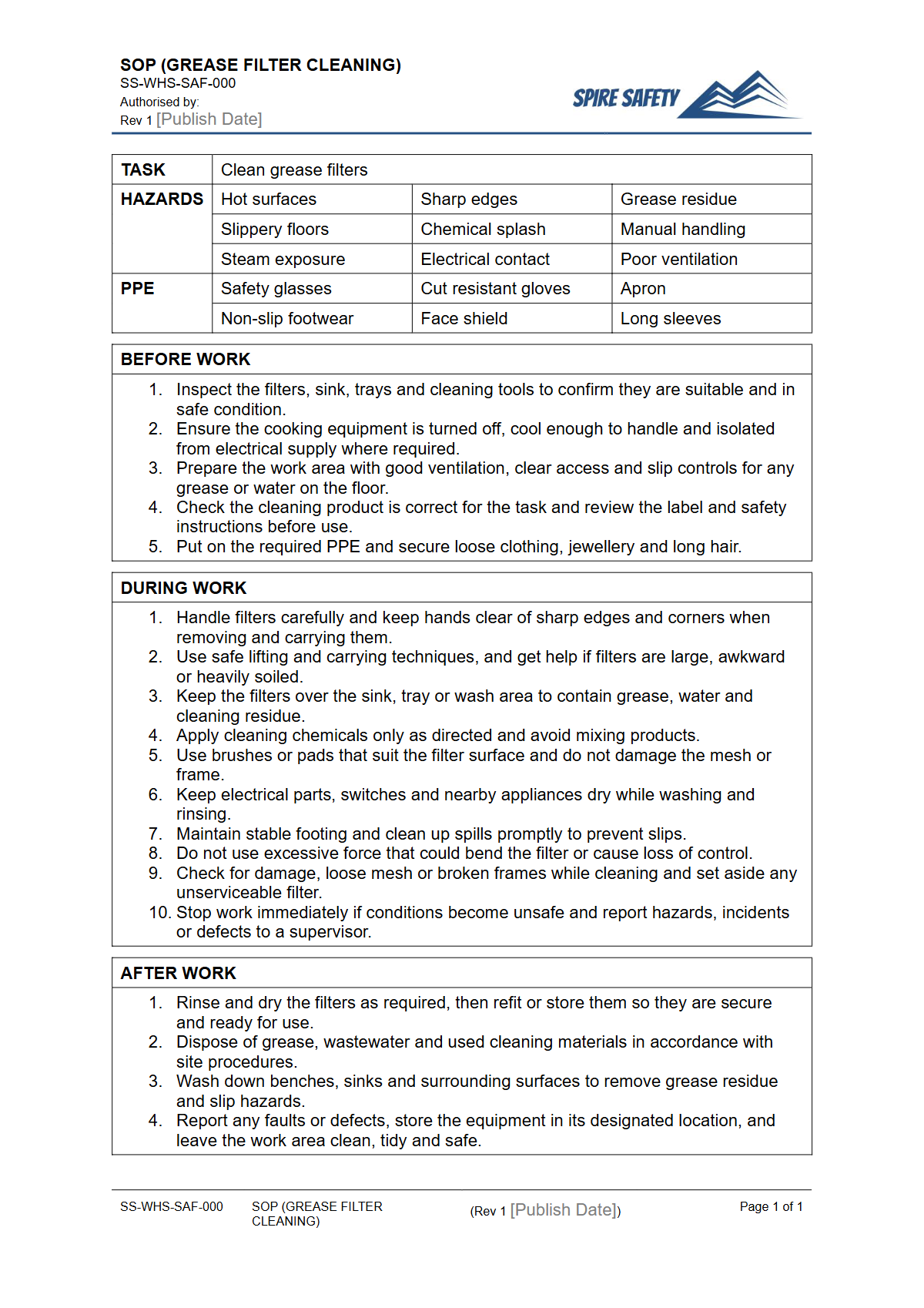
Purpose of the Free Safe Operating Procedure (Grease Filter Cleaning) Template
This Free Safe Operating Procedure (Grease Filter Cleaning) Template provides a structured framework for documenting the steps required to safely clean commercial kitchen grease filters. Proper cleaning is a critical task not only for hygiene but for fire prevention.
A build-up of grease in kitchen exhaust systems is a major fire hazard and can lead to serious incidents. This SOP helps businesses meet their duty of care under Australian WHS laws by establishing and communicating a safe system of work.
A documented procedure ensures that all workers follow the same safe, approved method, minimising risks such as chemical burns from cleaning agents, slips and falls from greasy surfaces, and manual handling injuries. Integrating this SOP into your safety framework is a practical step towards creating a safer kitchen environment.
It forms a vital part of more comprehensive WHS management systems, demonstrating a commitment to proactive risk management.
Video walkthrough
How to use the Free Safe Operating Procedure (Grease Filter Cleaning) Template
Using this template is straightforward. After downloading the DOCX file, you can begin to edit and adapt the content to suit your specific operational needs.
The document is pre-formatted with sections covering PPE, pre-operational checks, step-by-step cleaning instructions, and post-cleaning tasks. Your task is to fill in the details relevant to your workplace, including the specific brand of degreaser used, the location of safety equipment like eyewash stations, and your emergency procedures.
IMPORTANT: This is a template only. You must customise this document to reflect the specific equipment, chemicals, and procedures used in your workplace.
We recommend a consultation process with your workers to ensure the SOP is practical and effective. If you require assistance in tailoring this or other documents, consider engaging professional WHS consulting services.
Once customised, the SOP should be used to train all relevant staff. Keep a printed copy readily accessible near the cleaning area and ensure supervisors refer to it during safety checks and toolbox talks.
This document is one of many available in our free WHS resources library, which offers a range of templates to support your organisation's safety efforts.
When to use it
The Safe Operating Procedure for grease filter cleaning should be used as a primary reference document every time the task is performed. It serves multiple functions throughout its lifecycle.
New employees must be trained using the SOP as part of their induction. Existing employees should use it for periodic refresher training to prevent complacency and ensure adherence to the correct procedure.
Supervisors should refer to it when conducting safety observations or competency assessments. It also becomes a critical document during incident investigations, helping to determine if correct procedures were followed.
Who should use it
This SOP is intended for all personnel involved in the cleaning and maintenance of kitchen exhaust filters. This typically includes kitchen hands, cooks, chefs, and maintenance staff.
It is also a key tool for supervisors and managers who are responsible for overseeing kitchen operations, providing training, and ensuring WHS compliance. They use the SOP to set clear expectations for safe work behaviour and to monitor performance against those standards.
If accessing the filters requires working at height, even on a small platform, a relevant step ladder SOP should also be consulted and followed.
Key Hazards in Grease Filter Cleaning
Several significant hazards are associated with cleaning grease filters. These must be identified and controlled within your SOP. Key risks include:
- Chemical Exposure: Industrial-strength degreasers can cause skin irritation, chemical burns, or respiratory issues if inhaled.
- Slips, Trips, and Falls: Spilled water, grease, and cleaning solutions create extremely slippery surfaces.
- Manual Handling: Filters can be heavy, awkward to carry, and have sharp edges, leading to strains, sprains, or cuts.
- Working at Height: Accessing filters often requires using ladders or step platforms, introducing a risk of falls.
- Burns: Contact with hot surfaces or hot water used in the cleaning process can cause serious burns.
- Fire: Although cleaning reduces the risk, improper handling of flammable cleaning agents can introduce a different fire hazard.
Your SOP must detail the control measures for each of these hazards, from required PPE to emergency responses, such as using an eyewash station or following a Safe Operating Procedure for defibrillator operation in a medical emergency.
Elements of a Strong SOP
An effective SOP goes beyond a simple list of steps. To be a robust safety tool, it must contain several key elements.
Firstly, it should clearly state the required Personal Protective Equipment (PPE), such as chemical-resistant gloves and safety goggles. Secondly, it must include a detailed, sequential procedure that is easy to follow.
Thirdly, it should list any required pre-operational checks, like ensuring the work area is clear of obstructions. Finally, it must outline emergency procedures, including first aid for chemical exposure and spill containment actions.
Regular review and WHS compliance auditing ensure the document remains current and effective.
Common mistakes
Common mistakes to avoid
- Using overly generic procedures that don't match the specific chemicals or equipment in use.
- Failing to train workers on the SOP and verifying their understanding.
- Not consulting with kitchen staff when drafting the procedure, leading to impractical or unsafe steps.
- Forgetting to schedule and document regular reviews of the SOP.
Legal references
Legal considerations
The following legal requirements may be relevant to this type of work.
- Work Health and Safety Act (Harmonised) — Provides the primary duties for protecting workers and other people from work health and safety risks.
- Work Health and Safety Regulations (Harmonised) — Sets out requirements supporting the management of workplace hazards and risks.
The following codes may be relevant to this type of work.
- Managing WHS Risks Code of Practice — Provides practical guidance on identifying hazards, assessing risks and applying effective controls.
- Work Health and Safety Consultation, Cooperation and Coordination Code of Practice — Provides practical guidance on consulting workers and coordinating with other duty holders.
- Managing the Work Environment and Facilities Code of Practice — Provides practical guidance on safe work environments, workplace facilities and related controls.
Did you know
Fire Hazard
A significant portion of commercial kitchen fires originate in the exhaust system. Grease buildup on filters acts as a highly flammable fuel source, making regular cleaning a critical fire prevention measure.
Australian Standard
Australian Standard AS 1851–2012 (Routine service of fire protection systems and equipment) provides guidance on the maintenance and inspection schedules for kitchen exhaust systems, including filters.
FAQ
Frequently asked questions
01Is a Safe Operating Procedure for grease filter cleaning a legal requirement?
02How often should grease filters be cleaned?
03What PPE is needed for cleaning grease filters?
04Can I use this template for other kitchen cleaning tasks?
Share this resource
Free Safe Operating Procedure (Grease Filter Cleaning) Template
Browse Categories
How To Use It
- 1Download and open in Word or PDF.
- 2Replace the placeholders with your business details.
- 3Get it reviewed by a WHS specialist before rollout.
Need it customised?
Our WHS consultants can adapt this template to your site, run a gap analysis, or audit what you already have in place.
Book a Free Consultation WHS consulting servicesor call 1300 156 382
Related templates
- Free Safe Operating Procedure (Grease Pump) Template
- Free Safe Operating Procedure (Grease Transfer Pump) Template
- Free Safe Operating Procedure (Grease Trap Cleaning) Template
- Free Safe Operating Procedure (Green Waste Inspection) Template
- Free Safe Operating Procedure (Green Waste Loading) Template
- Free Safe Operating Procedure (Green Waste Sorting) Template