
Free Safe Operating Procedure (Grandstand Cleaning) Template
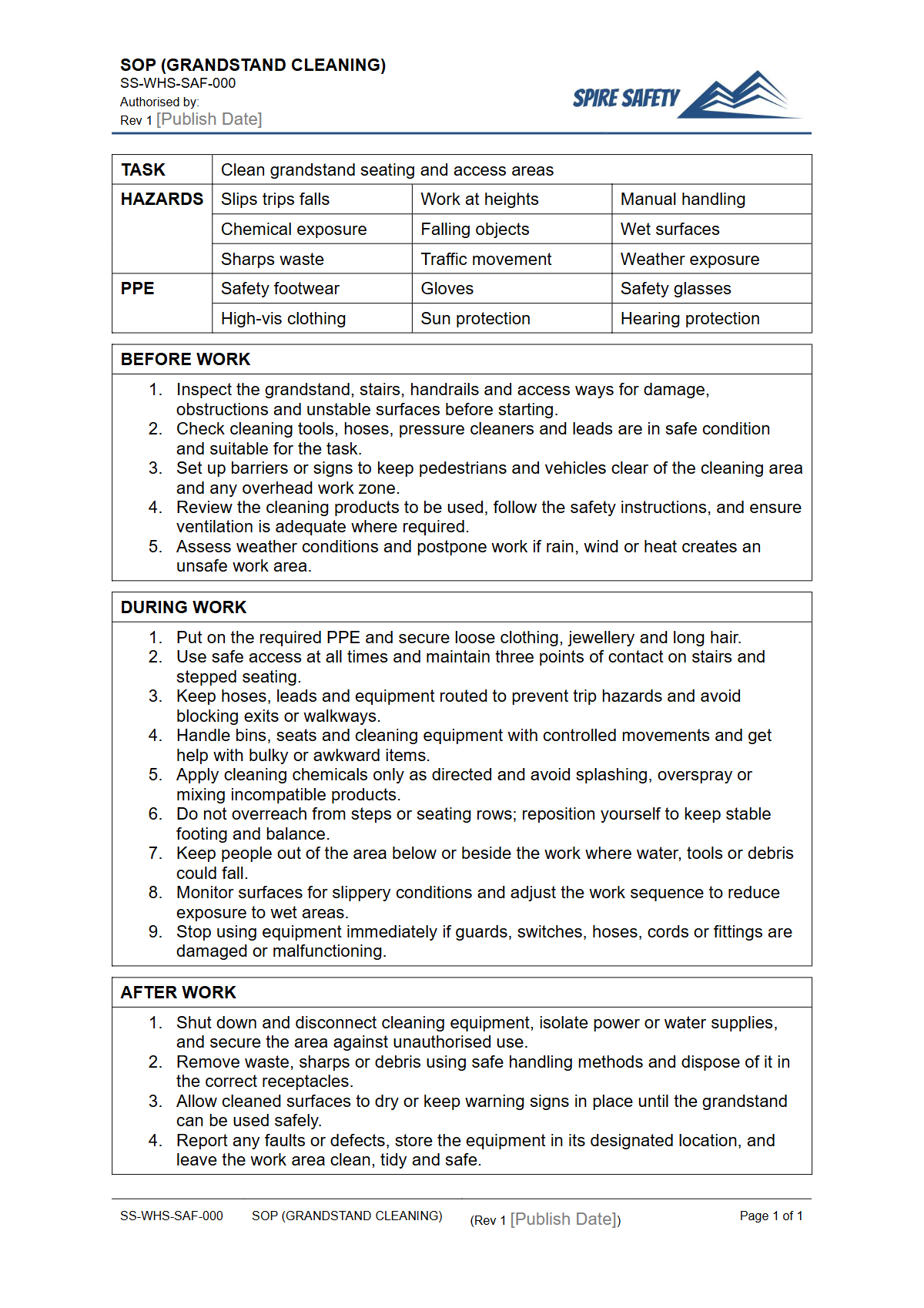
Download our free Safe Operating Procedure (Grandstand Cleaning) template.
Free Safe Operating Procedure (Grandstand Cleaning) Template
DOCX • 126 KB + PDF
Updated Oct 2026
No signup required
Purpose of the Free Safe Operating Procedure (Grandstand Cleaning) Template
Cleaning grandstands, stadiums, and tiered seating areas presents a unique set of workplace hazards. This task often involves working at heights, manual handling of equipment, potential exposure to cleaning chemicals, and risks of slips, trips, and falls.
Our Free Safe Operating Procedure (Grandstand Cleaning) Template provides a structured framework for documenting a safe system of work to manage these risks effectively.
A well-defined SOP helps your organisation meet its primary duty of care under Australian WHS laws by clearly outlining step-by-step instructions for performing the task safely. It identifies potential hazards, specifies necessary personal protective equipment (PPE), and establishes emergency procedures.
Using a documented procedure ensures consistency in training and work practices, reducing the likelihood of incidents. For tasks involving ladders or mobile scaffolds, it's crucial to have specific controls, which can be detailed with resources like our Free Step Ladder SOP Template.
Video walkthrough
How to use the Free Safe Operating Procedure (Grandstand Cleaning) Template
This template is a starting point designed for customisation. To use it effectively, you must adapt it to the specific circumstances of your workplace.
This involves conducting a site-specific risk assessment to identify all hazards associated with your grandstand, equipment, and cleaning agents. For example, if high-pressure water blasters are used, their specific operational risks must be included, potentially drawing from a resource like our Free Air Compressor SOP Template as a reference for powered equipment.
Important: This is a template, not a finished document. We have developed it as a guide, but you must consult with your workers and tailor the content to reflect your unique operational environment, machinery, chemicals, and internal safety protocols.
Integrating this SOP into your broader safety framework is a key step in creating a robust safety culture. A comprehensive approach involves embedding these procedures within your overall WHS management systems.
When to use it
A grandstand cleaning SOP should be used in several key situations. It is an essential training document for new employees or workers assigned to the task for the first time, ensuring they understand the approved safe method from the outset.
It should also be readily available at the point of work for easy reference by all team members. The procedure serves as a benchmark for supervisors conducting safety observations and competency checks.
Furthermore, the SOP should be a live document, reviewed and updated regularly. This includes after any incident or near-miss, when new equipment or chemicals are introduced, or when legislation changes.
Preparing for unforeseen events is also critical; having clear instructions for emergencies, such as those covered in our Free Safe Operating Procedure (Defibrillator Operation) Template, can be lifesaving.
Who should use it
This Safe Operating Procedure is intended for a range of personnel within an organisation responsible for facility management and maintenance. This includes:
- Workers and Cleaning Staff: To follow safe work instructions and understand their responsibilities.
- Supervisors and Team Leaders: To induct and train workers, monitor compliance, and lead toolbox talks based on the procedure.
- Facility and Venue Managers: To ensure a formalised, safe system of work is in place for all cleaning and maintenance activities.
- WHS Managers and Officers: To integrate the SOP into the organisation's overall WHS management system and use it as a tool for risk management and incident investigation. These professionals may also use the SOP as a key document during a WHS compliance auditing process to verify that safe practices are documented and followed.
By involving all relevant parties in the development and review of the SOP, you foster a stronger safety culture and ensure the procedure is practical and effective. For more templates and safety documents, you can browse our complete free WHS resources library.
Common mistakes
Common mistakes to avoid
- Using a generic SOP without performing a site-specific risk assessment.
- Failing to adequately train workers on the procedure and confirm their understanding.
- Neglecting to inspect and maintain equipment, such as ladders and pressure washers, before use.
- Not providing or enforcing the use of the correct Personal Protective Equipment (PPE) specified in the SOP.
Legal references
Legal considerations
The following legal requirements may be relevant to this type of work.
- Work Health and Safety Act (Harmonised) — Provides the primary duties for protecting workers and other people from work health and safety risks.
- Work Health and Safety Regulations (Harmonised) — Sets out requirements supporting the management of workplace hazards and risks.
The following codes may be relevant to this type of work.
- Managing WHS Risks Code of Practice — Provides practical guidance on identifying hazards, assessing risks and applying effective controls.
- Work Health and Safety Consultation, Cooperation and Coordination Code of Practice — Provides practical guidance on consulting workers and coordinating with other duty holders.
- Managing the Work Environment and Facilities Code of Practice — Provides practical guidance on safe work environments, workplace facilities and related controls.
Did you know
Slips, Trips and Falls
According to Safe Work Australia, slips, trips and falls are a leading cause of serious injuries in Australian workplaces, making documented procedures for tasks on varied levels and wet surfaces especially important.
FAQ
Frequently asked questions
01What are the main hazards when cleaning grandstands?
02Is a Safe Operating Procedure legally required for grandstand cleaning?
03How often should a grandstand cleaning SOP be reviewed?
04What PPE is needed for cleaning a grandstand?
Share this resource
Free Safe Operating Procedure (Grandstand Cleaning) Template
Browse Categories
How To Use It
- 1Download and open in Word or PDF.
- 2Replace the placeholders with your business details.
- 3Get it reviewed by a WHS specialist before rollout.
Need it customised?
Our WHS consultants can adapt this template to your site, run a gap analysis, or audit what you already have in place.
Book a Free Consultation WHS consulting servicesor call 1300 156 382
Related templates
- Free Safe Operating Procedure (Gravel Path Repair) Template
- Free Safe Operating Procedure (Gravel Raking) Template
- Free Safe Operating Procedure (Grease Filter Change) Template
- Free Safe Operating Procedure (Grease Filter Cleaning) Template
- Free Safe Operating Procedure (Grease Pump) Template
- Free Safe Operating Procedure (Grease Transfer Pump) Template