
Free Safe Operating Procedure (Gravel Raking) Template
Download our free Safe Operating Procedure (Gravel Raking) template.
Free Safe Operating Procedure (Gravel Raking) Template
DOCX • 126 KB + PDF
Updated Oct 2026
No signup required
Purpose of the Free Safe Operating Procedure (Gravel Raking) Template
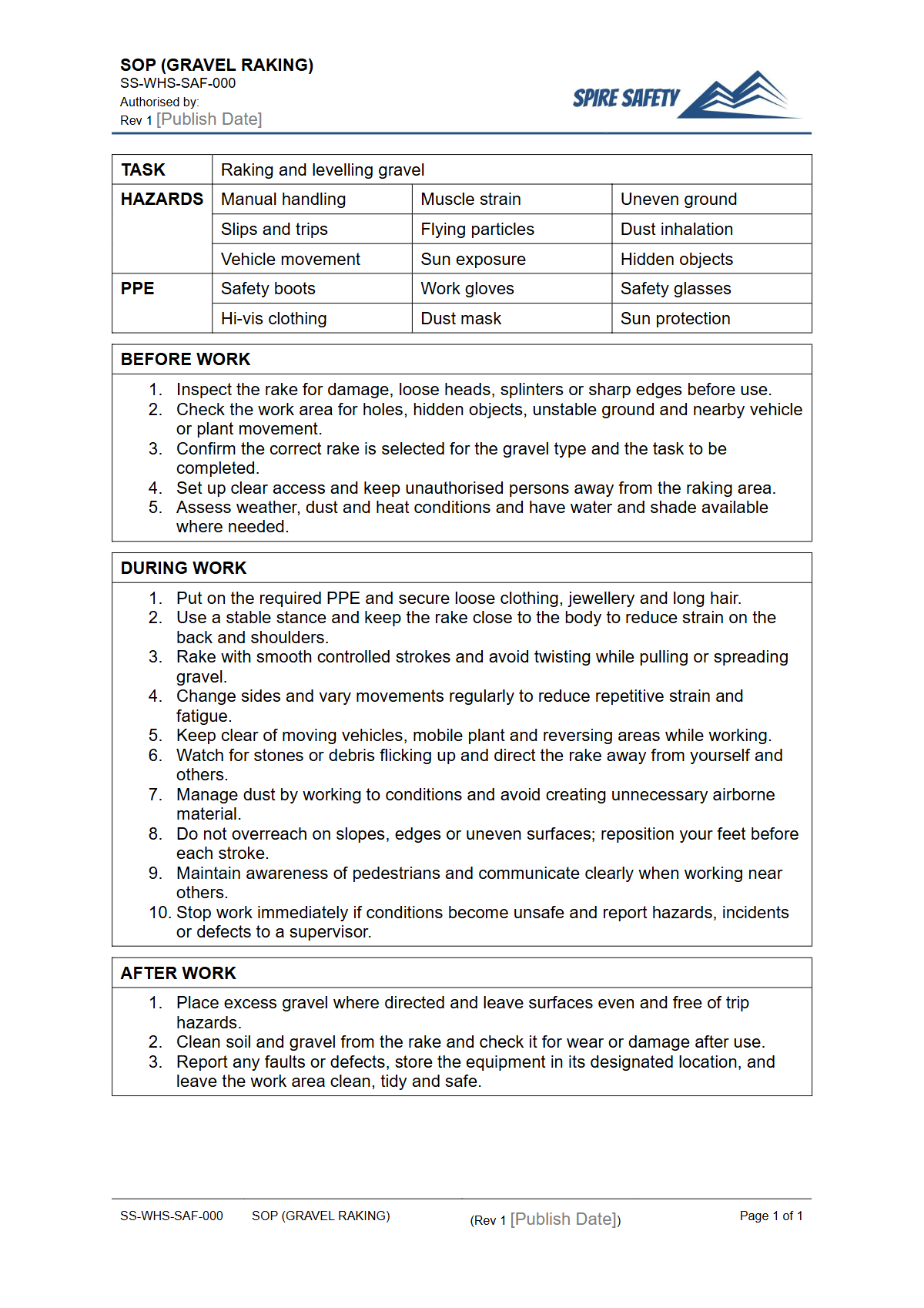
Gravel raking is a common task in landscaping, construction, and maintenance that carries significant work health and safety risks. This Free Safe Operating Procedure (Gravel Raking) Template provides a structured framework for documenting the safest way to perform this activity.
An SOP is a fundamental component of a safe system of work, offering clear, step-by-step instructions that help standardise practices and minimise worker exposure to hazards.
The primary purpose of this SOP is to control risks associated with manual tasks. These include musculoskeletal injuries from repetitive actions, awkward postures, and forceful exertion.
It also addresses environmental hazards like slips and trips on loose surfaces, sun exposure, and heat stress. By formally documenting the process, organisations can ensure all workers understand the required safety measures, personal protective equipment (PPE), and emergency responses.
This documentation is a key part of building and maintaining effective WHS management systems and demonstrates a commitment to proactive risk management.
Video walkthrough
How to use the Free Safe Operating Procedure (Gravel Raking) Template
This template is designed as a starting point. It provides a comprehensive structure aligned with Australian WHS principles, which you can download and adapt for your specific operational context.
IMPORTANT: This is a template only. We have developed it as a guide, and it must be customised to reflect the specific tools, materials, environment, and processes in your workplace.
We strongly recommend consulting with your workers—the people who perform the task—to ensure the final SOP is practical, accurate, and effective.
To use the template effectively:
- Download the DOCX file for easy editing.
- Conduct a thorough risk assessment for gravel raking activities at your specific site.
- Replace the placeholder text with your company details, site location, and the names of responsible personnel.
- Modify the procedural steps to match your exact methods, including the type of rakes used, the scale of the job, and site conditions.
- Integrate control measures identified in your risk assessment, such as mandatory rest breaks, job rotation, or specific manual handling techniques.
- Ensure the required PPE section is accurate, listing items like UV-rated clothing, safety glasses, steel-capped boots, and gloves.
- Once finalised, use the SOP as a basis for training and competency verification for all relevant workers.
While this SOP covers the manual task, larger site preparation may involve machinery, requiring documents like a Grader SOP template to ensure all activities are managed safely.
When to use a Safe Operating Procedure
A Safe Operating Procedure for gravel raking should be a live document integrated into your daily operations. It is not a 'set and forget' tool. It should be used:
- Before work commences: As a pre-task planning tool and to refresh workers' knowledge.
- During training and induction: To provide new and existing employees with clear instructions on the expected safe work method.
- For supervision and monitoring: As a benchmark for supervisors to observe work practices and provide corrective feedback.
- After an incident: As a key document to review during an investigation to determine if the procedure was followed and if it needs improvement.
Regular reviews of SOPs are often checked during WHS compliance auditing to ensure they remain current and effective in controlling risk.
Who should use this Safe Operating Procedure
This document is intended for a broad range of personnel within an organisation. Key users include:
- Persons Conducting a Business or Undertaking (PCBUs): To meet their primary duty of care to provide and maintain a safe work environment and safe systems of work.
- WHS Managers and Safety Advisors: To standardise procedures and integrate them into the overall safety management system.
- Supervisors and Team Leaders: To train their teams, assign tasks, and monitor adherence to safe work practices on-site.
- Workers: As a practical reference guide to understand the hazards and the steps they must follow to protect themselves and others.
This manual procedure complements SOPs for heavy machinery, such as our FREE Dozer SOP Template, to create a complete site safety picture. Similarly, teams using a variety of equipment will need specific procedures for each; for example, operators require a FREE Trencher SOP Template before using that machine.
If you need help integrating this procedure into your wider safety framework, our team provides general WHS consulting to assist. For more templates and guides, explore our comprehensive free WHS resources library.
Common mistakes
Common mistakes to avoid
- Using a generic template without customising it for site-specific hazards and equipment.
- Failing to consult with the workers who actually perform the raking task during development.
- Not providing practical training on the finalised SOP and verifying understanding.
- Forgetting to review and update the SOP after an incident, near-miss, or change in process.
Legal references
Legal considerations
The following legal requirements may be relevant to this type of work.
- Work Health and Safety Act (Harmonised) — Provides the primary duties for protecting workers and other people from work health and safety risks.
- Work Health and Safety Regulations (Harmonised) — Sets out requirements supporting the management of workplace hazards and risks.
The following codes may be relevant to this type of work.
- Managing WHS Risks Code of Practice — Provides practical guidance on identifying hazards, assessing risks and applying effective controls.
- Work Health and Safety Consultation, Cooperation and Coordination Code of Practice — Provides practical guidance on consulting workers and coordinating with other duty holders.
- Managing the Work Environment and Facilities Code of Practice — Provides practical guidance on safe work environments, workplace facilities and related controls.
Did you know
Repetitive Strain
Musculoskeletal disorders, often caused by repetitive manual tasks like raking, account for a significant portion of serious workers' compensation claims in Australia.
Hierarchy of Controls
An SOP is an administrative control. It's most effective when combined with higher-level controls like using ergonomic tools (an engineering control) or rotating tasks between workers.
FAQ
Frequently asked questions
01Is a Safe Operating Procedure for gravel raking legally required in Australia?
02What are the main hazards of gravel raking?
03How often should an SOP for gravel raking be reviewed?
04Can I use this template for other manual landscaping tasks?
Share this resource
Free Safe Operating Procedure (Gravel Raking) Template
Browse Categories
How To Use It
- 1Download and open in Word or PDF.
- 2Replace the placeholders with your business details.
- 3Get it reviewed by a WHS specialist before rollout.
Need it customised?
Our WHS consultants can adapt this template to your site, run a gap analysis, or audit what you already have in place.
Book a Free Consultation WHS consulting servicesor call 1300 156 382
Related templates
- Free Safe Operating Procedure (Grease Filter Change) Template
- Free Safe Operating Procedure (Grease Filter Cleaning) Template
- Free Safe Operating Procedure (Grease Pump) Template
- Free Safe Operating Procedure (Grease Transfer Pump) Template
- Free Safe Operating Procedure (Grease Trap Cleaning) Template
- Free Safe Operating Procedure (Green Waste Inspection) Template