
Free Safe Operating Procedure (Grade Laser) Template
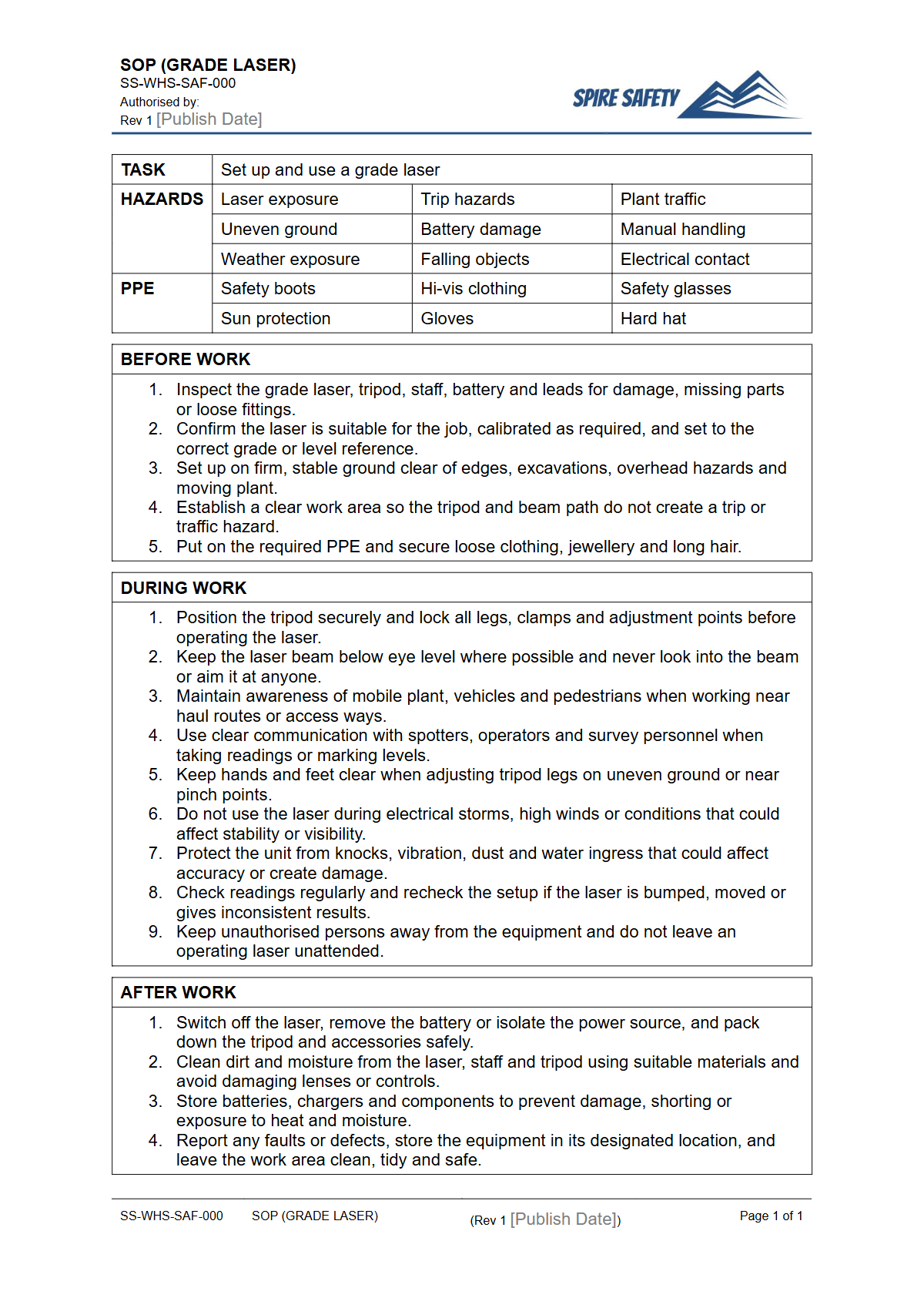
Download our free Safe Operating Procedure (Grade Laser) Template. This user-friendly DOCX and PDF resource helps you outline WHS steps for grade laser use.
Free Safe Operating Procedure (Grade Laser) Template
DOCX • 126 KB + PDF
Updated Oct 2026
No signup required
Purpose of the Free Safe Operating Procedure (Grade Laser) Template
Operating a grade laser on a worksite requires precision, skill, and a strong understanding of safety protocols. Our Free Safe Operating Procedure (Grade Laser) Template provides a structured starting point for your business to document the risks and control measures associated with this equipment.
This document is designed to help you create a clear, step-by-step guide for workers, promoting safe work practices and helping you meet your WHS obligations. Using a standardised SOP ensures that every operator, from new starters to experienced hands, follows the same verified process for setup, operation, and pack-down.
This template is based on the model WHS framework and is intended to be adapted to the specific grade laser models and site conditions at your workplace. A well-drafted SOP is a critical component of managing site hazards effectively.
It not only protects workers from potential eye injury and other risks but also safeguards the integrity of the project by ensuring accurate grade and level readings. For other excavation-related procedures, you might find our FREE Trencher SOP Template a useful companion document.
Video walkthrough
How to use the Free Safe Operating Procedure (Grade Laser) Template
This template is provided in both DOCX and PDF formats for your convenience. The DOCX version is fully editable, allowing you to tailor the content directly to your operational needs.
To use it effectively, you must consult with your workers—the people who actually use the equipment—and incorporate their feedback. Review the pre-filled sections, delete any that are not relevant, and add specific details about the make and model of your grade lasers, your site-specific hazards, and your emergency procedures.
Important: This is a template, not a finished document. Every workplace is unique, and you are responsible for ensuring the final SOP is accurate and relevant to your specific context.
We recommend a competent person reviews the customised document before it is implemented. This process of customisation and review is a key part of developing robust WHS management systems that genuinely reflect your business's operations.
When to use a Grade Laser SOP
A Safe Operating Procedure for a grade laser should be developed before the equipment is first used on site and reviewed whenever there is a change in equipment, processes, or regulations. It should be an integral part of worker induction and ongoing training.
The SOP must be readily accessible to operators at all times during their work.
It is particularly critical to use and refer to the SOP during:
- Pre-start checks and equipment inspection
- Initial setup of the laser and tripod on site
- Taking readings and transferring levels
- Working near other plant, personnel, or reflective surfaces
- Shut-down, cleaning, and storage procedures
Integrating this SOP with procedures for other heavy machinery ensures a cohesive approach to site safety. For instance, the process for using a grade laser during bulk earthworks should align with your FREE Dozer SOP (Safe Operating Procedure) Template.
Who should use this SOP template
This Safe Operating Procedure template is designed for use by Persons Conducting a Business or Undertaking (PCBUs), site supervisors, safety managers, and anyone responsible for drafting and implementing workplace safety documents in industries like construction, civil engineering, and agriculture. It provides the framework they need to create a comprehensive guide for the end-users: the workers and operators.
Operators, including surveyors, machine operators, and site hands, are the primary audience for the completed SOP. They must be trained in the procedure and understand their responsibility to follow it.
A well-written SOP empowers workers to carry out their tasks safely and efficiently. If you require expert assistance in developing or reviewing your site-specific procedures, consider engaging professional WHS consulting services.
Regularly reviewing your safety documents ensures they remain effective and relevant. This can be done internally or as part of formal WHS compliance audits to identify any gaps or areas for improvement in your safety systems.
This template is just one of many tools available to help you build a safer workplace. Be sure to explore our complete free WHS resources library for a wide range of templates, checklists, and guides.
Common mistakes
Common mistakes to avoid
- Failing to verify the laser's calibration before each use.
- Setting up the tripod on soft, uneven, or unstable ground.
- Neglecting eye protection when working with Class 3R or higher lasers.
- Not securing the work area to prevent people from accidentally looking into the beam.
Legal references
Legal considerations
The following legal requirements may be relevant to this type of work.
- Work Health and Safety Act (Harmonised) — Provides the primary duties for protecting workers and other people from work health and safety risks.
- Work Health and Safety Regulations (Harmonised) — Sets out requirements supporting the management of workplace hazards and risks.
The following codes may be relevant to this type of work.
- Managing WHS Risks Code of Practice — Provides practical guidance on identifying hazards, assessing risks and applying effective controls.
- Work Health and Safety Consultation, Cooperation and Coordination Code of Practice — Provides practical guidance on consulting workers and coordinating with other duty holders.
- Managing the Work Environment and Facilities Code of Practice — Provides practical guidance on safe work environments, workplace facilities and related controls.
Did you know
Laser Classification
Grade lasers are typically Class 2 or 3R. Class 2 lasers are considered safe for unintentional exposure as the blink reflex protects the eye, but deliberate staring can be harmful.
Accuracy is Key
Modern grade lasers can provide accuracy to within a few millimetres over hundreds of metres, making them essential for precision construction and agricultural work.
FAQ
Frequently asked questions
01What are the main hazards when using a grade laser?
02Is a Safe Operating Procedure a legal requirement for grade lasers in Australia?
03Who is responsible for developing a Grade Laser SOP?
04How often should a Grade Laser SOP be reviewed?
Share this resource
Free Safe Operating Procedure (Grade Laser) Template
Browse Categories
How To Use It
- 1Download and open in Word or PDF.
- 2Replace the placeholders with your business details.
- 3Get it reviewed by a WHS specialist before rollout.
Need it customised?
Our WHS consultants can adapt this template to your site, run a gap analysis, or audit what you already have in place.
Book a Free Consultation WHS consulting servicesor call 1300 156 382
Related templates
- Free Safe Operating Procedure (Graffiti Paint Touchup) Template
- Free Safe Operating Procedure (Graffiti Removal) Template
- Free Safe Operating Procedure (Grain Dryer) Template
- Free Safe Operating Procedure (Grain Elevator) Template
- Free Safe Operating Procedure (Grandstand Cleaning) Template
- Free Safe Operating Procedure (Gravel Path Repair) Template