
Free Safe Operating Procedure (Grain Dryer) Template
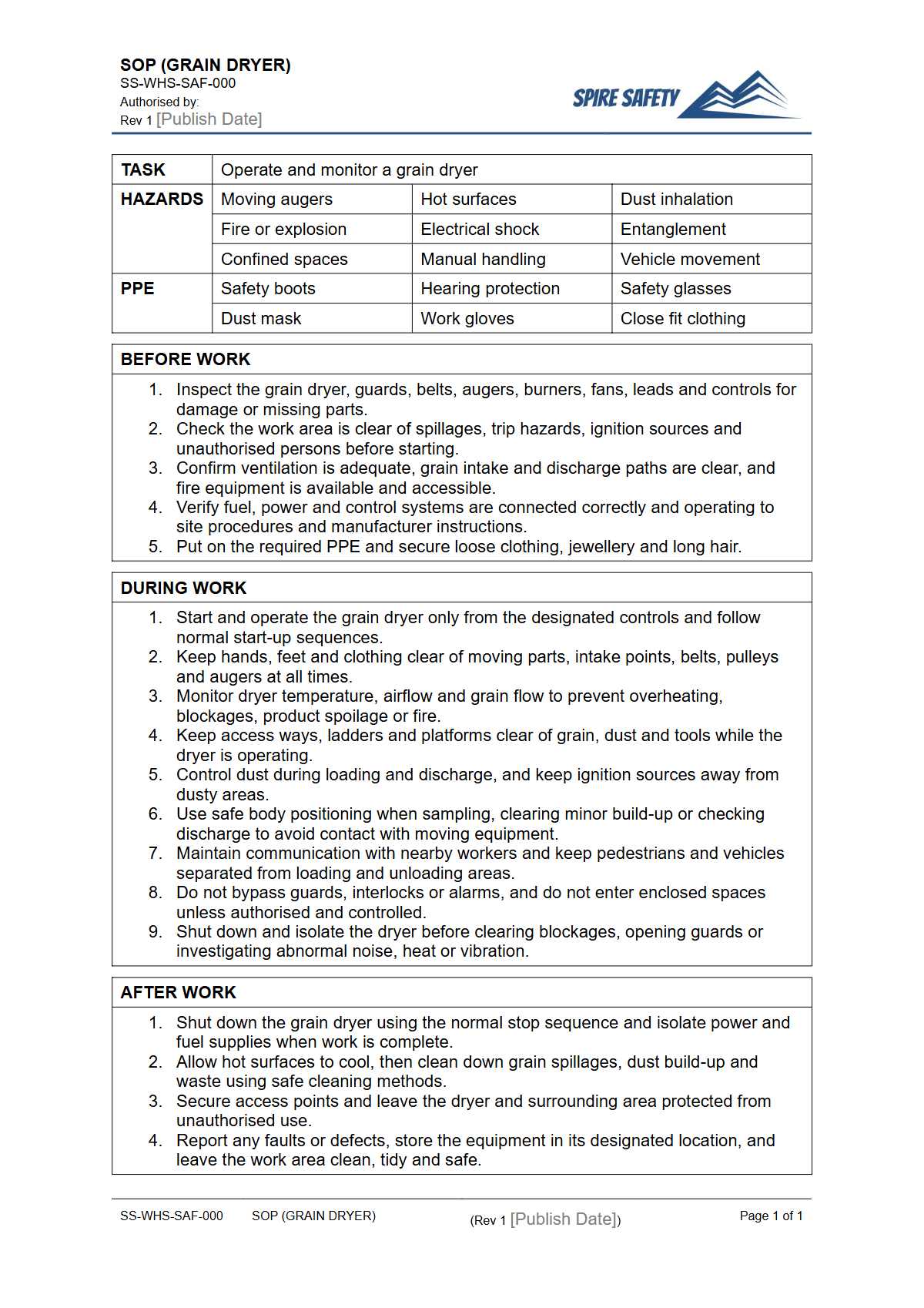
Manage grain dryer risks like fire and dust with our free Safe Operating Procedure template. A structured DOCX and PDF for your agricultural workplace.
Free Safe Operating Procedure (Grain Dryer) Template
DOCX • 126 KB + PDF
Updated Oct 2026
No signup required
Purpose of the Free Safe Operating Procedure (Grain Dryer) Template
Operating a grain dryer involves significant risks, including fire, explosions from grain dust, entrapment in moving parts, and exposure to hazardous atmospheres. This Free Safe Operating Procedure (Grain Dryer) Template provides a structured framework for documenting the key steps, hazards, and control measures required for the safe operation of this equipment.
It is designed to assist persons conducting a business or undertaking (PCBUs) in meeting their primary duty of care under WHS legislation. Using this template helps standardise work practices, facilitate worker training, and provide a clear reference for safe operation on your farm or industrial site.
A well-drafted SOP is a critical component of a systematic approach to workplace safety. It forms the basis for consistent training and competency assessments, ensuring every operator understands the required safety protocols.
For other agricultural machinery, you might also find our FREE Grain Drill SOP Template useful for standardising procedures across your operations.
Video walkthrough
How to use the Free Safe Operating Procedure (Grain Dryer) Template
This document is a template and must be customised to your specific circumstances. To use this Free Safe Operating Procedure (Grain Dryer) Template effectively, you should conduct a site-specific risk assessment for your particular make and model of grain dryer.
Involve your workers—the operators who use the equipment daily—in the process of reviewing and finalising the SOP. Their practical knowledge is invaluable for identifying real-world hazards and effective controls.
Note: This is a template document that we have created to serve as a starting point. It is essential that you adapt this document to the specific equipment, processes, and risks present in your workplace.
We are not responsible for any incidents that may occur. After customisation, the SOP should be integrated into your broader WHS management systems to ensure it is properly implemented, reviewed, and maintained.
Key Grain Dryer Hazards
Before finalising your SOP, ensure it addresses the common hazards associated with grain dryers. These often include:
- Fire and Explosion: Caused by the ignition of fine grain dust or overheating of the dryer components. Controls include regular cleaning, dust extraction systems, and ensuring ignition sources are controlled.
- Entanglement and Crushing: Moving parts such as augers, belts, and fans can cause severe injuries. Guards, lock-out tag-out (LOTO) procedures for maintenance, and emergency stops are critical controls.
- Confined Spaces: Entering bins or dryer columns for cleaning or maintenance poses risks of asphyxiation from carbon monoxide or engulfment by grain. A robust confined space entry permit system is necessary.
- Hazardous Atmospheres: The combustion process can produce carbon monoxide, a toxic gas. Adequate ventilation and atmospheric monitoring are essential.
- Manual Handling: Moving and handling grain, parts, or tools can lead to musculoskeletal injuries.
When moving materials around the grain dryer area, other machinery is often involved. It's crucial that operators are trained on all equipment, such as that covered in our FREE Telehandler SOP Template, which is commonly used in agricultural settings.
When to use a Grain Dryer Safe Operating Procedure
A Safe Operating Procedure for a grain dryer should be used consistently whenever the equipment is in operation, being cleaned, or undergoing maintenance. It is a primary document for:
- Worker Induction and Training: Use the SOP to train new operators on the safe and correct way to use the grain dryer.
- Refresher Training: Provide regular refresher training to experienced operators to reinforce safe work practices and introduce any new procedures.
- Pre-start Checks: The SOP should include a checklist for operators to complete before starting the dryer to ensure all safety features are functional.
- Incident Investigations: In the event of an incident or near-miss, the SOP serves as a benchmark for what should have occurred.
The effectiveness of your SOPs should be periodically verified. This can be done as part of routine site inspections or through formal WHS compliance auditing to ensure procedures are being followed correctly in practice.
Who should use this Safe Operating Procedure
This SOP is intended for several groups within an organisation:
- Workers and Operators: As a direct guide for performing their tasks safely.
- Supervisors and Managers: To monitor compliance, conduct safety observations, and enforce safe work standards.
- WHS Personnel: For developing training materials, conducting risk assessments, and integrating the procedure into the overall safety management system.
An effective SOP should be accessible and understandable to all relevant personnel, regardless of their role. The same principle applies to other common industrial equipment; for example, many sites also rely on our Free Air Compressor SOP Template to manage associated risks. You can find more templates like this in our free WHS resources library.
Common mistakes
Common mistakes to avoid
- Failing to conduct regular and thorough cleaning, allowing dangerous levels of grain dust to accumulate.
- Neglecting to implement and enforce a strict lock-out tag-out (LOTO) procedure before any maintenance, cleaning, or clearing of blockages.
- Using a generic template without customising it for the specific make, model, and condition of the grain dryer on site.
- Not providing adequate training on the SOP, assuming workers will read and understand it without guidance.
Legal references
Legal considerations
The following legal requirements may be relevant to this type of work.
- Work Health and Safety Act (Harmonised) — Provides the primary duties for protecting workers and other people from work health and safety risks.
- Work Health and Safety Regulations (Harmonised) — Sets out requirements supporting the management of workplace hazards and risks.
The following codes may be relevant to this type of work.
- Managing WHS Risks Code of Practice — Provides practical guidance on identifying hazards, assessing risks and applying effective controls.
- Work Health and Safety Consultation, Cooperation and Coordination Code of Practice — Provides practical guidance on consulting workers and coordinating with other duty holders.
- Managing the Work Environment and Facilities Code of Practice — Provides practical guidance on safe work environments, workplace facilities and related controls.
Did you know
Dust Explosions
Grain dust is highly combustible. As little as 40 grams of dust per cubic metre of air (about the density of a light fog) can be explosive if an ignition source is present.
Carbon Monoxide Risk
Incomplete combustion in gas-fired dryers can produce lethal levels of carbon monoxide (CO), an odourless, colourless gas. This is a major risk, especially during maintenance inside or near the unit.
FAQ
Frequently asked questions
01What should be included in a grain dryer SOP?
02How often should a Safe Operating Procedure for a grain dryer be reviewed?
03Who is responsible for writing a grain dryer SOP?
04Is a Safe Work Method Statement (SWMS) required for operating a grain dryer?
Share this resource
Free Safe Operating Procedure (Grain Dryer) Template
Browse Categories
How To Use It
- 1Download and open in Word or PDF.
- 2Replace the placeholders with your business details.
- 3Get it reviewed by a WHS specialist before rollout.
Need it customised?
Our WHS consultants can adapt this template to your site, run a gap analysis, or audit what you already have in place.
Book a Free Consultation WHS consulting servicesor call 1300 156 382
Related templates
- Free Safe Operating Procedure (Grain Elevator) Template
- Free Safe Operating Procedure (Grandstand Cleaning) Template
- Free Safe Operating Procedure (Gravel Path Repair) Template
- Free Safe Operating Procedure (Gravel Raking) Template
- Free Safe Operating Procedure (Grease Filter Change) Template
- Free Safe Operating Procedure (Grease Filter Cleaning) Template