
Free Safe Operating Procedure (Graffiti Removal) Template
Download our free Safe Operating Procedure (Graffiti Removal) template.
Free Safe Operating Procedure (Graffiti Removal) Template
DOCX • 126 KB + PDF
Updated Oct 2026
No signup required
Purpose of the Free Safe Operating Procedure (Graffiti Removal) Template
Graffiti removal, while often seen as a simple cleaning task, involves significant health and safety risks. Workers may be exposed to hazardous chemicals, engage in manual tasks, and work in public spaces with vehicle and pedestrian traffic.
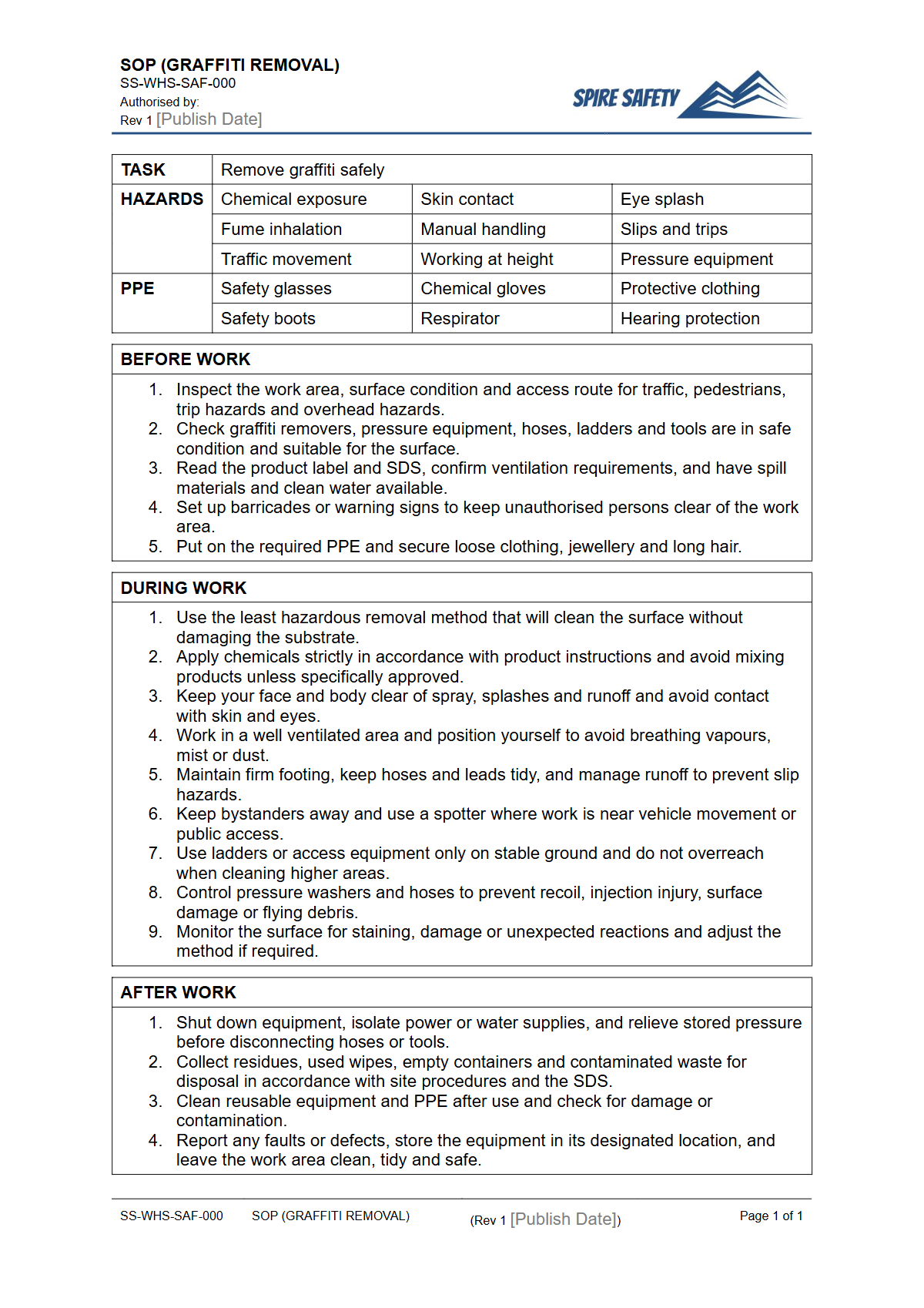
This free Safe Operating Procedure (Graffiti removal) template provides a structured starting point for organisations to document a clear, step-by-step process for performing this work safely. It is designed to help you control risks and meet your duty of care under Australian WHS laws.
Using a formal SOP helps standardise your approach, ensuring that every worker, regardless of experience, follows a tested and safe method. It serves as a critical training document and a foundation for risk assessments, helping to integrate safety into your operational workflow.
A well-drafted SOP is a key component of effective WHS management systems, demonstrating a proactive commitment to workplace safety.
Video walkthrough
How to use the Free Safe Operating Procedure (Graffiti Removal) Template
This document is a template, not a finished procedure. It must be customised to reflect the specific circumstances of your workplace.
Download the file in your preferred format (DOCX or PDF) and adapt it to your unique requirements. This involves consulting with your team, reviewing your specific chemicals and equipment, and incorporating site-specific controls.
Important: To be effective, you must customise this template. We have no way of knowing your specific site, equipment, chemical inventory, or worker competency.
You must conduct your own risk assessment and adapt the document accordingly, ensuring it accurately reflects the tasks being performed at your worksite.
Key Sections to Customise
Pay close attention to the following areas when adapting the template:
- Hazard Identification: List all potential hazards specific to your graffiti removal tasks. This includes chemical exposure (inhalation, skin contact), manual handling, working at heights, slips and trips, noise from equipment, and risks from working in public areas.
- Chemical Safety: Name the specific chemicals you use. Reference their Safety Data Sheets (SDS) and detail the required controls for handling, storage, and disposal. Include first aid measures for chemical exposure.
- Equipment Operation: Detail the pre-start checks, safe use, and shutdown procedures for all equipment, such as pressure washers, scrapers, or steam cleaners.
- PPE Requirements: Specify the exact Personal Protective Equipment (PPE) needed, such as respirator type, glove material, eye protection, and any required protective clothing. Be specific to the chemicals and tasks involved.
- Emergency Procedures: Outline steps to take in case of a chemical spill, fire, injury, or adverse reaction. Include contact numbers and the location of emergency equipment like first aid kits and eyewash stations. For complex sites, engaging professional WHS consulting can help ensure your procedures are robust.
When to use a Safe Operating Procedure for Graffiti Removal
An SOP for graffiti removal should be developed, implemented, and reviewed before any work begins. It is an essential document for any business or undertaking involved in property maintenance, facilities management, commercial cleaning, or council operations.
It should be used as a primary reference for training new staff and as a refresher for existing employees. If the task involves reaching high places, this SOP should be used in conjunction with other procedures, such as a FREE Step Ladder SOP Template, to manage all associated risks comprehensively.
Who should use this SOP
This Safe Operating Procedure is intended for use by multiple roles within an organisation:
- PCBUs (Persons Conducting a Business or Undertaking) and Managers: To establish and authorise a safe system of work, fulfilling their primary duty of care.
- Supervisors: To induct, train, and supervise workers, ensuring the procedures are followed correctly on every job.
- Workers and Contractors: To understand the risks and follow the step-by-step instructions required to perform the task safely.
The SOP ensures that everyone involved has a clear and consistent understanding of how to manage the risks associated with graffiti removal. Whether using chemical solvents or operating equipment like a pressure washer, having a clear procedure is vital.
If your process involves specific machinery, you may need additional SOPs, like our Free Air Compressor SOP, to cover all equipment use. For a wider selection of safety documents, browse our complete free WHS resources library.
Common mistakes
Common mistakes to avoid
- Failing to read the Safety Data Sheet (SDS) before using a new chemical.
- Working in a poorly ventilated area, leading to high exposure to chemical fumes.
- Not wearing the correct personal protective equipment (PPE), particularly respiratory protection and chemical-resistant gloves.
- Forgetting to secure the work area and manage pedestrian traffic, creating public safety risks.
Legal references
Legal considerations
The following legal requirements may be relevant to this type of work.
- Work Health and Safety Act (Harmonised) — Provides the primary duties for protecting workers and other people from work health and safety risks.
- Work Health and Safety Regulations (Harmonised) — Sets out requirements supporting the management of workplace hazards and risks.
The following codes may be relevant to this type of work.
- Managing WHS Risks Code of Practice — Provides practical guidance on identifying hazards, assessing risks and applying effective controls.
- Work Health and Safety Consultation, Cooperation and Coordination Code of Practice — Provides practical guidance on consulting workers and coordinating with other duty holders.
- Managing the Work Environment and Facilities Code of Practice — Provides practical guidance on safe work environments, workplace facilities and related controls.
Did you know
Chemical Hazards
Many graffiti removal agents contain volatile organic compounds (VOCs). Inhaling these can cause short-term health effects like headaches and dizziness, and long-term exposure can lead to more serious organ damage.
Surface Damage
Using the wrong chemical or application method can permanently damage the underlying surface, leading to costly repairs. This is why material testing in an inconspicuous area is a critical step in any professional graffiti removal process.
FAQ
Frequently asked questions
01What key elements should a Safe Operating Procedure for graffiti removal include?
02Is it necessary to have a Safety Data Sheet (SDS) for each chemical used?
03Who is responsible for providing the training on a graffiti removal SOP?
04How often does a Graffiti Removal SOP need to be reviewed?
Share this resource
Free Safe Operating Procedure (Graffiti Removal) Template
Browse Categories
How To Use It
- 1Download and open in Word or PDF.
- 2Replace the placeholders with your business details.
- 3Get it reviewed by a WHS specialist before rollout.
Need it customised?
Our WHS consultants can adapt this template to your site, run a gap analysis, or audit what you already have in place.
Book a Free Consultation WHS consulting servicesor call 1300 156 382
Related templates
- Free Safe Operating Procedure (Grain Dryer) Template
- Free Safe Operating Procedure (Grain Elevator) Template
- Free Safe Operating Procedure (Grandstand Cleaning) Template
- Free Safe Operating Procedure (Gravel Path Repair) Template
- Free Safe Operating Procedure (Gravel Raking) Template
- Free Safe Operating Procedure (Grease Filter Change) Template