
Free Safe Operating Procedure (Grab Rail Cleaning) Template
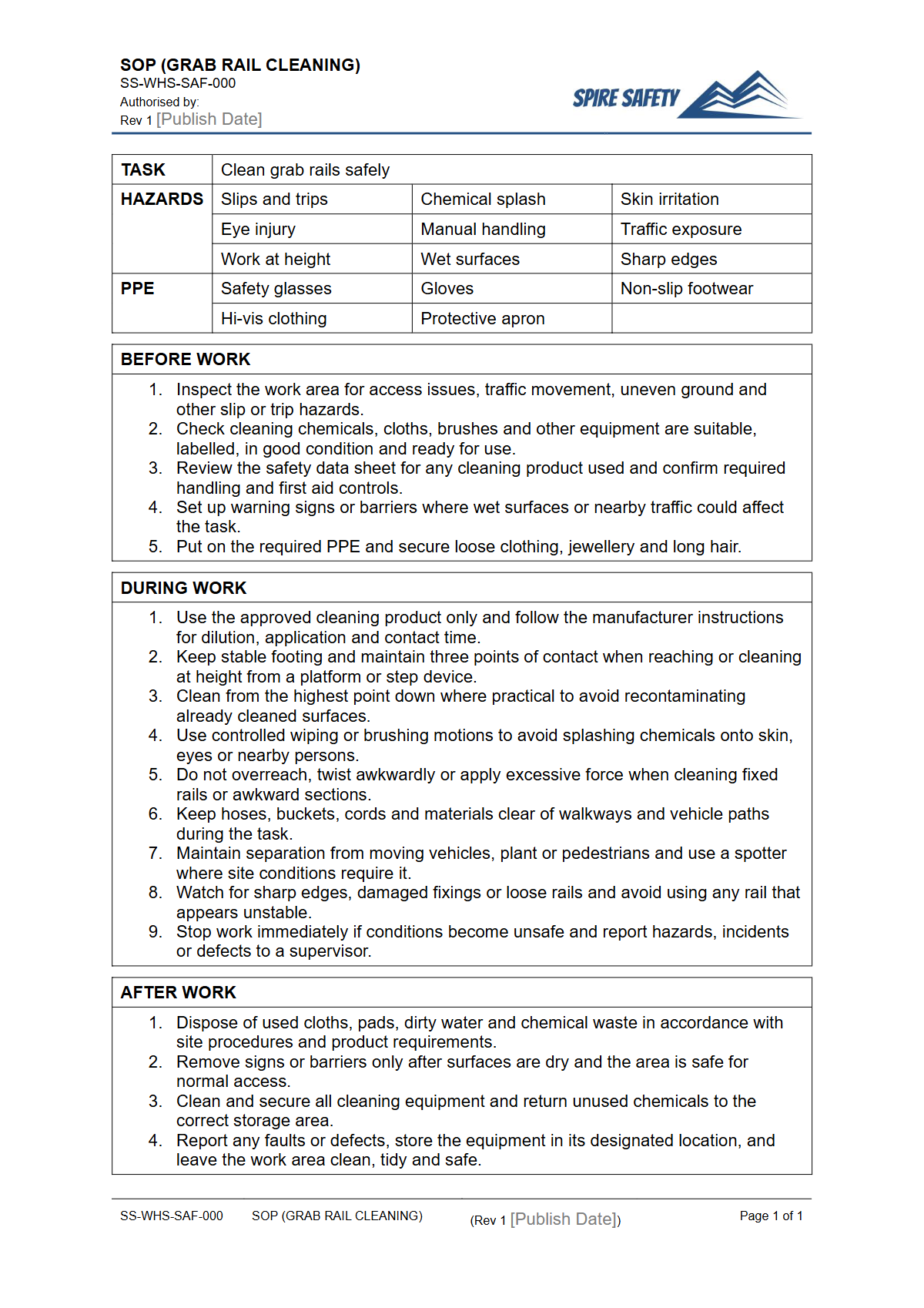
Download our free Safe Operating Procedure (Grab Rail Cleaning) template. This user-friendly Word document provides a solid foundation for your WHS procedures.
Free Safe Operating Procedure (Grab Rail Cleaning) Template
DOCX • 126 KB + PDF
Updated Oct 2026
No signup required
Purpose of the Free Safe Operating Procedure (Grab Rail Cleaning) Template
This Safe Operating Procedure (SOP) provides a structured framework for safely cleaning grab rails in various settings, such as commercial buildings, public transport, healthcare facilities, and aged care homes. While often seen as a routine task, cleaning grab rails involves specific hazards that must be managed to prevent injury.
Using a formal procedure helps standardise the cleaning process, ensuring every worker performs the task safely and effectively, every time. The primary purpose of this Free Safe Operating Procedure (Grab Rail Cleaning) Template is to help you control risks including chemical exposure from cleaning agents, slips and trips from wet surfaces, and musculoskeletal injuries from awkward postures or repetitive motions.
A well-drafted SOP is a critical component of a proactive safety culture. It serves as a key training document for new and existing employees, a reference guide for supervisors, and a benchmark for performance.
Implementing clear, documented procedures demonstrates a commitment to worker safety and forms a fundamental part of effective WHS management systems. This template helps you systematically outline the required steps, personal protective equipment (PPE), and emergency responses, reducing the likelihood of workplace incidents.
Video walkthrough
How to use the Free Safe Operating Procedure (Grab Rail Cleaning) Template
This Safe Operating Procedure for grab rail cleaning is provided as a fully editable Microsoft Word (DOCX) file, with a PDF version also available for easy printing and sharing. It is designed to be a starting point that you can adapt to the unique conditions of your workplace.
It is not a one-size-fits-all solution, and its effectiveness depends on proper customisation and implementation.
Important: This document is a template and is not a substitute for a site-specific risk assessment. We strongly recommend you customise this SOP to reflect your specific workplace environment, equipment, chemicals used, and worker competencies. To use the template effectively:
- Download: Get the DOCX file and open it.
- Review and Customise: Read through each section and replace the generic text with your site-specific details. This includes specifying the exact cleaning chemicals, dilution ratios, required PPE (e.g., specific glove types), and emergency contact numbers.
- Consult: Involve the workers who perform the cleaning tasks in the customisation process. Their direct experience is invaluable for creating a practical and effective procedure.
- Approve: Have the final document reviewed and approved by a competent person, such as a supervisor or WHS manager.
- Train: Formally train all relevant workers on the finalised SOP. Ensure they understand every step and have an opportunity to ask questions. Keep training records.
If you require assistance in adapting this template or developing other safety documentation, Spire Safety offers specialist WHS consulting to help you meet your obligations.
When to use it
A Safe Operating Procedure for grab rail cleaning should be used consistently as part of your organisation's standard work practices. It is not just a document to be filed away.
It should be actively used before, during, and after the cleaning task. Key times to reference the SOP include when inducting and training new cleaning staff, conducting refresher training for existing employees, or when a new cleaning product or piece of equipment is introduced.
It also serves as a crucial reference point during incident investigations to determine if procedural breakdowns contributed to the event.
Regular safety observations and workplace inspections should verify that the steps outlined in the SOP are being followed correctly. Furthermore, the procedure should be a live document, reviewed and updated periodically—typically annually or after any significant change in process or legislation.
Regular WHS compliance auditing can help ensure that documented procedures like this SOP are being effectively implemented and maintained across the business.
Who should use it
This SOP is intended for several key roles within an organisation. Primarily, it is for the workers or cleaners who are directly responsible for performing the task.
They must follow the step-by-step instructions to ensure their own safety and the safety of others in the vicinity. Supervisors and team leaders should also use the SOP to induct new staff, monitor work practices, and provide corrective guidance when they observe deviations from the procedure.
It gives them a clear, agreed-upon standard to manage performance against.
Work Health and Safety (WHS) managers or representatives will use this document as part of the broader safety management system. They are often responsible for facilitating the initial risk assessment, drafting the procedure in consultation with workers, and scheduling regular reviews.
In situations where grab rails are located at height, such as along stairwells or mezzanines, tasks may require working from a ladder. In these cases, this procedure should be used in conjunction with other relevant documents, such as our Free Step Ladder SOP Template, to manage the additional risks of working at heights. You can find more templates like this in our free WHS resources library.
Common mistakes
Common mistakes to avoid
- Using a generic template without customising it with site-specific details like chemical names and emergency contacts.
- Failing to consult with the workers who perform the cleaning task during the drafting and review process.
- Not providing the specific Personal Protective Equipment (PPE) listed in the SOP or the chemical's Safety Data Sheet (SDS).
- Neglecting to train workers on the final, approved procedure before they are required to follow it.
Legal references
Legal considerations
The following legal requirements may be relevant to this type of work.
- Work Health and Safety Act (Harmonised) — Provides the primary duties for protecting workers and other people from work health and safety risks.
- Work Health and Safety Regulations (Harmonised) — Sets out requirements supporting the management of workplace hazards and risks.
The following codes may be relevant to this type of work.
- Managing WHS Risks Code of Practice — Provides practical guidance on identifying hazards, assessing risks and applying effective controls.
- Work Health and Safety Consultation, Cooperation and Coordination Code of Practice — Provides practical guidance on consulting workers and coordinating with other duty holders.
- Managing the Work Environment and Facilities Code of Practice — Provides practical guidance on safe work environments, workplace facilities and related controls.
Did you know
Slips, Trips, and Falls
Slips, trips, and falls are a leading cause of serious workplace injuries in Australia. According to Safe Work Australia, they account for thousands of workers' compensation claims each year, many resulting from wet or contaminated floors.
FAQ
Frequently asked questions
01What is the difference between a Safe Operating Procedure (SOP) and a Safe Work Method Statement (SWMS)?
02What hazards are involved in cleaning grab rails?
03Do I need a Safety Data Sheet (SDS) for my cleaning chemicals?
04How often should Safe Operating Procedures be reviewed?
Share this resource
Free Safe Operating Procedure (Grab Rail Cleaning) Template
Browse Categories
How To Use It
- 1Download and open in Word or PDF.
- 2Replace the placeholders with your business details.
- 3Get it reviewed by a WHS specialist before rollout.
Need it customised?
Our WHS consultants can adapt this template to your site, run a gap analysis, or audit what you already have in place.
Book a Free Consultation WHS consulting servicesor call 1300 156 382
Related templates
- Free Safe Operating Procedure (Grade Laser) Template
- Free Safe Operating Procedure (Graffiti Paint Touchup) Template
- Free Safe Operating Procedure (Graffiti Removal) Template
- Free Safe Operating Procedure (Grain Dryer) Template
- Free Safe Operating Procedure (Grain Elevator) Template
- Free Safe Operating Procedure (Grandstand Cleaning) Template