
Free Safe Operating Procedure (Golf Bunker Raking) Template
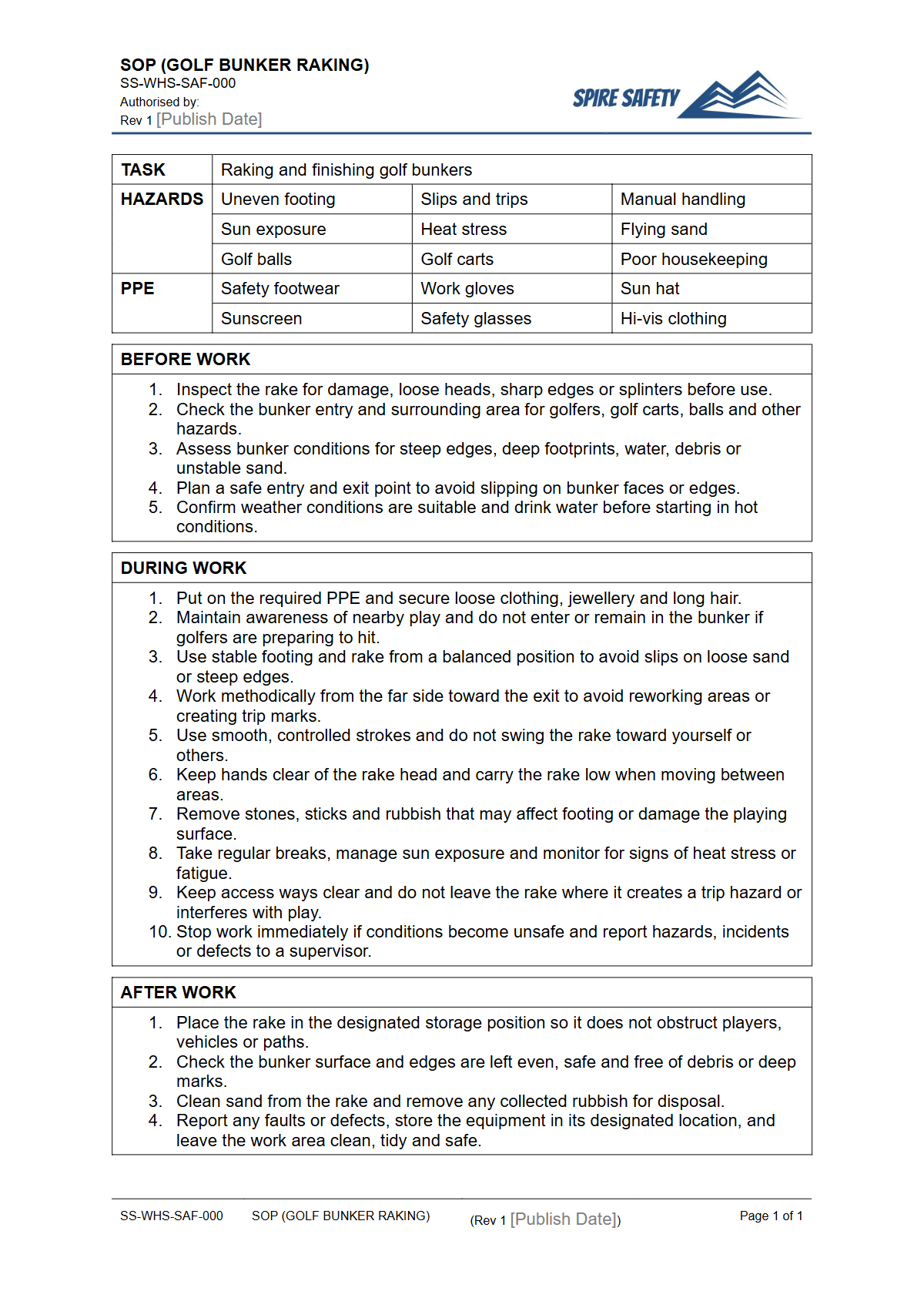
Download our free Safe Operating Procedure (SOP) for golf bunker raking. This customisable template helps you outline controls for manual tasks.
Free Safe Operating Procedure (Golf Bunker Raking) Template
DOCX • 126 KB + PDF
Updated Oct 2026
No signup required
Purpose of the Free Safe Operating Procedure (Golf Bunker Raking) Template
This Safe Operating Procedure (SOP) for golf bunker raking provides a structured framework for outlining the safest way to perform this common groundskeeping task. Its purpose is to standardise the procedure across your workforce, ensuring every worker understands the required steps, potential hazards, and necessary control measures.
By implementing a clear SOP, your organisation can actively minimise risks such as manual handling injuries, slips and trips on uneven surfaces, and environmental exposure. A well-defined procedure is a key part of an effective safety management system, demonstrating a commitment to worker health and safety.
Implementing documented procedures is a fundamental step in risk management. A formal SOP helps in training new staff, conducting refresher courses, and investigating incidents.
It provides a clear benchmark for expected safe behaviour and work practices on the golf course. While bunker raking might seem simple, standardising the approach helps control for variables like different bunker designs, sand conditions, and individual techniques.
For more complex maintenance tasks, you might also require procedures like our free Grader SOP to manage risks associated with heavy machinery.
Video walkthrough
How to use the Free Safe Operating Procedure (Golf Bunker Raking) Template
This document serves as a comprehensive starting point, aligned with Australian WHS principles. To make it effective for your specific golf course, you must adapt it to your unique environment.
Start by downloading the DOCX file and adding your company logo and details. Walk through each section and modify the content to reflect the actual rakes used (manual or motorised), the specific terrain of your bunkers, and your site's emergency procedures.
It is crucial to consult with the groundskeepers who perform the task daily. Their direct input is invaluable for identifying practical hazards and effective controls that might not be obvious from an office.
This collaborative approach fosters a stronger safety culture and ensures the final document is practical and respected. For instance, your team might identify specific access paths to bunkers that are safer than others, a detail that must be included.
Important: We have pre-filled this document with common steps, hazards, and controls. However, you MUST customise it to reflect the specific equipment, environment, and processes at your workplace.
A generic document that is not site-specific will not effectively manage risk. This process of customisation and consultation is a core component of developing WHS management systems that are truly integrated into your operations.
When to use it
A Safe Operating Procedure for golf bunker raking should be used as a primary training document for any new or inexperienced groundskeeper before they undertake the task. It should also be readily available in the maintenance shed or on a digital device for workers to reference at any time.
The SOP is a critical tool for toolbox talks or pre-start meetings, especially when weather conditions like extreme heat or recent heavy rain change the risk profile of outdoor work.
Furthermore, this procedure should be formally reviewed and used for refresher training on a regular basis, such as annually. It must also be reviewed immediately following any incident or near miss related to bunker maintenance, or whenever a new type of equipment (like a new model of bunker rake) or work method is introduced.
Regular reviews ensure the document remains a relevant and effective risk control measure. This is similar to how you would manage the introduction of other tools, which might require a step ladder SOP for tasks involving work at height.
Who should use it
This SOP is primarily intended for workers who perform the task, including groundskeepers, greenkeepers, and casual maintenance staff. It provides them with clear, step-by-step instructions to follow for their own safety.
Supervisors and course managers should use the SOP to train their teams, set clear performance expectations, and monitor that safe work practices are being followed consistently. They are responsible for ensuring the procedure is understood and implemented correctly.
Work Health and Safety (WHS) officers and consultants will also find this template useful as part of their toolkit for building a comprehensive safety framework. It can be integrated into a broader system of risk assessments and safe work documentation.
Conducting periodic checks to ensure SOPs are being followed is a key activity in WHS compliance audits, helping to verify that documented procedures translate into safe practices on the ground. When managing various tools, a similar process would apply for a air compressor SOP back at the maintenance shed. To find more templates for other common tasks, you can browse our complete free WHS resources library.
Common mistakes
Common mistakes to avoid
- Using the downloaded template without customising it for the specific course, equipment, and sand type.
- Failing to train workers on the SOP, assuming they will read and follow it without guidance.
- Forgetting to include pre-start checks, such as inspecting the rake for damage or loose parts.
- Neglecting to review and update the SOP after a near miss or when work practices change.
Legal references
Legal considerations
The following legal requirements may be relevant to this type of work.
- Work Health and Safety Act (Harmonised) — Provides the primary duties for protecting workers and other people from work health and safety risks.
- Work Health and Safety Regulations (Harmonised) — Sets out requirements supporting the management of workplace hazards and risks.
The following codes may be relevant to this type of work.
- Managing WHS Risks Code of Practice — Provides practical guidance on identifying hazards, assessing risks and applying effective controls.
- Work Health and Safety Consultation, Cooperation and Coordination Code of Practice — Provides practical guidance on consulting workers and coordinating with other duty holders.
- Managing the Work Environment and Facilities Code of Practice — Provides practical guidance on safe work environments, workplace facilities and related controls.
Did you know
Manual Task Risks
Hazardous manual tasks are a leading cause of workplace injury in Australia. Even seemingly light activities like raking, when repetitive or done in awkward postures, can lead to serious musculoskeletal disorders over time.
Bunker Design
The architectural design of a golf bunker—including its depth, the steepness of its faces ('flashings'), and the type of sand used—can significantly alter the physical demands and ergonomic risks associated with raking it.
FAQ
Frequently asked questions
01What are the main hazards of raking golf bunkers?
02Is a Safe Operating Procedure legally required for raking a bunker?
03What PPE is recommended for bunker raking?
04How often should an SOP for bunker raking be reviewed?
Share this resource
Free Safe Operating Procedure (Golf Bunker Raking) Template
Browse Categories
How To Use It
- 1Download and open in Word or PDF.
- 2Replace the placeholders with your business details.
- 3Get it reviewed by a WHS specialist before rollout.
Need it customised?
Our WHS consultants can adapt this template to your site, run a gap analysis, or audit what you already have in place.
Book a Free Consultation WHS consulting servicesor call 1300 156 382
Related templates
- Free Safe Operating Procedure (Golf Green Repair) Template
- Free Safe Operating Procedure (Golf Tee Maintenance) Template
- Free Safe Operating Procedure (Goods Lift) Template
- Free Safe Operating Procedure (Goods Receipt Check) Template
- Free Safe Operating Procedure (Grab Rail Cleaning) Template
- Free Safe Operating Procedure (Grade Laser) Template