
Free Safe Operating Procedure (Goods Lift) Template
Download our free Safe Operating Procedure (Goods Lift) Template. This customisable DOCX and PDF resource helps you outline safe work practices. Start today.
Free Safe Operating Procedure (Goods Lift) Template
DOCX • 126 KB + PDF
Updated Oct 2026
No signup required
Purpose of the Free Safe Operating Procedure (Goods Lift) Template
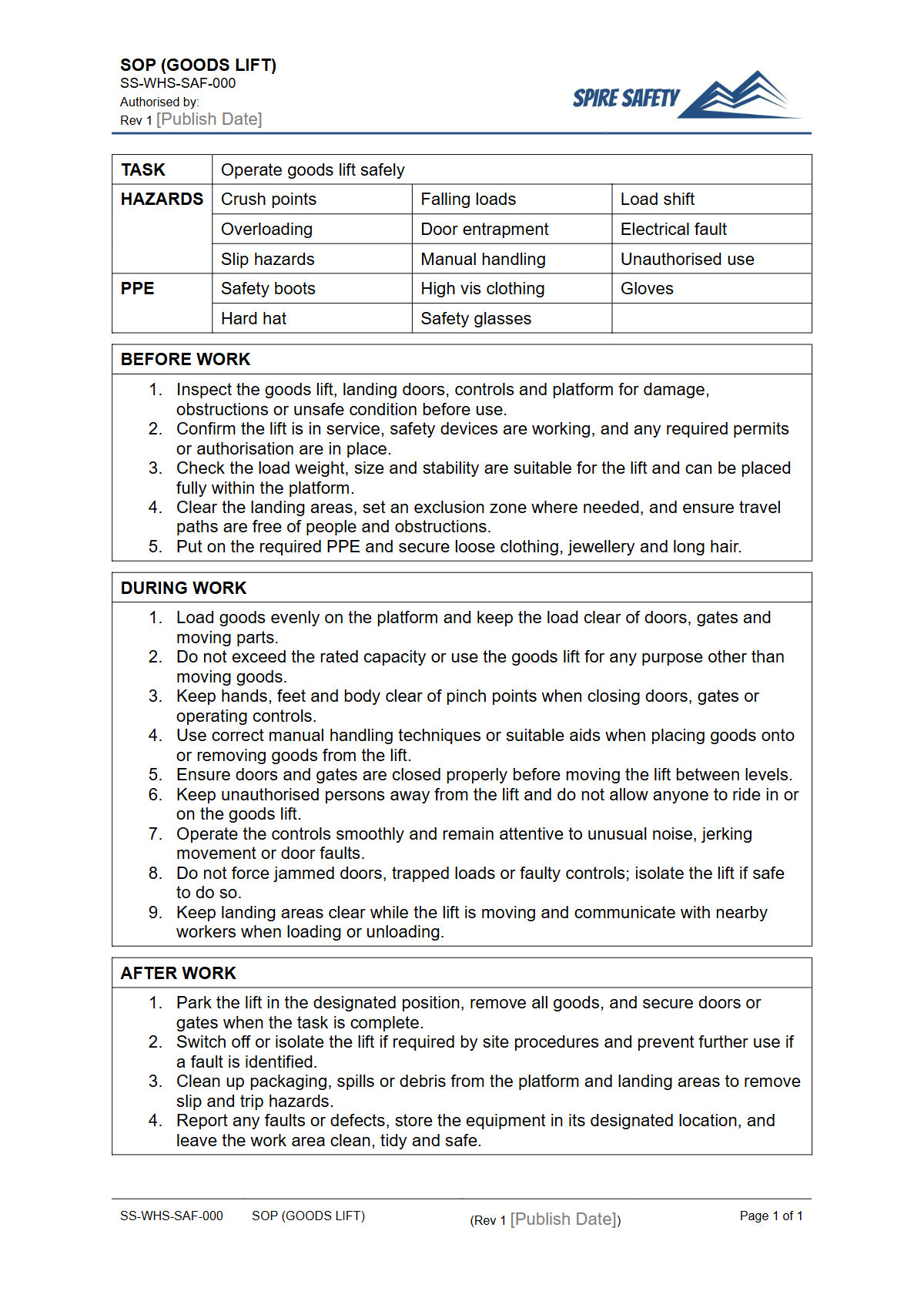
Operating a goods lift, like any piece of plant, introduces risks that must be managed to ensure workplace safety. This Free Safe Operating Procedure (Goods Lift) Template provides a structured framework for documenting the safe use of goods lifts in your workplace.
It guides you through outlining critical pre-operational checks, step-by-step operating instructions, and emergency procedures. Using a standardised SOP helps your organisation meet its duty of care, reduces the risk of incidents involving crushing, shearing, or manual handling, and ensures all operators are trained to a consistent standard.
A well-drafted SOP is more than just a document; it's a critical administrative control measure that forms part of your overall safety strategy. It serves as a practical tool for training, a reference for operators, and evidence of your commitment to proactive risk management.
Integrating SOPs into your daily operations helps build a stronger safety culture and supports the development of comprehensive WHS management systems that protect your workers and your business.
Video walkthrough
How to use the Free Safe Operating Procedure (Goods Lift) Template
This template is provided in both DOCX and PDF formats for your convenience. The DOCX file is fully editable, allowing you to tailor it to the specific make and model of the goods lift at your site, as well as the unique environmental and operational conditions of your workplace.
It is crucial to remember that this is a template, not a finished document. You must customise it by consulting with the lift manufacturer’s instructions and, most importantly, the workers who operate the equipment daily.
To effectively implement this SOP, follow these steps:
- Download the template and review its contents against your existing procedures.
- Identify the specific make, model, and Safe Working Load (SWL) of your goods lift.
- Walk through the operation of the lift with an experienced operator, documenting each step, potential hazard, and control measure.
- Customise the pre-start checks, operating sequence, and shutdown procedures in the document.
- Have the draft SOP reviewed and approved by a competent person, such as a supervisor or WHS manager.
- Train all relevant workers on the finalised SOP and keep records of this training.
This customisation process ensures the procedure is practical and relevant, a principle that applies to all plant documentation. For example, creating this document follows a similar process to developing our Safe Operating Procedure for telehandler use, where site-specific factors are paramount.
Regularly reviewing and updating your SOPs is a key activity that can be verified during a WHS compliance auditing process to ensure ongoing effectiveness.
When to use a Goods Lift SOP
A Safe Operating Procedure for a goods lift should be used as a primary reference document in several key situations. It should be the foundation for all initial training provided to new operators before they are authorised to use the equipment.
It also serves as an essential tool for conducting refresher training to ensure standards do not slip over time. The SOP must be readily available to operators at or near the goods lift for quick reference during normal operation.
Furthermore, the SOP should be formally reviewed and referenced following any incident or near-miss involving the goods lift. This helps to identify any gaps in the procedure that may have contributed to the event.
It should also be updated whenever there are changes to the equipment, the work environment, or the tasks being performed. This ensures the document remains a live and accurate guide to safe work, just as you would maintain a Free Brake Press SOP for other critical workshop machinery.
Who should use this Safe Operating Procedure
This SOP is intended for a range of personnel within an organisation. Primarily, it is for the operators of the goods lift, who must understand and follow the documented procedures to perform their tasks safely.
Supervisors and managers are responsible for ensuring operators are trained on the SOP and that its instructions are followed consistently. They use the SOP as a tool for supervision, performance assessment, and incident investigation.
WHS managers and safety representatives will use the SOP as part of the workplace's risk management framework. They are often involved in its development, review, and approval.
Maintenance personnel may also refer to the SOP, particularly sections on isolation and shutdown procedures, before commencing any repair or service work. Having clear procedures for all equipment, such as a free Air Compressor SOP, ensures every team member understands their role in maintaining a safe work environment.
By downloading and customising this template, you take a positive step towards formalising your safety processes. For more tools to support your safety management system, feel free to browse our extensive library of free WHS resources.
Common mistakes
Common mistakes to avoid
- Using a generic SOP without customising it for the specific lift model, capacity, and site conditions.
- Allowing untrained or unauthorised personnel to operate the goods lift.
- Overloading the lift beyond its rated capacity, known as the Safe Working Load (SWL).
- Failing to conduct and document regular inspections and maintenance as required by the manufacturer and WHS regulations.
Legal references
Legal considerations
The following legal requirements may be relevant to this type of work.
- Work Health and Safety Act (Harmonised) — Provides the primary duties for protecting workers and other people from work health and safety risks.
- Work Health and Safety Regulations (Harmonised) — Sets out requirements supporting the management of workplace hazards and risks.
The following codes may be relevant to this type of work.
- Managing WHS Risks Code of Practice — Provides practical guidance on identifying hazards, assessing risks and applying effective controls.
- Work Health and Safety Consultation, Cooperation and Coordination Code of Practice — Provides practical guidance on consulting workers and coordinating with other duty holders.
- Managing the Work Environment and Facilities Code of Practice — Provides practical guidance on safe work environments, workplace facilities and related controls.
Did you know
Design Registration
Certain types of goods lifts require design registration with the relevant state or territory WHS regulator before they can be legally supplied or used in a workplace.
Crushing Hazards
The space between the moving lift car and a fixed structure is a primary crushing hazard. SOPs must include specific controls, such as guarding and operational rules, to prevent access to these areas while the lift is in motion.
FAQ
Frequently asked questions
01What should be included in a goods lift SOP?
02How often should a goods lift SOP be reviewed?
03Is training required to operate a goods lift?
04What is the difference between a goods lift and a passenger lift?
Share this resource
Free Safe Operating Procedure (Goods Lift) Template
Browse Categories
How To Use It
- 1Download and open in Word or PDF.
- 2Replace the placeholders with your business details.
- 3Get it reviewed by a WHS specialist before rollout.
Need it customised?
Our WHS consultants can adapt this template to your site, run a gap analysis, or audit what you already have in place.
Book a Free Consultation WHS consulting servicesor call 1300 156 382
Related templates
- Free Safe Operating Procedure (Goods Receipt Check) Template
- Free Safe Operating Procedure (Grab Rail Cleaning) Template
- Free Safe Operating Procedure (Grade Laser) Template
- Free Safe Operating Procedure (Graffiti Paint Touchup) Template
- Free Safe Operating Procedure (Graffiti Removal) Template
- Free Safe Operating Procedure (Grain Dryer) Template