
Free Safe Operating Procedure (Golf Tee Maintenance) Template
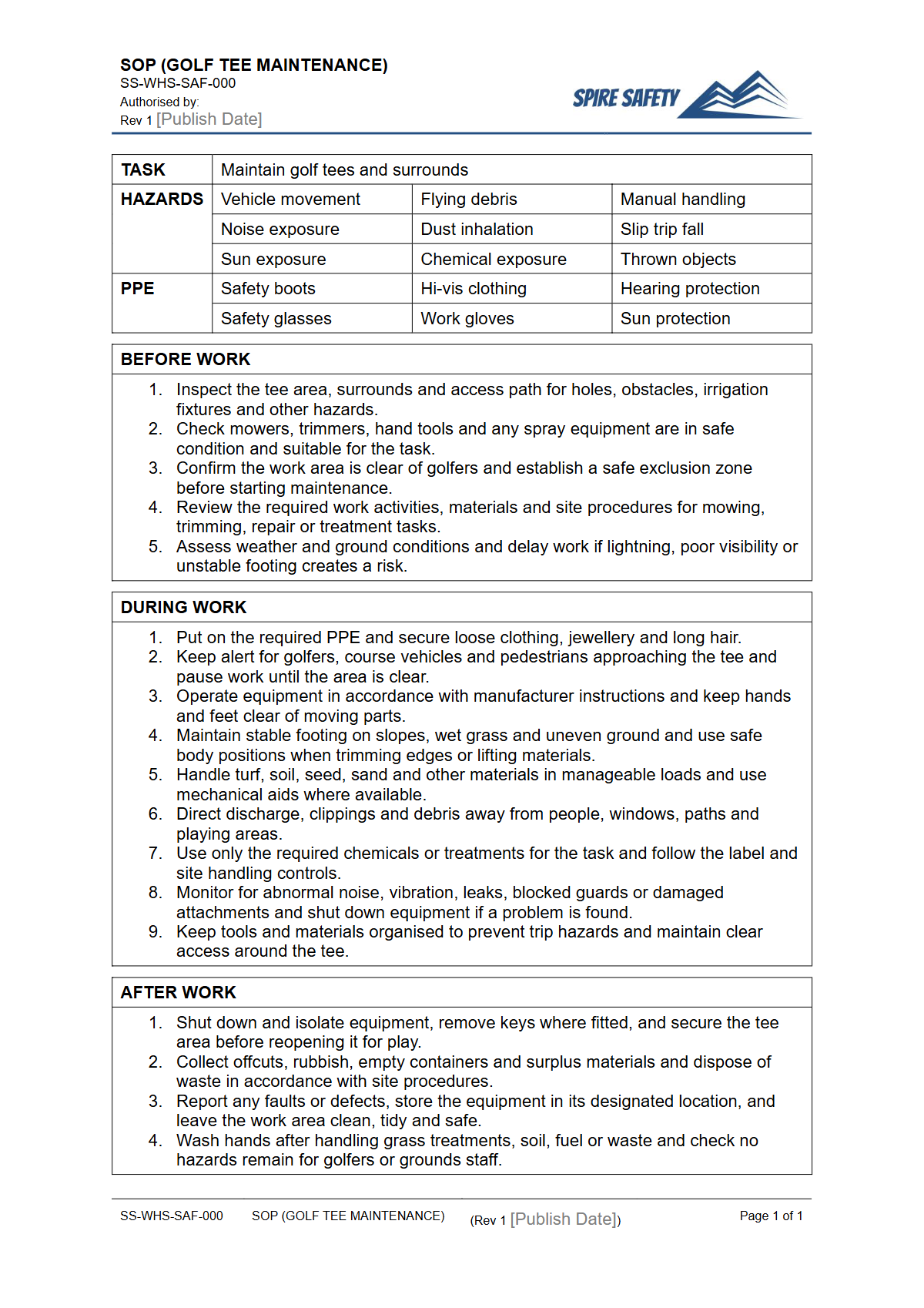
Download our free Safe Operating Procedure (Golf Tee Maintenance) template.
Free Safe Operating Procedure (Golf Tee Maintenance) Template
DOCX • 126 KB + PDF
Updated Oct 2026
No signup required
Purpose of the Free Safe Operating Procedure (Golf Tee Maintenance) Template
Maintaining a golf course to a high standard involves many routine tasks, including the maintenance of teeing grounds. While it may seem like a simple job, it carries inherent risks such as manual handling injuries, exposure to the elements, and hazards from maintenance equipment.
This Free Safe Operating Procedure (Golf Tee Maintenance) Template provides a structured framework for documenting a safe system of work for this specific task. Using an SOP helps standardise procedures, ensuring that every worker performs the task in the safest, most efficient way possible.
Formalising your process is a fundamental part of demonstrating due diligence and is a critical component of any effective WHS management system. A documented procedure clearly outlines the identified hazards, risk controls, and required personal protective equipment (PPE), reducing the likelihood of incidents and injuries on your course.
Video walkthrough
How to use the Free Safe Operating Procedure (Golf Tee Maintenance) Template
This document is a downloadable template in both DOCX and PDF formats, designed to be a starting point. To use it effectively, you must adapt it to the specific circumstances of your workplace.
This involves conducting a site-specific risk assessment for the task of maintaining golf tees, considering your unique course layout, the specific tools used (e.g., divot repair tools, ball washers, rubbish collection equipment), and environmental conditions.
Important: This is a template only. We have provided a solid foundation based on Australian WHS principles, but you must customise this Safe Operating Procedure to reflect the actual hazards and control measures relevant to your specific worksite, machinery, and processes.
It is not a complete, out-of-the-box solution. If you're documenting procedures for larger equipment, you can refer to other examples like our free Trencher SOP template to see how different hazards are managed.
When to use a Golf Tee Maintenance SOP
A Safe Operating Procedure for this task should be used in several key situations. It is an essential tool for inducting and training new groundskeepers, providing them with clear, step-by-step instructions from day one.
It also serves as a valuable refresher for experienced staff to reinforce correct and safe work practices.
The SOP should be readily accessible in the maintenance shed or on a mobile device for workers to review before they begin their duties. Furthermore, it becomes a critical reference document during safety audits or after an incident or near-miss, helping to identify any gaps in the prescribed procedure. Regularly reviewing and updating your SOPs is a key activity verified during a WHS compliance audit.
Who should use this SOP
This Safe Operating Procedure is intended for use by all personnel involved in the maintenance of golf course teeing areas. This includes:
- Groundskeepers and greenkeepers
- Course maintenance supervisors
- Golf course superintendents or managers
- WHS officers and representatives
By ensuring everyone follows the same documented procedure, you create a consistent and predictable safety standard across the entire team. This reduces confusion and the likelihood of workers adopting unsafe shortcuts.
The principles applied here are similar to those in other routine but hazardous tasks, such as those covered in our Step Ladder SOP, where simple tasks can lead to serious injury if not performed correctly.
Integrating with Other Safety Documents
An SOP for a specific task should not exist in isolation. It should be integrated with broader safety documents such as your overall risk register, chemical safety data sheets (if cleaning agents are used), and equipment manuals.
It complements other task-specific procedures, like our free Grain Drill SOP, to build a comprehensive safety framework for all grounds and maintenance operations. This creates a holistic approach to managing health and safety across the entire workplace.
By downloading this template, you're taking a positive step toward improving workplace safety. Explore our complete free WHS resources library for more templates and tools to support your safety management system.
Common mistakes
Common mistakes to avoid
- Using the template without customising it with a site-specific risk assessment.
- Forgetting to include clear requirements for PPE, such as gloves, safety glasses, and sun protection (hat, sunscreen).
- Failing to train all relevant workers on the contents and application of the finalised SOP.
- Not keeping the document in a location where workers can easily access it for reference.
Legal references
Legal considerations
The following legal requirements may be relevant to this type of work.
- Work Health and Safety Act (Harmonised) — Provides the primary duties for protecting workers and other people from work health and safety risks.
- Work Health and Safety Regulations (Harmonised) — Sets out requirements supporting the management of workplace hazards and risks.
The following codes may be relevant to this type of work.
- Managing WHS Risks Code of Practice — Provides practical guidance on identifying hazards, assessing risks and applying effective controls.
- Work Health and Safety Consultation, Cooperation and Coordination Code of Practice — Provides practical guidance on consulting workers and coordinating with other duty holders.
- Managing the Work Environment and Facilities Code of Practice — Provides practical guidance on safe work environments, workplace facilities and related controls.
Did you know
Ergonomic Risk
Repetitive bending and twisting while collecting broken tees or repairing divots can contribute to musculoskeletal disorders. Job rotation and proper manual handling techniques are crucial ergonomic controls.
Duty of Care
Under Australian WHS laws, a golf club (as a PCBU) has a primary duty of care to ensure worker safety. Providing safe systems of work, such as a well-developed SOP, is a key part of fulfilling this duty.
FAQ
Frequently asked questions
01What hazards are involved in golf tee maintenance?
02Is a Safe Operating Procedure legally required for this task in Australia?
03How often should we review our Golf Tee Maintenance SOP?
04Can I use this template for other golf course maintenance tasks?
Share this resource
Free Safe Operating Procedure (Golf Tee Maintenance) Template
Browse Categories
How To Use It
- 1Download and open in Word or PDF.
- 2Replace the placeholders with your business details.
- 3Get it reviewed by a WHS specialist before rollout.
Need it customised?
Our WHS consultants can adapt this template to your site, run a gap analysis, or audit what you already have in place.
Book a Free Consultation WHS consulting servicesor call 1300 156 382
Related templates
- Free Safe Operating Procedure (Goods Lift) Template
- Free Safe Operating Procedure (Goods Receipt Check) Template
- Free Safe Operating Procedure (Grab Rail Cleaning) Template
- Free Safe Operating Procedure (Grade Laser) Template
- Free Safe Operating Procedure (Graffiti Paint Touchup) Template
- Free Safe Operating Procedure (Graffiti Removal) Template