
Free Safe Operating Procedure (Golf Green Repair) Template
Download our free Safe Operating Procedure (Golf Green Repair) Template to document safety controls for groundskeeping tasks. Customise your DOCX or PDF now.
Free Safe Operating Procedure (Golf Green Repair) Template
DOCX • 126 KB + PDF
Updated Oct 2026
No signup required
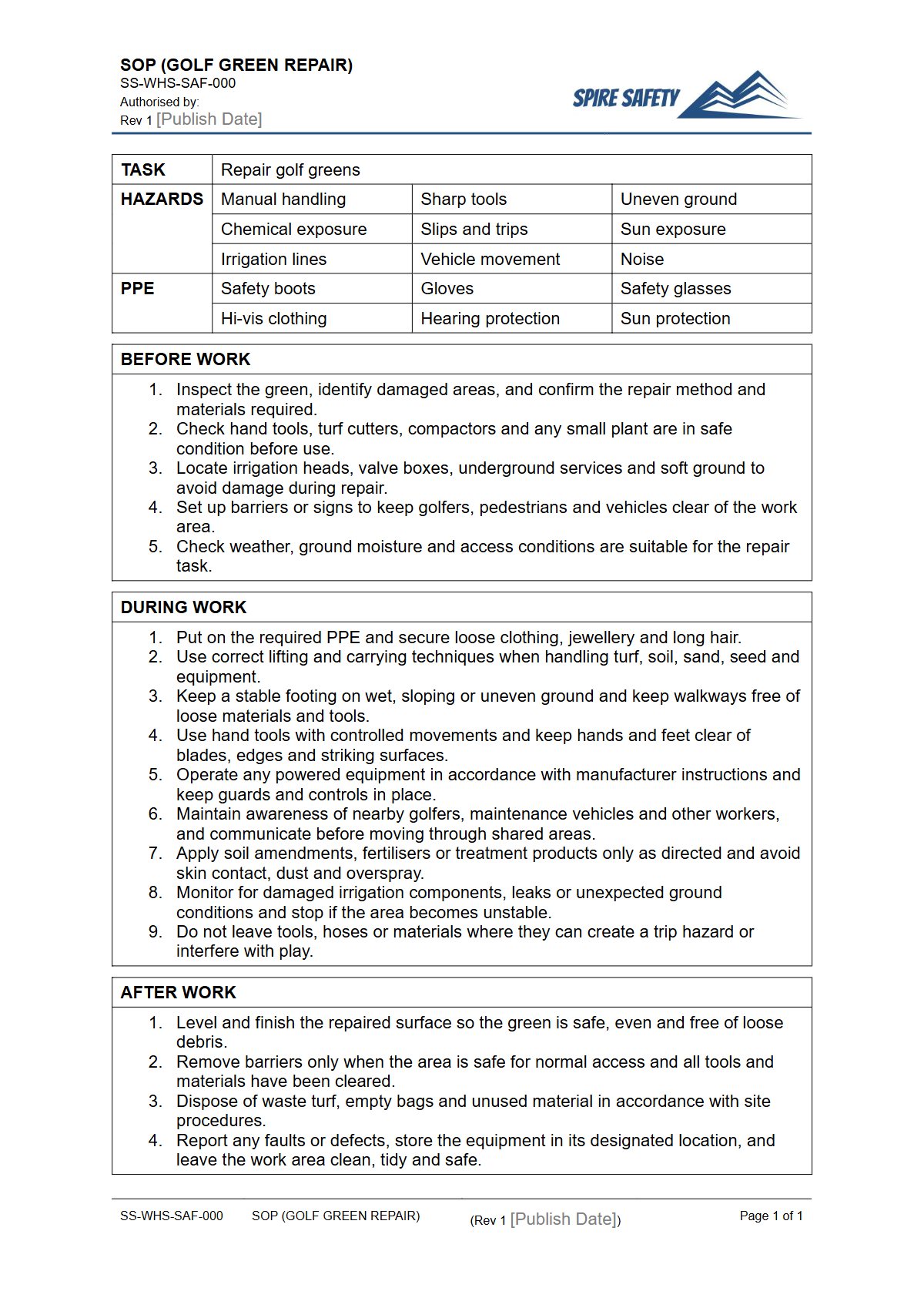
Purpose of the Free Safe Operating Procedure (Golf Green Repair) Template
Maintaining pristine golf greens requires specific tasks, tools, and materials. This Safe Operating Procedure for golf green repair provides a structured framework for documenting the safest way to perform this work.
By outlining potential hazards and clear control measures, it helps your business meet its duty of care and protect workers from injury. This document is a critical component for managing risks associated with manual handling, tool operation, and chemical use common in turf management.
A well-developed SOP demonstrates a commitment to operational safety and is a key element in a holistic safety framework. Integrating this procedure into your operations supports the development of robust WHS management systems, ensuring safety practices are consistent and verifiable across your team.
Video walkthrough
How to use the Free Safe Operating Procedure (Golf Green Repair) Template
This template is designed as a starting point. After downloading the DOCX or PDF file, you must adapt it to the specific context of your golf course.
This involves consulting with your groundskeeping team to accurately detail the tools, equipment (e.g., aerators, scarifiers), chemicals (e.g., fungicides, fertilisers), and unique environmental conditions at your site. A generic procedure is not effective; customisation is essential for managing your actual risks.
Important: We have developed this resource as a guide, not as a finished document. You must review, edit, and customise this template to align with your specific machinery, chemicals, processes, and risk profile.
This ensures the final SOP is a practical and relevant tool for your workers.
When should a Safe Operating Procedure be used?
An SOP for golf green repair should be a central part of your daily operations. It is not a document to be filed away and forgotten.
It should be used for training and inducting new groundskeepers, providing a clear, step-by-step guide to performing tasks safely. It also serves as a valuable pre-work reference for experienced staff, especially before undertaking non-routine or complex repairs.
Regular toolbox talks can reference the SOP to reinforce key safety points.
For tasks involving larger machinery during course modifications, such as installing new irrigation, consulting a specific trencher SOP is also necessary to manage associated high-risk activities.
Who should use this document?
This Safe Operating Procedure is intended for all personnel involved in turf management and maintenance. This includes golf course superintendents, greenkeepers, grounds crew, and maintenance staff.
WHS managers and coordinators will also find it essential for implementing and monitoring safety protocols. The document should be easily accessible to workers at the point of work, empowering them to follow agreed-upon safety measures and raise concerns if procedures cannot be followed.
Regular checks to ensure procedures are being followed correctly are a core part of safety management. These checks can be formalised through internal or third-party WHS compliance auditing to verify that documented controls are effective in practice.
Key Hazards in Golf Green Repair
Your customised SOP should address the specific hazards at your workplace, which may include:
- Manual Tasks: Injuries from lifting rolls of turf, carrying bags of sand or seed, bending or kneeling for extended periods, and using hand tools.
- Plant and Equipment: Risks associated with walk-behind aerators, motorised scarifiers, top dressers, and other equipment. This includes entanglement, noise, and vibration hazards.
- Chemicals: Exposure to fertilisers, pesticides, and fungicides through inhalation, skin contact, or ingestion. Your SOP must reference the Safety Data Sheet (SDS) for each chemical used.
- Environmental: Slips, trips, and falls on wet or uneven ground, heat stress from working outdoors, UV radiation exposure, and bites or stings from insects or snakes.
Safe equipment maintenance is also crucial. When cleaning turf management tools, processes must account for hazards from pressurised air.
Referencing an air compressor SOP can help establish safe procedures for tool clean-down stations.
For broader course maintenance that involves moving heavy materials like pallets of fertiliser or sand, you should also have procedures in place for relevant machinery. A telehandler SOP provides a framework for the safe operation of this versatile plant.
Spire Safety offers a wide range of templates and guides to support your WHS obligations. You can explore our entire free WHS resources library to find more documents to help you build a safer workplace.
Common mistakes
Common mistakes to avoid
- Failing to customise the template with site-specific equipment, turf types, and chemicals.
- Not involving experienced groundskeepers in the drafting and review process.
- Treating the SOP as a one-time compliance document instead of a live tool for training.
- Storing the SOP in an office, making it inaccessible to workers at the point of use on the course.
Legal references
Legal considerations
The following legal requirements may be relevant to this type of work.
- Work Health and Safety Act (Harmonised) — Provides the primary duties for protecting workers and other people from work health and safety risks.
- Work Health and Safety Regulations (Harmonised) — Sets out requirements supporting the management of workplace hazards and risks.
The following codes may be relevant to this type of work.
- Managing WHS Risks Code of Practice — Provides practical guidance on identifying hazards, assessing risks and applying effective controls.
- Work Health and Safety Consultation, Cooperation and Coordination Code of Practice — Provides practical guidance on consulting workers and coordinating with other duty holders.
- Managing the Work Environment and Facilities Code of Practice — Provides practical guidance on safe work environments, workplace facilities and related controls.
Did you know
Manual Task Risk
Hazardous manual tasks are a leading cause of workplace injuries in Australia. In groundskeeping, tasks like lifting turf, bending to plug greens, and dragging equipment contribute significantly to this risk, making a clear SOP vital.
A Chemical Record
WHS Regulations require a workplace to maintain a register of all hazardous chemicals used on site. Your SOP for green repair should align with this register, ensuring workers know exactly what they're using and its associated risks.
FAQ
Frequently asked questions
01What is the difference between a SWMS and an SOP for golf green repair?
02How often should our Golf Green Repair SOP be reviewed?
03Does this SOP template cover the use of specific pesticides or fungicides?
04Can I use this Safe Operating Procedure for training new groundskeepers?
Share this resource
Free Safe Operating Procedure (Golf Green Repair) Template
Browse Categories
How To Use It
- 1Download and open in Word or PDF.
- 2Replace the placeholders with your business details.
- 3Get it reviewed by a WHS specialist before rollout.
Need it customised?
Our WHS consultants can adapt this template to your site, run a gap analysis, or audit what you already have in place.
Book a Free Consultation WHS consulting servicesor call 1300 156 382
Related templates
- Free Safe Operating Procedure (Golf Tee Maintenance) Template
- Free Safe Operating Procedure (Goods Lift) Template
- Free Safe Operating Procedure (Goods Receipt Check) Template
- Free Safe Operating Procedure (Grab Rail Cleaning) Template
- Free Safe Operating Procedure (Grade Laser) Template
- Free Safe Operating Procedure (Graffiti Paint Touchup) Template