
Free Safe Operating Procedure (Goal Post Inspection) Template
Download a free Safe Operating Procedure (SOP) template for goal post inspections.
Free Safe Operating Procedure (Goal Post Inspection) Template
DOCX • 126 KB + PDF
Updated Oct 2026
No signup required
Purpose of the Free Safe Operating Procedure (Goal Post Inspection) Template
Ensuring the structural integrity and stability of sporting goal posts is a critical safety measure for schools, councils, and sports clubs. This Free Safe Operating Procedure (Goal Post Inspection) Template provides a framework to guide your team through the process of inspecting, maintaining, and safely managing goal posts.
By establishing a formal procedure, you can significantly reduce the risk of accidents caused by equipment failure, protecting players and the public alike.
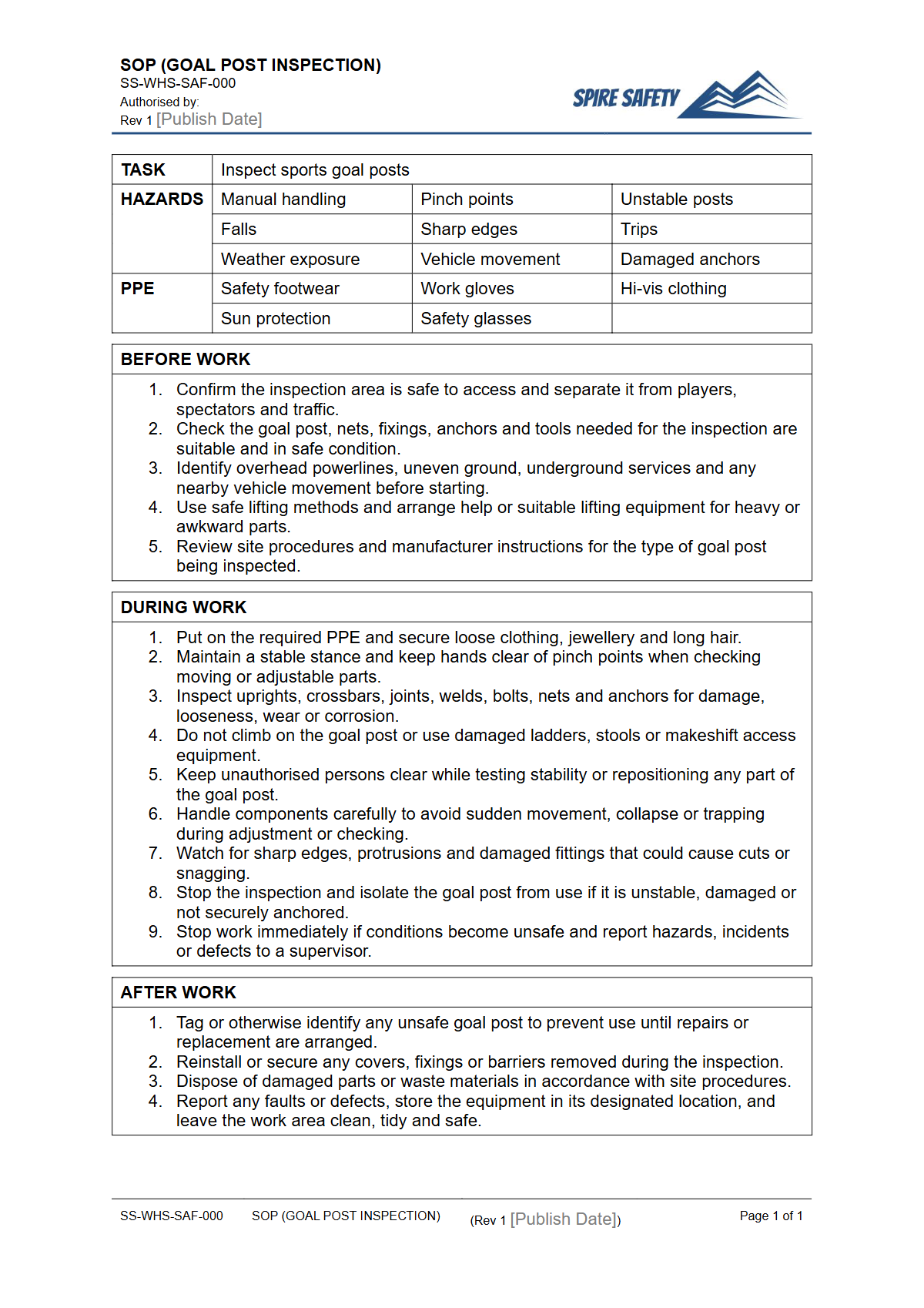
This Safe Operating Procedure (SOP) template is designed to help you create a documented safe system of work. It prompts you to outline potential hazards, specify personal protective equipment (PPE), and detail the step-by-step process for a thorough inspection.
It forms a key part of your overall safety framework, helping to build robust WHS management systems that demonstrate due diligence.
Video walkthrough
How to use the Free Safe Operating Procedure (Goal Post Inspection) Template
This document is provided as a starting point. To use it effectively, you must adapt it to the unique requirements of your facility and the specific types of goal posts in use (e.g., AFL, rugby, soccer; fixed or portable).
After downloading, you should consult with your team—including groundskeepers, maintenance staff, and facility managers—to gather input and ensure the procedure is practical and comprehensive.
To customise the template:
- Add your company name, logo, and relevant site details.
- Identify the specific makes and models of goal posts covered by the SOP.
- Review and update the list of potential hazards to reflect your environment, considering factors like ground condition, weather exposure, and public access.
- Detail the inspection checklist, including checks for rust, corrosion, weld integrity, loose fittings, anchor stability, and net condition.
- Clearly define the actions to be taken if a defect is found, including isolation, reporting, and repair procedures.
- For example, if repairs require working at a small height, the process must align with procedures like those in our free Step Ladder SOP Template.
Important: This template is a starting point. It is essential that you customise this document to reflect the specific hazards, equipment, and operational context of your workplace.
We recommend detailed consultation with your workers during this process to ensure the final SOP is effective and understood by all.
When to conduct inspections
A consistent inspection schedule is key to maintaining safety. This SOP should be used as part of a regular maintenance program. Key times to conduct an inspection include:
- Before the start of each sporting season.
- On a scheduled basis during the season (e.g., weekly or monthly visual checks, with more detailed checks quarterly).
- After any severe weather event, such as high winds or storms.
- Following any reported incident, near miss, or concern raised about the equipment's stability.
Adherence to this schedule and the documented outcomes are often reviewed during a formal WHS compliance auditing process to verify safety compliance.
Who should use this Safe Operating Procedure
This SOP is intended for any person responsible for the maintenance and safety of sporting facilities. This includes, but is not limited to:
- Groundskeepers and maintenance personnel.
- Facility or operations managers.
- School principals and business managers.
- Sports club committee members and designated volunteers.
- Council workers responsible for public parks and reserves.
Ultimately, the Person Conducting a Business or Undertaking (PCBU) is responsible for ensuring that a safe system of work is in place for all plant and structures, including goal posts. While this SOP covers goal posts, your facility likely has other equipment and tasks requiring formal procedures; you can explore our full free WHS resources library for more templates.
Common mistakes
Common mistakes to avoid
- Only inspecting the goal posts at the start of the season and not throughout.
- Failing to document inspections, leaving no record of due diligence or actions taken.
- Using unqualified or untrained personnel to conduct and sign off on inspections.
- Ignoring minor issues like surface rust or loose fittings, which can escalate into major structural failures.
Legal references
Legal considerations
The following legal requirements may be relevant to this type of work.
- Work Health and Safety Act (Harmonised) — Provides the primary duties for protecting workers and other people from work health and safety risks.
- Work Health and Safety Regulations (Harmonised) — Sets out requirements supporting the management of workplace hazards and risks.
The following codes may be relevant to this type of work.
- Managing WHS Risks Code of Practice — Provides practical guidance on identifying hazards, assessing risks and applying effective controls.
- Work Health and Safety Consultation, Cooperation and Coordination Code of Practice — Provides practical guidance on consulting workers and coordinating with other duty holders.
- Managing the Work Environment and Facilities Code of Practice — Provides practical guidance on safe work environments, workplace facilities and related controls.
Did you know
Australian Standard Guidance
While there is no single mandatory Australian Standard for all goal posts, AS 4866.1-2007 provides guidance for playing field equipment, including soccer goals, which can be adapted for other types.
Tragic Consequences
Accidents involving falling or collapsing goal posts have led to serious injuries and fatalities worldwide, highlighting the critical importance of regular and thorough safety inspections.
FAQ
Frequently asked questions
01Are portable goal posts safer than fixed ones?
02How often should goal posts be inspected?
03What is a PCBU's responsibility for goal post safety?
04Can volunteers perform goal post inspections?
Share this resource
Free Safe Operating Procedure (Goal Post Inspection) Template
Browse Categories
How To Use It
- 1Download and open in Word or PDF.
- 2Replace the placeholders with your business details.
- 3Get it reviewed by a WHS specialist before rollout.
Need it customised?
Our WHS consultants can adapt this template to your site, run a gap analysis, or audit what you already have in place.
Book a Free Consultation WHS consulting servicesor call 1300 156 382
Related templates
- Free Safe Operating Procedure (Golf Bunker Raking) Template
- Free Safe Operating Procedure (Golf Green Repair) Template
- Free Safe Operating Procedure (Golf Tee Maintenance) Template
- Free Safe Operating Procedure (Goods Lift) Template
- Free Safe Operating Procedure (Goods Receipt Check) Template
- Free Safe Operating Procedure (Grab Rail Cleaning) Template