
Free Safe Operating Procedure (Glass Polisher) Template
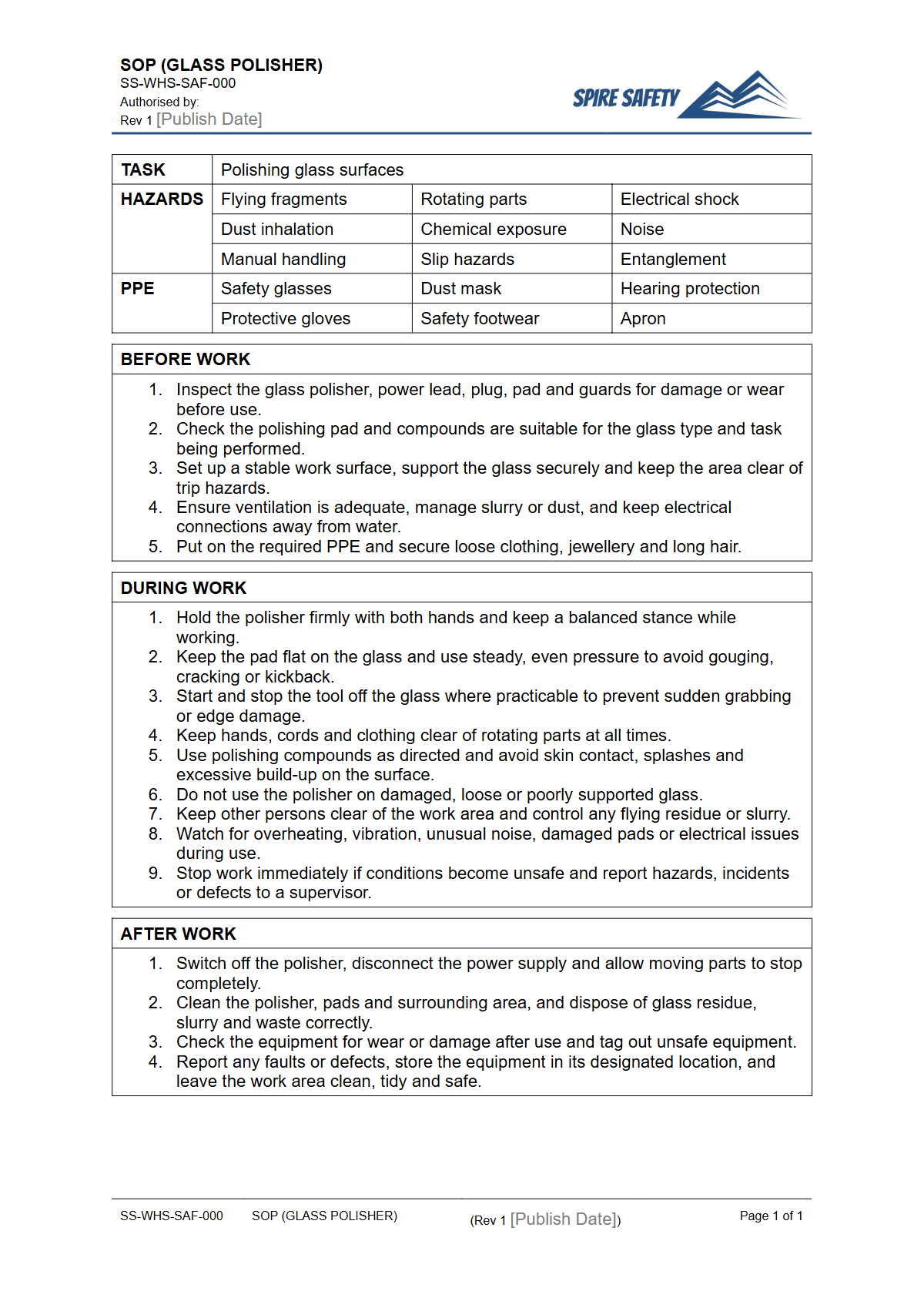
Download our free Safe Operating Procedure (Glass Polisher) template. This DOCX and PDF resource helps you outline safe work methods for glass polishing.
Free Safe Operating Procedure (Glass Polisher) Template
DOCX • 126 KB + PDF
Updated Oct 2026
No signup required
Purpose of the Free Safe Operating Procedure (Glass Polisher) Template
Operating a glass polisher requires precision and a strong focus on safety. To help manage the associated risks, Spire Safety offers this free Safe Operating Procedure (Glass Polisher) template.
This document provides a structured framework for outlining the step-by-step process for safely using glass polishing equipment in your workplace, helping you meet your duty of care obligations.
The primary purpose of this Safe Operating Procedure (Glass Polisher) template is to provide a clear, documented process that minimises the risk of injury to operators and others in the vicinity. A well-drafted SOP identifies potential hazards, specifies necessary personal protective equipment (PPE), and details safe operational steps from pre-start checks to shutdown.
By formalising these procedures, you create a consistent safety standard for all users, reduce the likelihood of incidents, and provide a valuable tool for training and competency assessments. It serves as a critical component of your overall risk management strategy for plant and equipment, similar to procedures for other workshop machinery detailed in documents like a plasma cutter SOP.
Video walkthrough
How to use the Safe Operating Procedure (Glass Polisher) Template
To get the most value from this resource, you must adapt it to the specific context of your workplace. Download the template in DOCX format and customise it to reflect your particular model of glass polisher, the materials being worked on, and your unique site conditions and hazards.
Important Customisation Note
We have drafted this document as a comprehensive starting point aligned with Australian WHS principles. However, it is not a complete, out-of-the-box solution.
You must consult with your workers and other relevant stakeholders to ensure the final SOP is practical, relevant, and effectively controls all identified risks for your specific operations. A customised SOP is a key element in developing robust WHS management systems.
When to use this Safe Operating Procedure
A glass polisher SOP should be developed before the equipment is first used in the workplace and must be readily accessible to all operators. The SOP should be a central part of operator training, induction, and refresher courses.
It is also a key reference document during incident investigations or when planning non-routine tasks involving the polisher. Regular reviews are essential; the SOP should be updated whenever there is a change to the equipment, the process, or the work environment, or following a formal review process as part of your WHS compliance auditing schedule.
Who should use it
This Safe Operating Procedure is intended for use by several groups within an organisation.
- Operators: To understand and follow the safe work method each time they use the glass polisher.
- Supervisors and Managers: To enforce safe work practices, conduct training, and monitor compliance.
- WHS Personnel: To integrate the procedure into the broader safety management system and use it as a basis for risk assessments and audits.
Everyone involved in the operation or supervision of glass polishing activities must be familiar with the contents of the finalised procedure. Its effectiveness depends on consistent application by trained and competent personnel, just as it would for equipment covered by an air compressor SOP.
Key Elements Covered in the Template
This template provides a logical structure to guide your documentation process, covering critical safety areas. It includes sections for:
- Hazard Identification: Prompts to list potential hazards like cuts from broken glass, electrical shock, ergonomic strain, and exposure to polishing compounds or dust.
- Risk Control Measures: Space to detail the hierarchy of controls implemented to mitigate identified risks.
- Personal Protective Equipment (PPE): A checklist for required PPE, such as safety glasses, face shields, cut-resistant gloves, and respiratory protection.
- Pre-operational Checks: A sequence of checks to perform before starting work, including inspecting pads, guards, and electrical cords.
- Step-by-Step Operating Procedure: A detailed guide for the entire task, from setup to operation and cleaning. This can also cover related tasks like accessing components using equipment covered in a step ladder SOP.
- Emergency Procedures: Instructions for emergency shutdown, first aid response, and reporting incidents.
Further Resources and Next Steps
Implementing a single SOP is a great step, but it is most effective as part of a comprehensive safety framework. After customising this template, ensure it is communicated to all relevant staff through training and toolbox talks.
Consider what other high-risk tasks or equipment in your workplace require similar documented procedures, such as those detailed in our circular saw SOP. You can browse our extensive free WHS resources library for more templates and checklists to support your safety management efforts.
Common mistakes
Common mistakes to avoid
- Using a generic template without customising it for the specific machine and workplace hazards.
- Failing to specify the correct type of PPE, especially cut-resistant gloves and appropriate eye/face protection.
- Neglecting to include clear instructions for emergency shutdown procedures and first aid for common injuries.
- Not providing practical training to workers on the finalised SOP before they operate the equipment.
Legal references
Legal considerations
The following legal requirements may be relevant to this type of work.
- Work Health and Safety Act (Harmonised) — Provides the primary duties for protecting workers and other people from work health and safety risks.
- Work Health and Safety Regulations (Harmonised) — Sets out requirements supporting the management of workplace hazards and risks.
The following codes may be relevant to this type of work.
- Managing WHS Risks Code of Practice — Provides practical guidance on identifying hazards, assessing risks and applying effective controls.
- Work Health and Safety Consultation, Cooperation and Coordination Code of Practice — Provides practical guidance on consulting workers and coordinating with other duty holders.
- Managing the Work Environment and Facilities Code of Practice — Provides practical guidance on safe work environments, workplace facilities and related controls.
Did you know
Silica Risk
Polishing glass can release fine crystalline silica dust, a hazardous substance that can cause silicosis, a serious lung disease. Effective dust control and respiratory protection are critical.
Water as a Coolant
Most glass polishing processes use water not only to cool the glass and prevent it from cracking due to friction heat but also to help suppress hazardous dust.
FAQ
Frequently asked questions
01What should be included in a glass polisher SOP?
02How often should a Safe Operating Procedure for a glass polisher be reviewed?
03Is a glass polisher SOP a legal requirement in Australia?
04Who is responsible for writing a glass polisher SOP?
Share this resource
Free Safe Operating Procedure (Glass Polisher) Template
Browse Categories
How To Use It
- 1Download and open in Word or PDF.
- 2Replace the placeholders with your business details.
- 3Get it reviewed by a WHS specialist before rollout.
Need it customised?
Our WHS consultants can adapt this template to your site, run a gap analysis, or audit what you already have in place.
Book a Free Consultation WHS consulting servicesor call 1300 156 382
Related templates
- Free Safe Operating Procedure (Glass Rack Handling) Template
- Free Safe Operating Procedure (Glassware Handling) Template
- Free Safe Operating Procedure (Glassware Washing) Template
- Free Safe Operating Procedure (Glasswasher Cleaning) Template
- Free Safe Operating Procedure (GNSS Rover) Template
- Free Safe Operating Procedure (Goal Post Inspection) Template