
Free Safe Operating Procedure (Glassware Handling) Template
Download our free Safe Operating Procedure (Glassware Handling) template.
Free Safe Operating Procedure (Glassware Handling) Template
DOCX • 126 KB + PDF
Updated Oct 2026
No signup required
Purpose of the Free Safe Operating Procedure (Glassware Handling) Template
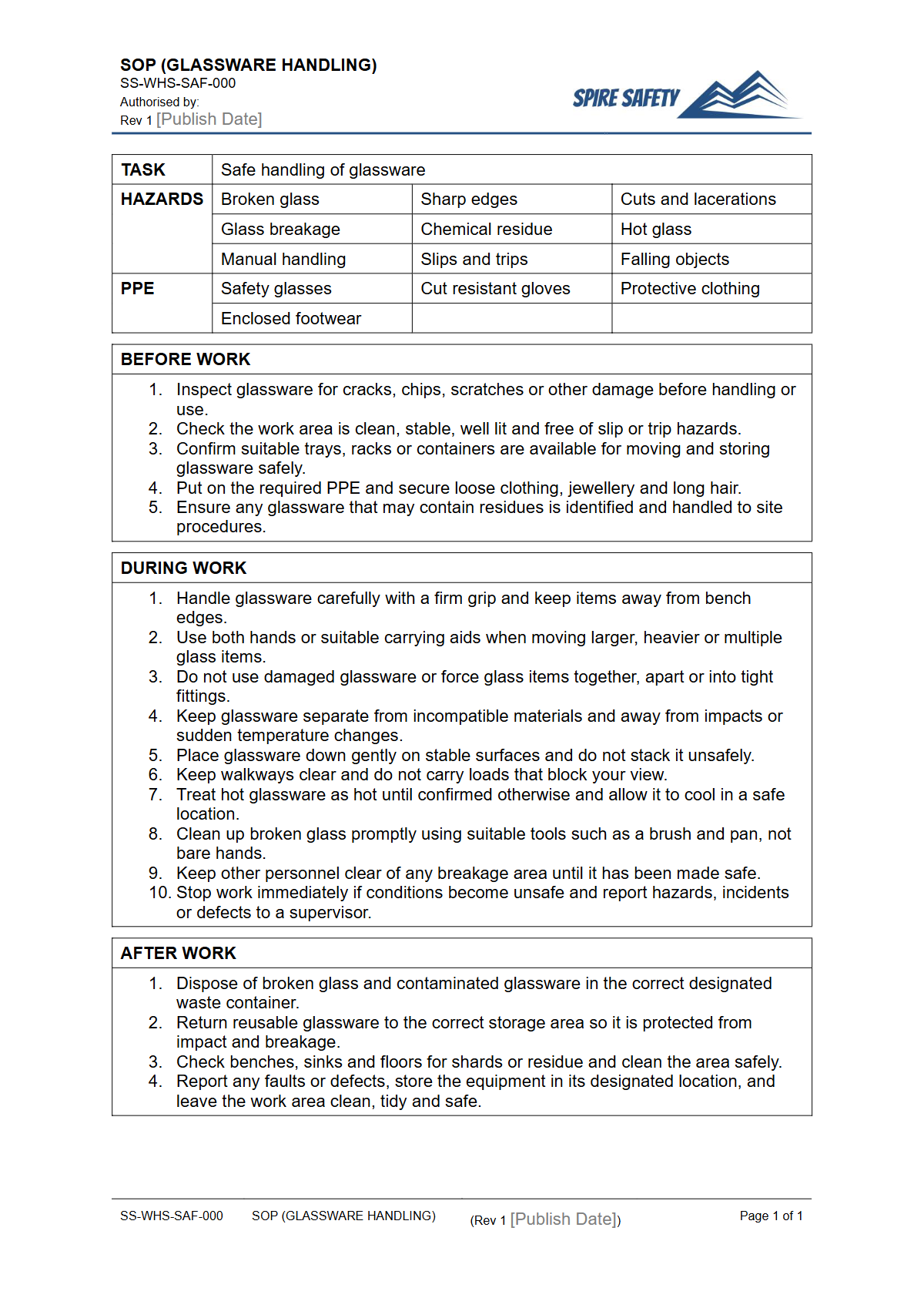
Handling glassware, whether in a laboratory, kitchen, or bar, presents significant yet often underestimated risks. This free Safe Operating Procedure (Glassware Handling) Template provides a structured framework for documenting the specific hazards and control measures associated with these tasks.
Its primary purpose is to establish a clear, repeatable process that minimises the risk of injury, such as cuts and punctures from broken glass, or exposure to hazardous substances. By standardising procedures for inspection, handling, cleaning, and disposal, this SOP helps organisations fulfil their duty of care and promote a safer working environment for all personnel.
A well-documented procedure is a cornerstone of operational safety, whether for complex machinery or for seemingly simple tasks. It ensures that every worker understands the expected safe work method.
This principle applies equally to using heavy equipment and to everyday tasks like using common workplace items, where a Safe Operating Procedure for a step ladder can prevent serious fall injuries.
Video walkthrough
How to use the Free Safe Operating Procedure (Glassware Handling) Template
This document is a template, not a finished procedure. To be effective, it must be adapted to the specific context of your workplace.
Download the DOCX file and consult with workers and supervisors who handle glassware daily to fill in the details relevant to your operations. The template prompts you to define key elements such as the required Personal Protective Equipment (PPE), pre-use inspection checks, step-by-step instructions for safe handling during tasks, cleaning protocols, and procedures for dealing with breakages and emergencies.
Remember to include details about the specific types of glassware used and any chemical or biological hazards involved.
Integrating this SOP into your broader safety framework is crucial for its success. A standalone document is less effective than one that is part of a holistic system.
Developing and maintaining effective WHS management systems ensures that procedures like this are consistently implemented, reviewed, and improved upon over time. Once customised, the SOP should be used as a key document for training, inductions, and ongoing competency assessments.
A Note on Customisation
This is a template that provides a starting point. We are not familiar with your specific site, equipment, or operational context.
It is your responsibility to ensure the final document is comprehensive and accurately reflects the specific hazards and control measures necessary for your workplace. We strongly recommend a thorough risk assessment is conducted before finalising and implementing this procedure.
When to use this Safe Operating Procedure
This Safe Operating Procedure should be developed and implemented before any worker is required to handle glassware as part of their job. It is a foundational document for any workplace where glass items are used, including hospitality venues (bars, cafes, restaurants), scientific and medical laboratories, healthcare facilities, and manufacturing plants.
Use it as a central part of your worker induction and training program to ensure new staff are aware of the risks and procedures from day one. The SOP should also be readily accessible in the work area for easy reference and serve as a benchmark during safety observations and WHS compliance audits.
Who should use this Safe Operating Procedure
This SOP is intended for multiple audiences within an organisation. Primarily, workers who directly handle glassware (e.g., lab technicians, kitchen hands, bartenders, nurses) must be trained on and follow the procedure.
Supervisors and managers are responsible for implementing the SOP, ensuring workers are trained, and monitoring compliance. A Person Conducting a Business or Undertaking (PCBU) can use the finalised procedure as evidence of providing a safe system of work.
WHS managers or advisors will use this template as a tool to guide the risk management process and standardise safety documentation across the business. For complex environments, seeking expert WHS consulting can help ensure your procedures are robust and fit for purpose.
Key Elements of an Effective Glassware Handling SOP
A robust SOP for glassware goes beyond simple handling instructions. It should be a comprehensive guide covering the full lifecycle of glassware in the workplace.
Key sections to develop include a detailed risk assessment identifying all potential hazards, from cuts and chemical exposure to thermal shock and ergonomic strains. The PPE section must be specific, detailing not just 'gloves' but the type of glove required (e.g., cut-resistant, chemical-resistant).
Disposal is another critical element; your procedure must clearly differentiate between disposing of intact, contaminated, and broken glassware, specifying the correct bins or sharps containers for each. Finally, a clear emergency response plan for injuries or spills is essential for ensuring a swift and effective reaction.
You can explore our free WHS resources library for other templates that can support your safety system.
Common mistakes
Common mistakes to avoid
- Using incorrect gloves that do not offer adequate cut or chemical protection.
- Disposing of broken glass in general waste bins instead of designated, puncture-proof sharps containers.
- Failing to inspect glassware for chips, cracks, or star fractures before use.
- Carrying too many glass items at once or by the rim, increasing the risk of dropping and breakage.
Legal references
Legal considerations
The following legal requirements may be relevant to this type of work.
- Work Health and Safety Act (Harmonised) — Provides the primary duties for protecting workers and other people from work health and safety risks.
- Work Health and Safety Regulations (Harmonised) — Sets out requirements supporting the management of workplace hazards and risks.
The following codes may be relevant to this type of work.
- Managing WHS Risks Code of Practice — Provides practical guidance on identifying hazards, assessing risks and applying effective controls.
- Work Health and Safety Consultation, Cooperation and Coordination Code of Practice — Provides practical guidance on consulting workers and coordinating with other duty holders.
- Managing the Work Environment and Facilities Code of Practice — Provides practical guidance on safe work environments, workplace facilities and related controls.
Did you know
Sharps Injuries
Lacerations from broken glass are one of the most common and preventable injuries in laboratory and hospitality settings. Proper disposal procedures using designated sharps containers are a critical control measure.
Thermal Shock
Rapid temperature changes can cause glassware, particularly non-borosilicate types, to shatter unexpectedly. This is a significant hazard when washing hot glassware with cold water or autoclaving improperly.
FAQ
Frequently asked questions
01What should be included in an SOP for handling broken glass?
02Is this glassware handling SOP suitable for a science laboratory?
03How often should glassware handling procedures be reviewed?
04What PPE is typically required for handling glassware?
Share this resource
Free Safe Operating Procedure (Glassware Handling) Template
Browse Categories
How To Use It
- 1Download and open in Word or PDF.
- 2Replace the placeholders with your business details.
- 3Get it reviewed by a WHS specialist before rollout.
Need it customised?
Our WHS consultants can adapt this template to your site, run a gap analysis, or audit what you already have in place.
Book a Free Consultation WHS consulting servicesor call 1300 156 382
Related templates
- Free Safe Operating Procedure (Glassware Washing) Template
- Free Safe Operating Procedure (Glasswasher Cleaning) Template
- Free Safe Operating Procedure (GNSS Rover) Template
- Free Safe Operating Procedure (Goal Post Inspection) Template
- Free Safe Operating Procedure (Golf Bunker Raking) Template
- Free Safe Operating Procedure (Golf Green Repair) Template