
Free Safe Operating Procedure (Glass Door Cleaning) Template
Download our free Safe Operating Procedure for glass door cleaning. This DOCX and PDF template helps manage risks like manual handling and chemical use.
Free Safe Operating Procedure (Glass Door Cleaning) Template
DOCX • 126 KB + PDF
Updated Oct 2026
No signup required
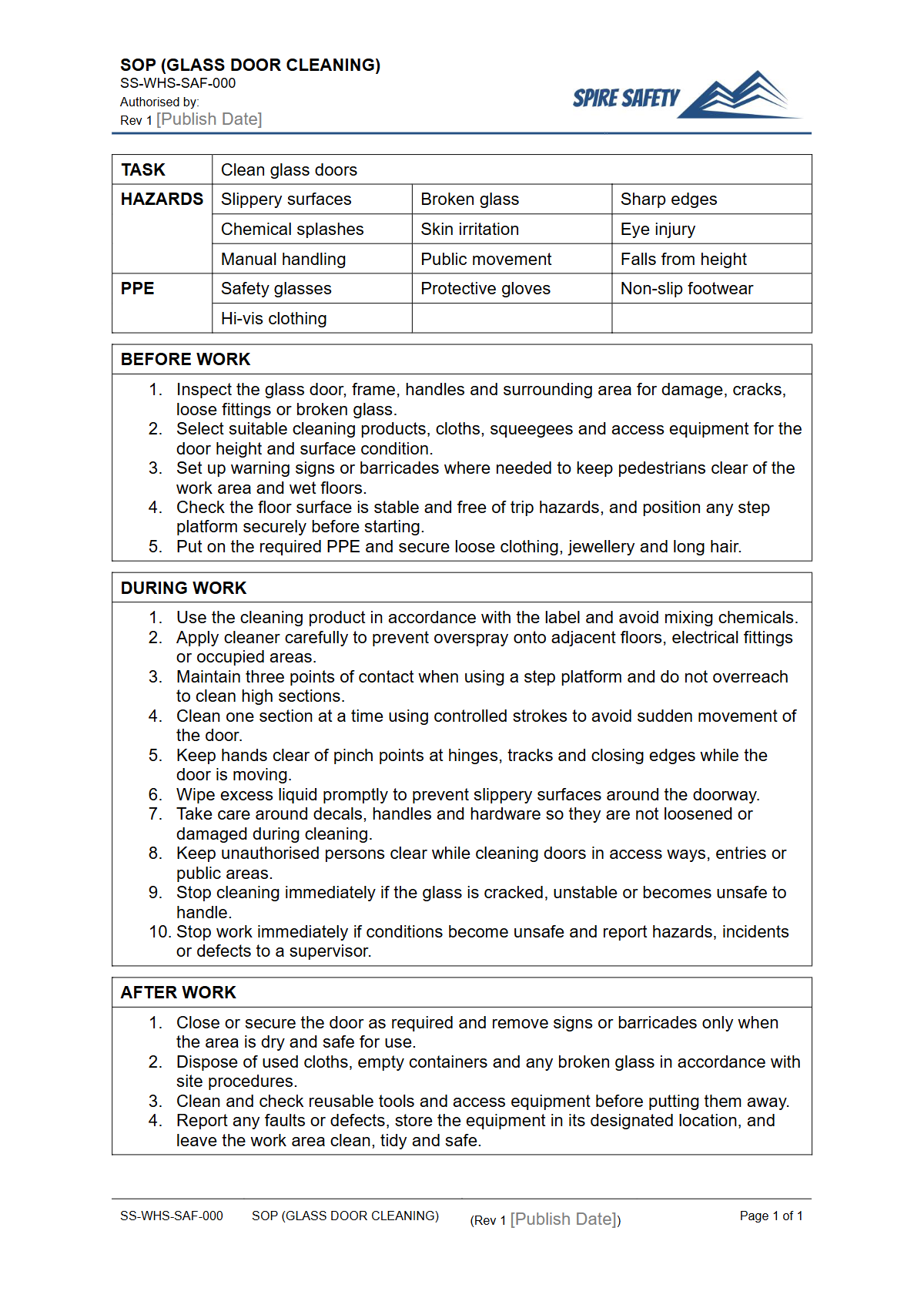
Purpose of the Free Safe Operating Procedure (Glass Door Cleaning) Template
Cleaning glass doors may seem like a straightforward task, but it carries inherent risks that must be managed to ensure worker safety. This Free Safe Operating Procedure (Glass Door Cleaning) Template provides a structured starting point for your organisation to document a safe system of work.
It helps identify hazards such as slips from spills, musculoskeletal strain from awkward postures, exposure to cleaning chemicals, and the potential for cuts from broken glass. Implementing a formal procedure demonstrates a commitment to proactive safety management.
A well-drafted SOP is a key component in minimising workplace incidents. By outlining specific steps, required personal protective equipment (PPE), and emergency responses, you create a clear and repeatable process for workers to follow.
This template is designed based on Australian WHS principles to help you formalise your approach to this common but often overlooked task. For tailored advice on integrating procedures like this into your overall safety framework, consider our expert WHS consulting services.
Video walkthrough
How to use the Free Safe Operating Procedure (Glass Door Cleaning) Template
This document is a template, not a finished product. To be effective, you must customise it to reflect the specific environment, chemicals, equipment, and personnel in your workplace.
Download the DOCX file to edit the content, adding site-specific details, brand guidelines, and internal review processes. The PDF version is provided as a read-only reference.
When customising this Safe Operating Procedure, consult the Safety Data Sheets (SDS) for all cleaning products used. Incorporate information from the SDS regarding required PPE, first aid measures, and spill containment.
It is also crucial to consult with the workers who will be performing the task to ensure the procedure is practical and addresses the real-world challenges they face. A well-designed procedure is a core part of effective WHS management systems, ensuring safety documentation is both comprehensive and user-friendly.
Important Customisation Note
This document has been developed as a general guide. We have not prepared it for your specific needs, and it is your responsibility to ensure it is customised and suitable for your organisation's operations.
You must review and adapt the content to align with your unique risk profile, legal obligations, and operational context before implementation.
When to Use This Safe Operating Procedure
An SOP for cleaning glass doors should be used consistently as part of your standard operational workflow. It is essential for training new employees or contractors, providing them with a clear, step-by-step guide to performing the task safely.
It also serves as a valuable refresher for existing staff and a benchmark for competency. Furthermore, the SOP should be referenced during toolbox talks before commencing cleaning tasks in new or unusual environments.
Procedures like this SOP should also be reviewed as part of any regular WHS compliance auditing program to ensure they remain current and effective. A review is also necessary after any incident or near-miss, or when a new chemical or piece of equipment is introduced.
When cleaning requires reaching above shoulder height, it's crucial to manage the risks of working at heights, even low ones. Our FREE Step Ladder SOP (Safe Operating Procedure) Template provides a detailed framework for this common task.
Who Should Use It
This SOP is intended for use by anyone involved in the task of cleaning glass doors. This includes cleaning staff, maintenance personnel, and facilities managers.
Team leaders and supervisors should use the document to conduct training, assess competency, and supervise work to ensure the established procedures are being followed correctly. WHS managers and coordinators will find the template useful for building a library of risk-control documents that support the organisation's safety objectives.
A robust safety culture involves documenting procedures for all types of equipment and tasks, not just complex machinery. For instance, even common workshop tools require clear instructions, as detailed in our Free Air Compressor SOP (Safe Operating Procedure) Template. By standardising procedures for all tasks, you foster consistent, safe work behaviour across the entire organisation.
Explore our free WHS resources library for more templates to support your safety management system.
Common mistakes
Common mistakes to avoid
- Failing to display 'Wet Floor' signs, creating a slip hazard for others.
- Using incorrect or undiluted cleaning chemicals, which can damage surfaces or increase health risks.
- Over-reaching from the ground or a ladder instead of repositioning, leading to strains or falls.
- Not consulting the Safety Data Sheet (SDS) for a new cleaning product before use.
Legal references
Legal considerations
The following legal requirements may be relevant to this type of work.
- Work Health and Safety Act (Harmonised) — Provides the primary duties for protecting workers and other people from work health and safety risks.
- Work Health and Safety Regulations (Harmonised) — Sets out requirements supporting the management of workplace hazards and risks.
The following codes may be relevant to this type of work.
- Managing WHS Risks Code of Practice — Provides practical guidance on identifying hazards, assessing risks and applying effective controls.
- Work Health and Safety Consultation, Cooperation and Coordination Code of Practice — Provides practical guidance on consulting workers and coordinating with other duty holders.
- Managing the Work Environment and Facilities Code of Practice — Provides practical guidance on safe work environments, workplace facilities and related controls.
Did you know
Slips, Trips, and Falls
According to Safe Work Australia, slips, trips, and falls are the second leading cause of serious workers' compensation claims, with wet or greasy floors being a major contributor.
Ergonomic Risk
Repetitive motions, such as wiping, and awkward postures, like reaching or bending, are leading contributors to musculoskeletal disorders, which account for a significant portion of workplace injuries in Australia.
FAQ
Frequently asked questions
01What PPE is required for cleaning glass doors?
02How do I safely clean high sections of glass doors?
03What should I do if a glass door cracks or shatters during cleaning?
04Is an SOP legally required for a simple task like cleaning glass?
Share this resource
Free Safe Operating Procedure (Glass Door Cleaning) Template
Browse Categories
How To Use It
- 1Download and open in Word or PDF.
- 2Replace the placeholders with your business details.
- 3Get it reviewed by a WHS specialist before rollout.
Need it customised?
Our WHS consultants can adapt this template to your site, run a gap analysis, or audit what you already have in place.
Book a Free Consultation WHS consulting servicesor call 1300 156 382
Related templates
- Free Safe Operating Procedure (Glass Installation) Template
- Free Safe Operating Procedure (Glass Lifter) Template
- Free Safe Operating Procedure (Glass Partition Clean) Template
- Free Safe Operating Procedure (Glass Polisher) Template
- Free Safe Operating Procedure (Glass Rack Handling) Template
- Free Safe Operating Procedure (Glassware Handling) Template