
Free Safe Operating Procedure (Glass Lifter) Template
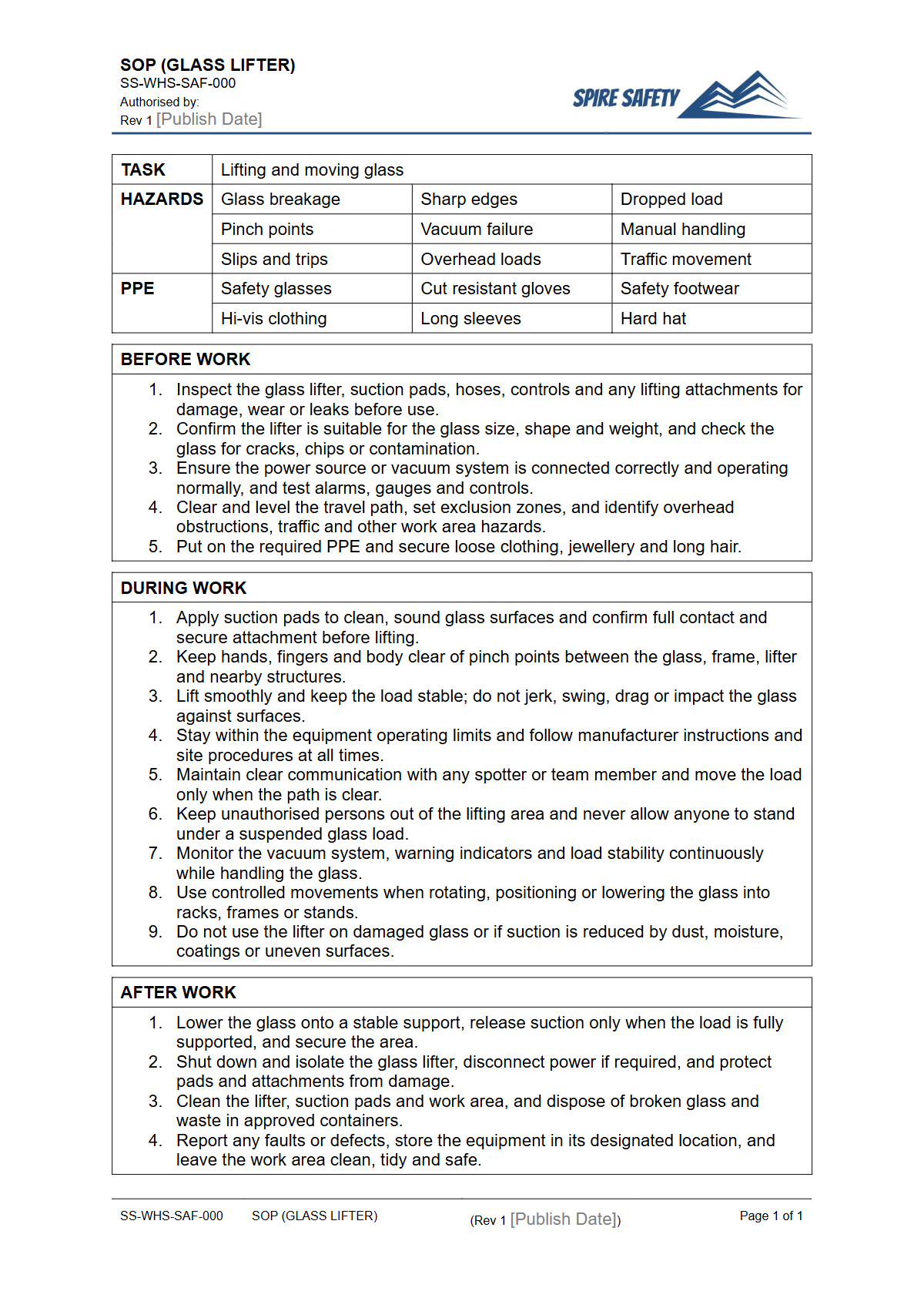
Download our free Safe Operating Procedure (Glass Lifter) Template. This customisable DOCX and PDF resource helps outline safety steps for glass lifter use.
Free Safe Operating Procedure (Glass Lifter) Template
DOCX • 126 KB + PDF
Updated Oct 2026
No signup required
Purpose of the Free Safe Operating Procedure (Glass Lifter) Template
This Free Safe Operating Procedure (Glass Lifter) Template provides a structured framework for documenting the essential safety steps required to operate vacuum or mechanical glass lifters. Using this equipment introduces significant risks, including falling glass panels, crushing injuries, and equipment failure.
A documented Safe Operating Procedure (SOP) is a critical tool for any organisation to manage these hazards effectively. It serves as a foundational document for worker training, competency assessment, and risk management, helping to ensure tasks are performed consistently and safely every time.
By clearly defining pre-operational checks, step-by-step operating instructions, and emergency responses, this SOP helps meet your duty of care under Australian WHS legislation. It forms an integral part of a broader safety framework, demonstrating a commitment to proactive risk control.
Implementing a thorough SOP is a key component of robust WHS management systems, providing clarity for operators and supervisors alike.
Video walkthrough
How to use the Free Safe Operating Procedure (Glass Lifter) Template
This document is a comprehensive starting point, designed to be adapted to your specific operational context. It is not a ready-to-use, document out of the box.
To implement it correctly, you must conduct a site-specific risk assessment and consult with your team.
Important: This resource is a template that we have created to be a starting point. You must customise it to reflect the specific glass lifter models, tasks, environment, and control measures unique to your workplace.
To correctly use this template:
- Download the DOCX file and add your company name, logo, and other relevant details.
- Review each section and modify the content to align with the specific make and model of the glass lifter(s) used on your site.
- In consultation with operators and supervisors, detail the unique hazards and control measures present in your work environment (e.g., uneven ground, overhead power lines, wind conditions).
- Add any site-specific emergency procedures, contact numbers, and communication protocols.
- Have the final document reviewed and approved by a competent person within your organisation.
- Use the finalised SOP as a primary tool for training workers, ensuring they read, understand, and sign off on it before operating the equipment.
- Schedule regular reviews and updates as part of your ongoing safety management processes.
When to use a Safe Operating Procedure
An SOP for a glass lifter should be used as a constant reference point for safe work. It is essential in several key situations, including during the induction of new employees who will operate the machinery and for refresher training for existing staff to prevent complacency.
The document should also be referenced when planning any high-risk lifting operations. For complex lifts, such as those involving a FREE Telehandler SOP Template, both procedures should be consulted together.
Furthermore, this SOP is a vital resource following any incident, near-miss, or equipment malfunction. It provides a baseline against which behaviour and procedures can be audited, helping to identify gaps in your safety system.
Regular reviews prompted by these events ensure the SOP remains relevant and effective. This process of continual improvement can be verified through formal WHS compliance auditing.
Who should use this Safe Operating Procedure
This SOP is intended for several key roles within an organisation to ensure a multi-layered approach to safety.
- Operators: The primary users of the SOP. They must understand and follow the specified procedures for pre-start checks, operation, and shutdown to perform their work safely.
- Supervisors and Line Managers: Responsible for ensuring that operators are trained on the SOP and that its procedures are consistently followed on-site. They use it as a tool for monitoring work and enforcing safety standards.
- WHS Managers and Advisors: Use the SOP as part of the overall risk management framework. They are often responsible for developing, reviewing, and updating the document in line with legislative changes and organisational needs.
- Persons Conducting a Business or Undertaking (PCBUs): The ultimate responsibility lies with the PCBU to provide a safe system of work. A well-implemented SOP is direct evidence of fulfilling this duty.
Using other related procedures, such as a FREE Step Ladder SOP Template for tasks associated with preparing the work area, ensures a holistic approach to safety on site. Having clear procedures for all equipment, no matter how simple, is fundamental to a strong safety culture.
For more guidance, browse our complete free WHS resources library for templates covering a wide range of plant and equipment.
Common mistakes
Common mistakes to avoid
- Failing to inspect suction pads, seals, and vacuum lines for damage or wear before each use.
- Neglecting to clean the glass surface, leading to poor adhesion and potential loss of suction.
- Exceeding the lifter's specified Safe Working Load (SWL) or lifting in adverse weather like high winds.
- Moving the load too quickly or over personnel, creating a significant dropped object risk.
Legal references
Legal considerations
The following legal requirements may be relevant to this type of work.
- Work Health and Safety Act (Harmonised) — Provides the primary duties for protecting workers and other people from work health and safety risks.
- Work Health and Safety Regulations (Harmonised) — Sets out requirements supporting the management of workplace hazards and risks.
The following codes may be relevant to this type of work.
- Managing WHS Risks Code of Practice — Provides practical guidance on identifying hazards, assessing risks and applying effective controls.
- Work Health and Safety Consultation, Cooperation and Coordination Code of Practice — Provides practical guidance on consulting workers and coordinating with other duty holders.
- Managing the Work Environment and Facilities Code of Practice — Provides practical guidance on safe work environments, workplace facilities and related controls.
Did you know
Lifting Power
Modern vacuum glass lifters can handle panels weighing over 2,000kg. The suction is so powerful that a failure in the vacuum seal or a single pad can lead to catastrophic failure of the entire lift.
Tempered Safety
Large glass panels are often made from tempered glass. If this type of glass breaks under stress, it is designed to shatter into thousands of small, blunt-edged pieces, a feature called 'dicing' that significantly reduces the risk of severe lacerations.
FAQ
Frequently asked questions
01What should be included in a Glass Lifter SOP?
02Is a Safe Operating Procedure a legal requirement in Australia?
03How often should a Glass Lifter SOP be reviewed?
04Who is responsible for training workers on the SOP?
Share this resource
Free Safe Operating Procedure (Glass Lifter) Template
Browse Categories
How To Use It
- 1Download and open in Word or PDF.
- 2Replace the placeholders with your business details.
- 3Get it reviewed by a WHS specialist before rollout.
Need it customised?
Our WHS consultants can adapt this template to your site, run a gap analysis, or audit what you already have in place.
Book a Free Consultation WHS consulting servicesor call 1300 156 382
Related templates
- Free Safe Operating Procedure (Glass Partition Clean) Template
- Free Safe Operating Procedure (Glass Polisher) Template
- Free Safe Operating Procedure (Glass Rack Handling) Template
- Free Safe Operating Procedure (Glassware Handling) Template
- Free Safe Operating Procedure (Glassware Washing) Template
- Free Safe Operating Procedure (Glasswasher Cleaning) Template