
Free Safe Operating Procedure (Glass Installation) Template
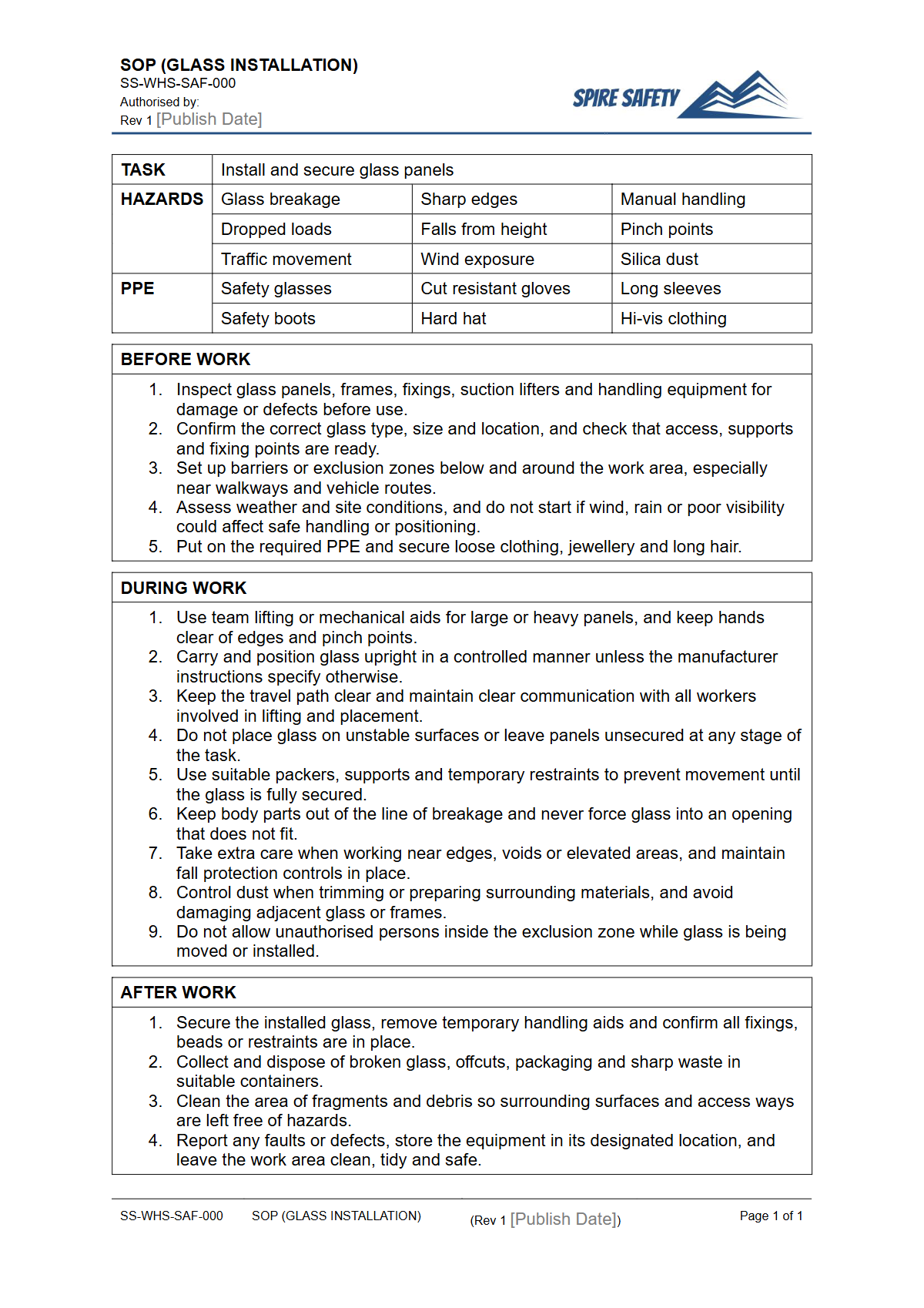
Download our free Safe Operating Procedure (Glass Installation) template. A structured starting point for managing glass handling and installation risks.
Free Safe Operating Procedure (Glass Installation) Template
DOCX • 126 KB + PDF
Updated Oct 2026
No signup required
Purpose of the Free Safe Operating Procedure (Glass Installation) Template
Working with glass presents significant workplace health and safety risks. This free Safe Operating Procedure (Glass Installation) Template provides a structured framework for documenting the specific steps, hazards, and controls required for the safe handling and installation of glass panels.
It's designed to help you formalise your processes and meet your WHS obligations. By systematically addressing risks such as severe lacerations, musculoskeletal injuries from awkward lifts, falls from height, and crushing from falling panels, you create a safer environment for your team and anyone else on site.
Key Hazards in Glass Installation
A comprehensive Safe Operating Procedure for glass installation should address several critical risk areas, including:
- Cuts and Lacerations: The most obvious risk, ranging from minor cuts to life-threatening injuries from broken or sharp-edged glass.
- Manual Handling: Glass panels are often heavy, large, and awkward to manoeuvre. This creates a high risk of musculoskeletal disorders (sprains and strains) affecting the back, shoulders, and arms.
- Falls from Height: Installation frequently requires working on ladders, scaffolds, or elevated work platforms, introducing the risk of falls.
- Falling Objects: Dropped tools or unsecured glass panels can cause serious injury to people below. Setting up exclusion zones is a critical control.
- Weather Conditions: Wind can make large panels act like a sail, making them extremely difficult and dangerous to control. Rain can make surfaces and the glass itself slippery.
Video walkthrough
How to use the Free Safe Operating Procedure (Glass Installation) Template
This document is provided in DOCX format for easy customisation. After downloading, open the template and meticulously work through each section.
You must adapt the content to match the specific types of glass, equipment (like suction cups and dollies), and site conditions your team encounters. Fill in the details of your business, list the relevant personnel, and detail the step-by-step process your workers must follow.
Integrating this SOP is a key step in developing a comprehensive WHS management system for your organisation.
Please note: This is a template document that we have created as a starting point. You must customise it to reflect the specific hazards, equipment, and control measures relevant to your workplace.
Generic, uncustomised procedures are not effective and may not meet your legal duties.
When to use this Safe Operating Procedure
A SOP for glass installation should be an active part of your daily safety management. It should be used to instruct workers before they begin any glass handling or installation task.
It is an essential tool for worker inductions, task-specific training, and regular toolbox talks to reinforce safe practices. The procedure also serves as a critical reference document during the planning phase of a job, helping supervisors and workers complete a pre-start risk assessment and confirm all necessary controls are in place. Its effectiveness should be monitored through regular WHS compliance auditing.
Who should use it
This Safe Operating Procedure should be used by multiple people within an organisation. A Person Conducting a Business or Undertaking (PCBU) is ultimately responsible for ensuring it is created and implemented.
Site managers and supervisors are responsible for training workers on the procedure and ensuring it is followed correctly on site. Health and Safety Representatives (HSRs) can use it as a benchmark for monitoring workplace safety.
Finally, and most importantly, workers performing the glass installation must use the SOP to guide their actions and ensure they are working safely and in accordance with established company procedures. For complex sites or operations, seeking expert WHS consulting advice can help ensure your procedures are robust and effective.
Essential Control Measures
Your customised SOP must detail the specific controls for identified hazards. This includes:
- Personal Protective Equipment (PPE): Specify the required PPE, such as cut-resistant gloves (rated to the appropriate standard), safety glasses or goggles, steel-capped boots, and high-visibility clothing.
- Mechanical Aids: Mandate the use of mechanical lifting aids like vacuum lifters, cranes, or hoists for heavy or large panels to minimise manual handling risks. Consider creating a specific telehandler SOP if this equipment is used to move glass around the site.
- Work at Height Protocols: If installation involves working above ground level, your SOP must reference specific procedures for the equipment being used, whether it is a scaffold, EWP, or ladder. The hierarchy of controls for falls must be applied, and a separate step ladder SOP may be required.
- Training and Competency: Outline the training requirements for all workers involved, including instruction on this specific SOP, manual handling techniques, and the correct use of all equipment and PPE.
By implementing a thorough, site-specific Safe Operating Procedure, you provide clear, actionable guidance that protects your workers and helps build a stronger safety culture. Explore our free WHS resources library for other templates and tools to support your safety management system.
Common mistakes
Common mistakes to avoid
- Using a generic SOP that hasn't been customised for the specific site, glass type, and equipment.
- Failing to use mechanical aids for heavy or large glass panels, leading to high-risk manual handling.
- Selecting inadequate PPE, such as gloves with a low cut-resistance rating.
- Not establishing and enforcing exclusion zones below areas where glass is being installed overhead.
Legal references
Legal considerations
The following legal requirements may be relevant to this type of work.
- Work Health and Safety Act (Harmonised) — Provides the primary duties for protecting workers and other people from work health and safety risks.
- Work Health and Safety Regulations (Harmonised) — Sets out requirements supporting the management of workplace hazards and risks.
The following codes may be relevant to this type of work.
- Managing WHS Risks Code of Practice — Provides practical guidance on identifying hazards, assessing risks and applying effective controls.
- Work Health and Safety Consultation, Cooperation and Coordination Code of Practice — Provides practical guidance on consulting workers and coordinating with other duty holders.
- Managing the Work Environment and Facilities Code of Practice — Provides practical guidance on safe work environments, workplace facilities and related controls.
Did you know
Manual Handling Risk
Musculoskeletal disorders, primarily from hazardous manual tasks, account for a significant portion of serious workers' compensation claims in Australia. Large glass panels are a prime example of a hazardous manual task.
Cut-Resistant Gloves
Not all 'cut-resistant' gloves are equal. They are rated based on standards like AS/NZS 2161.3, and the appropriate level must be chosen based on the specific risk of laceration.
FAQ
Frequently asked questions
01What are the main hazards of glass installation?
02Is a Safe Operating Procedure a legal requirement for glass installation in Australia?
03Who is responsible for creating a SOP for glass installation?
04How often should a glass installation SOP be reviewed?
Share this resource
Free Safe Operating Procedure (Glass Installation) Template
Browse Categories
How To Use It
- 1Download and open in Word or PDF.
- 2Replace the placeholders with your business details.
- 3Get it reviewed by a WHS specialist before rollout.
Need it customised?
Our WHS consultants can adapt this template to your site, run a gap analysis, or audit what you already have in place.
Book a Free Consultation WHS consulting servicesor call 1300 156 382
Related templates
- Free Safe Operating Procedure (Glass Lifter) Template
- Free Safe Operating Procedure (Glass Partition Clean) Template
- Free Safe Operating Procedure (Glass Polisher) Template
- Free Safe Operating Procedure (Glass Rack Handling) Template
- Free Safe Operating Procedure (Glassware Handling) Template
- Free Safe Operating Procedure (Glassware Washing) Template