
Free Safe Operating Procedure (Glass Bottle Disposal) Template
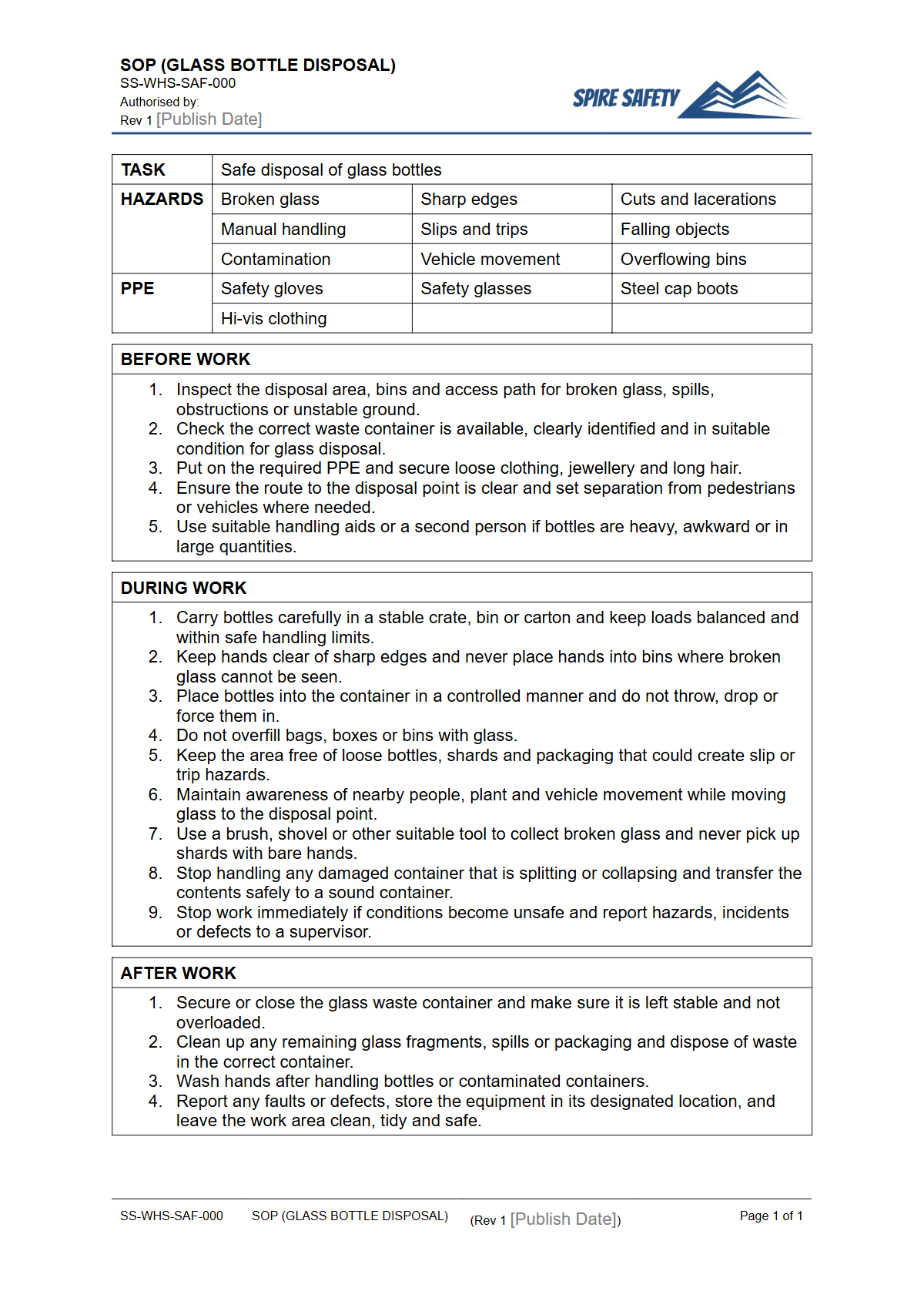
Download our free Safe Operating Procedure for Glass Bottle Disposal template. This DOCX & PDF resource helps you outline safe work practices for your team.
Free Safe Operating Procedure (Glass Bottle Disposal) Template
DOCX • 126 KB + PDF
Updated Oct 2026
No signup required
Purpose of the Free Safe Operating Procedure (Glass Bottle Disposal) Template
Handling and disposing of glass bottles, whether empty or broken, presents significant workplace hazards. This task is common in industries like hospitality, recycling, and manufacturing, and without a formalised process, the risk of injury is high.
Our Free Safe Operating Procedure (Glass Bottle Disposal) Template provides a structured starting point for documenting the required steps to manage this task safely. The primary goal is to control risks such as cuts and lacerations from broken glass, musculoskeletal injuries from manual handling, and potential exposure to biological hazards if containers are contaminated.
Implementing a clear SOP helps your organisation meet its duty of care under Australian WHS laws. It standardises the procedure, ensuring every worker follows the same safe method, thereby reducing incident rates and improving overall safety culture.
This document serves as a critical component within broader WHS management systems, providing clear instructions that support risk assessments and training programs.
Video walkthrough
How to use the Free Safe Operating Procedure (Glass Bottle Disposal) Template
This downloadable resource is provided in an editable DOCX format, allowing for full customisation to your specific operational context. It is designed as a foundation, not a finished document.
To make it effective, you must adapt it to reflect your unique workplace environment, equipment, and personnel. Start by reviewing the pre-filled sections and adding site-specific details, such as the location of designated glass disposal bins, the types of glass being handled, and the specific personal protective equipment (PPE) required.
Important: We have provided a comprehensive template, but it must be customised to your workplace. You need to conduct your own risk assessment and consult with your workers to ensure the procedure is practical, relevant, and effectively controls the identified hazards.
Be sure to include details about emergency procedures for injuries, such as cuts, and clearly assign responsibilities for each step. After customisation, the SOP should be used as a training tool for all relevant employees.
Regular reviews are also essential to keep the document current, a process that can be verified during a WHS compliance auditing cycle.
When to use it
A Safe Operating Procedure for glass bottle disposal should be implemented in any workplace where employees are required to handle and discard glass containers as part of their duties. This is especially critical in high-volume environments where the task is repetitive and the risk of complacency is high.
Key industries include pubs, clubs, restaurants, hotels, recycling and waste management facilities, bottling plants, and scientific laboratories.
The SOP should be used during employee induction and as the basis for ongoing refresher training. It is also a vital reference document to be displayed near the work area, such as in bar areas, kitchens, or waste sorting zones.
Furthermore, it should be reviewed and updated whenever there is a change in process, equipment (e.g., new types of bins or collection machinery), or following any incident or near-miss related to glass handling. Similar structured procedures are necessary for other common tasks, which is why we also provide resources like our step ladder SOP for tasks that may seem simple but carry significant risk.
Who should use it
This SOP is intended for use by multiple roles within an organisation. WHS Managers, Health and Safety Representatives (HSRs), and Supervisors are responsible for customising, implementing, and enforcing the procedure.
They must ensure it aligns with the business's overall safety framework and that workers are adequately trained to follow it. If your team lacks the internal expertise to develop or review these documents, seeking specialist WHS consulting can provide valuable external oversight and ensure best practice.
The primary users, however, are the frontline workers who perform the task. This includes bar staff, kitchen hands, cleaners, warehouse operators, and recycling sorters.
The SOP should be written in clear, simple language that is easy for them to understand and follow. Involving these workers in the development and review process through consultation is a legal requirement and greatly improves the procedure's effectiveness and acceptance. Even in workshop environments where glass isn't the primary material, related procedures are vital, such as our Circular Saw SOP template.
Spire Safety offers a wide range of templates and guides to help your business manage its safety obligations. Explore our complete free WHS resources library for more tools to support your safety management system.
Common mistakes
Common mistakes to avoid
- Overfilling disposal bins, which creates a risk of bottles falling and shattering.
- Throwing bottles into bins from a distance instead of placing them in carefully.
- Using hands to compress glass in a bin, leading to severe lacerations.
- Forgetting to wear or using inadequate PPE, such as standard cleaning gloves instead of cut-resistant ones.
Legal references
Legal considerations
The following legal requirements may be relevant to this type of work.
- Work Health and Safety Act (Harmonised) — Provides the primary duties for protecting workers and other people from work health and safety risks.
- Work Health and Safety Regulations (Harmonised) — Sets out requirements supporting the management of workplace hazards and risks.
The following codes may be relevant to this type of work.
- Managing WHS Risks Code of Practice — Provides practical guidance on identifying hazards, assessing risks and applying effective controls.
- Work Health and Safety Consultation, Cooperation and Coordination Code of Practice — Provides practical guidance on consulting workers and coordinating with other duty holders.
- Managing the Work Environment and Facilities Code of Practice — Provides practical guidance on safe work environments, workplace facilities and related controls.
Did you know
Hospitality Hazards
The accommodation and food services industry has one of the highest rates of serious workers' compensation claims for cuts and open wound injuries, often resulting from handling glass and other sharp objects.
Sharps Bins Aren't Just for Needles
While commonly associated with medical waste, designated sharps containers are also the best practice for disposing of broken glass in many workplace settings to prevent injuries to waste handlers downstream.
FAQ
Frequently asked questions
01What key information should be included in an SOP for glass bottle disposal?
02Who is responsible for training workers on this Safe Operating Procedure?
03How often should a glass bottle disposal SOP be reviewed?
04Is Personal Protective Equipment (PPE) required for disposing of glass bottles?
Share this resource
Free Safe Operating Procedure (Glass Bottle Disposal) Template
Browse Categories
How To Use It
- 1Download and open in Word or PDF.
- 2Replace the placeholders with your business details.
- 3Get it reviewed by a WHS specialist before rollout.
Need it customised?
Our WHS consultants can adapt this template to your site, run a gap analysis, or audit what you already have in place.
Book a Free Consultation WHS consulting servicesor call 1300 156 382
Related templates
- Free Safe Operating Procedure (Glass Canopy Cleaning) Template
- Free Safe Operating Procedure (Glass Crusher) Template
- Free Safe Operating Procedure (Glass Door Cleaning) Template
- Free Safe Operating Procedure (Glass Installation) Template
- Free Safe Operating Procedure (Glass Lifter) Template
- Free Safe Operating Procedure (Glass Partition Clean) Template