
Free Safe Operating Procedure (Glass Balustrade Clean) Template
Download our free Safe Operating Procedure for cleaning glass balustrades. This customisable template helps you outline risks and controls.
Free Safe Operating Procedure (Glass Balustrade Clean) Template
DOCX • 126 KB + PDF
Updated Oct 2026
No signup required
Purpose of the Free Safe Operating Procedure (Glass Balustrade Clean) Template
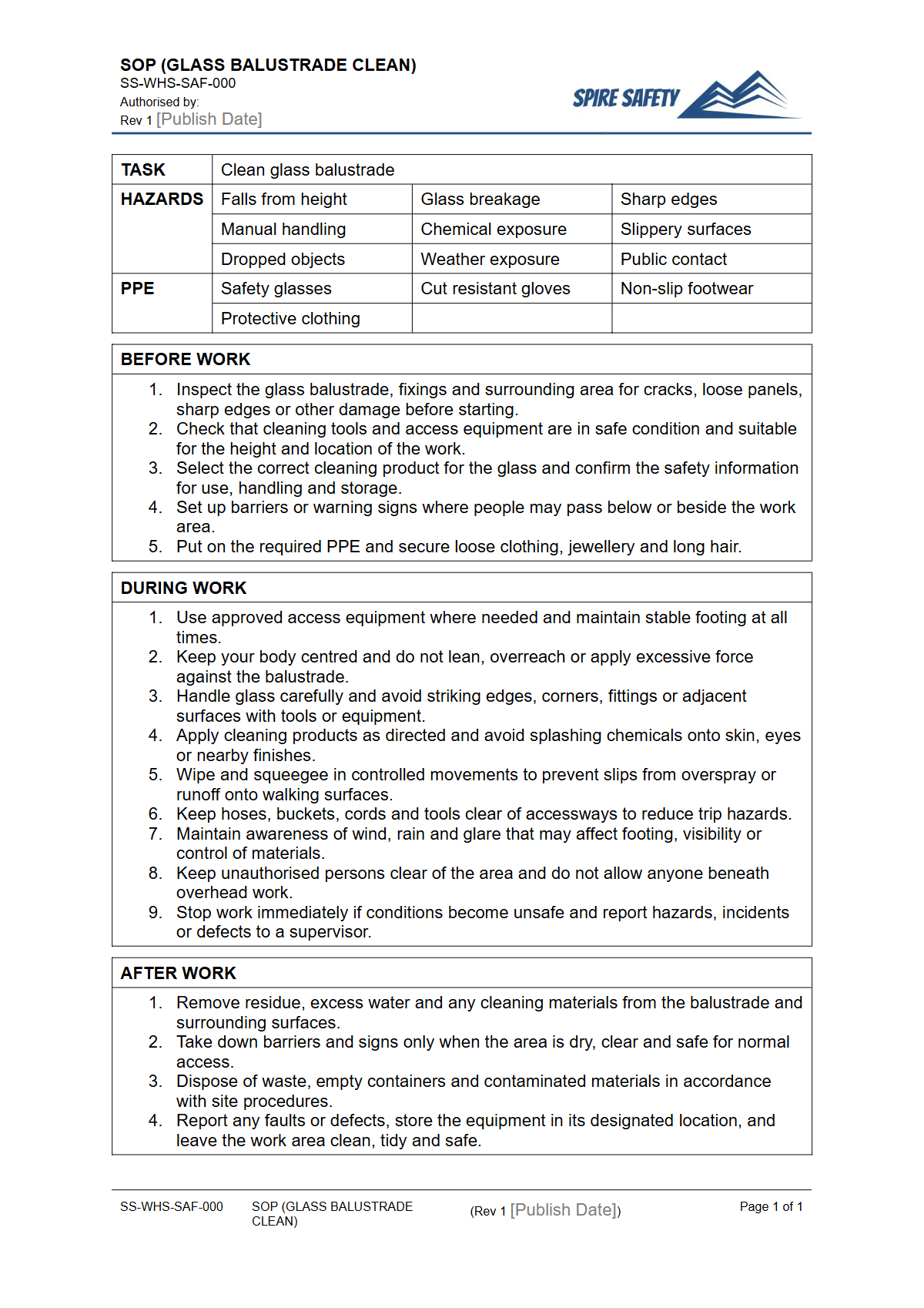
This Free Safe Operating Procedure (Glass Balustrade Clean) Template provides a structured framework for documenting the required steps to clean glass balustrades safely and efficiently. A Safe Operating Procedure (SOP), also known as a Safe Work Procedure (SWP), is a fundamental tool in any Australian workplace safety management system.
It breaks down a task into a logical sequence of steps, identifying potential hazards and outlining clear control measures to mitigate risks to workers.
Cleaning glass balustrades, while seeming routine, involves significant hazards that must be managed. These include working at heights, the manual handling of equipment, exposure to cleaning chemicals, and the risk of slips, trips, and falls.
This template is designed as a starting point, aligned with Australian WHS principles, to help you formalise your processes, ensure consistency, and provide a clear, documented resource for worker training and supervision.
Key Hazards in Glass Balustrade Cleaning
A comprehensive SOP must address all foreseeable hazards associated with the task. This template prompts you to consider controls for common risks, including:
- Falls from height: This is a primary risk, whether working from ladders, elevated platforms, or near unprotected edges. Establishing clear rules for equipment use is critical, and our step ladder safe operating procedure provides a more detailed guide for that specific task.
- Hazardous Chemicals: Cleaning agents can cause skin irritation, respiratory issues, or other health effects if not handled correctly. Your SOP should detail the specific chemicals used, required Personal Protective Equipment (PPE), and reference the Safety Data Sheet (SDS).
- Manual Tasks: Handling buckets of water, extension poles, and other equipment can lead to musculoskeletal injuries if not performed with correct technique.
- Slips, Trips, and Falls: Wet surfaces created during cleaning pose a significant risk. The procedure must include measures like using warning signs and ensuring a tidy work area.
Video walkthrough
How to use the Free Safe Operating Procedure (Glass Balustrade Clean) Template
After downloading the DOCX or PDF file, the first step is to adapt it to your specific operational context. A generic document is not sufficient for compliance or safety; it must reflect the reality of your workplace.
This involves a thorough review and customisation process to ensure it is relevant and effective for your team.
It's crucial to understand that this template is a starting point. We've provided a structured framework, but you must customise it with specific details relevant to your site, equipment, chemicals, and personnel.
The most effective SOPs are developed in consultation with the workers who actually perform the task. They bring practical experience that is invaluable for identifying real-world hazards and effective controls. This collaborative approach is a core component of a healthy WHS management system.
What to Include in Your Customisation
- Site-Specific Information: Add details about the specific location, including access points and any unique environmental hazards.
- Equipment Details: List the exact make and model of equipment used, from ladders to squeegees.
- Chemical Register: Name the specific cleaning products and attach or reference their Safety Data Sheets (SDS).
- PPE Requirements: Go beyond generic terms like 'gloves' and specify the type (e.g., nitrile chemical-resistant gloves).
- Emergency Procedures: Outline the steps to take in case of a chemical spill, fall, or other incident, including contact numbers and the location of first aid kits.
When to use it
A Safe Operating Procedure is a dynamic document used throughout the work cycle, not just a form to be filed away. It should be used before work commences as a planning tool and a pre-start checklist to ensure all safety measures are in place.
It is an essential resource for the induction of new employees and for ongoing refresher training to reinforce safe work habits. Supervisors can also use it as an observational guide to confirm procedures are being followed correctly in practice.
If your organisation needs help integrating these documents into your daily operations, our expert WHS consulting services can provide practical guidance.
Who should use it
Responsibility for safety is shared across an organisation, and the SOP is a tool for multiple roles. The Person Conducting a Business or Undertaking (PCBU) has the primary duty of care to provide safe systems of work, and developing and implementing SOPs is a key part of fulfilling that duty.
Supervisors and managers are responsible for ensuring workers are trained on the SOP and that the procedures are followed on the ground. Workers themselves must understand and adhere to the SOP to protect their own health and safety and that of their colleagues. Finally, the effectiveness and implementation of these procedures are often a key focus of internal and external WHS compliance audits.
By properly developing, implementing, and reviewing your procedures, you create a safer environment for everyone. You can explore our full library of free WHS resources for more templates to support your safety management system.
Common mistakes
Common mistakes to avoid
- Failing to customise the template with site-specific equipment, chemicals, and environments.
- Not consulting with workers who perform the task when drafting or reviewing the procedure.
- Neglecting to inspect equipment like ladders, harnesses, or extension poles before each use.
- Treating the SOP as a one-time document instead of using it for ongoing training and supervision.
Legal references
Legal considerations
The following legal requirements may be relevant to this type of work.
- Work Health and Safety Act (Harmonised) — Provides the primary duties for protecting workers and other people from work health and safety risks.
- Work Health and Safety Regulations (Harmonised) — Sets out requirements supporting the management of workplace hazards and risks.
The following codes may be relevant to this type of work.
- Managing WHS Risks Code of Practice — Provides practical guidance on identifying hazards, assessing risks and applying effective controls.
- Work Health and Safety Consultation, Cooperation and Coordination Code of Practice — Provides practical guidance on consulting workers and coordinating with other duty holders.
- Managing the Work Environment and Facilities Code of Practice — Provides practical guidance on safe work environments, workplace facilities and related controls.
Did you know
Falls from Height
Falls from a height are a leading cause of workplace fatalities and serious injuries in Australia. Even a fall from a seemingly low height of two metres can be fatal.
Chemical Safety Data Sheets
A Safety Data Sheet (SDS) is a legal document that must be made available to any worker who uses a hazardous chemical. It provides critical information on identity, hazards, first aid, and safe handling.
FAQ
Frequently asked questions
01What should be included in a glass balustrade cleaning SOP?
02Is a Safe Operating Procedure a legal requirement in Australia for cleaning tasks?
03How often should a Safe Operating Procedure for cleaning be reviewed?
04Can this template be used for cleaning other glass surfaces?
Share this resource
Free Safe Operating Procedure (Glass Balustrade Clean) Template
Browse Categories
How To Use It
- 1Download and open in Word or PDF.
- 2Replace the placeholders with your business details.
- 3Get it reviewed by a WHS specialist before rollout.
Need it customised?
Our WHS consultants can adapt this template to your site, run a gap analysis, or audit what you already have in place.
Book a Free Consultation WHS consulting servicesor call 1300 156 382
Related templates
- Free Safe Operating Procedure (Glass Bottle Disposal) Template
- Free Safe Operating Procedure (Glass Canopy Cleaning) Template
- Free Safe Operating Procedure (Glass Crusher) Template
- Free Safe Operating Procedure (Glass Door Cleaning) Template
- Free Safe Operating Procedure (Glass Installation) Template
- Free Safe Operating Procedure (Glass Lifter) Template