
Free Safe Operating Procedure (Glass Awning Cleaning) Template
Formalise safety measures for cleaning glass awnings with our structured template. This SOP helps identify hazards and control risks like working at heights.
Free Safe Operating Procedure (Glass Awning Cleaning) Template
DOCX • 126 KB + PDF
Updated Oct 2026
No signup required
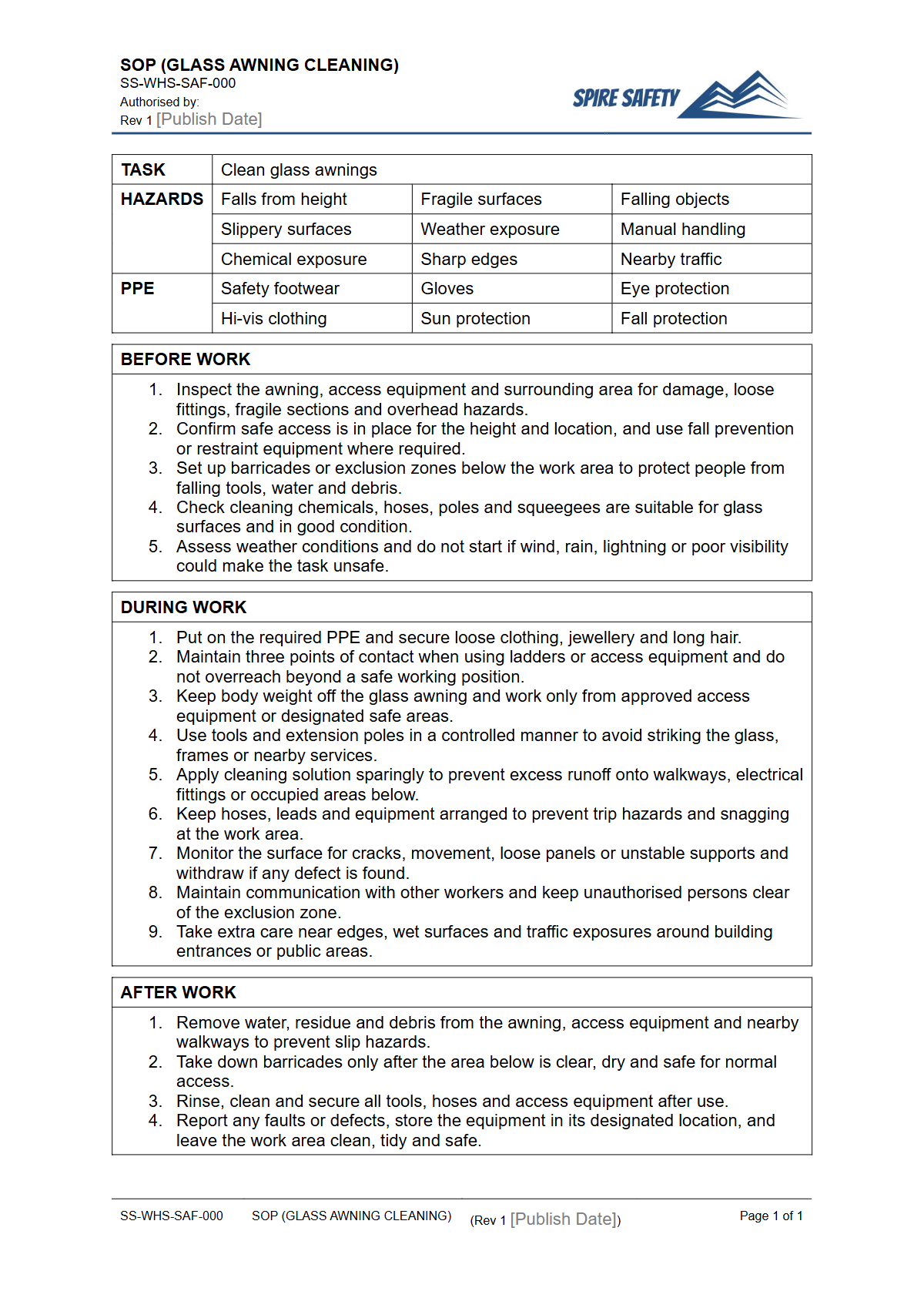
Purpose of the Free Safe Operating Procedure (Glass Awning Cleaning) Template
Cleaning glass awnings, canopies, and similar structures introduces significant workplace hazards. This task often involves working at heights, using chemicals, and performing manual handling, all of which require a formalised safety process.
Our Free Safe Operating Procedure (Glass Awning Cleaning) Template provides a structured starting point for your organisation to document the specific steps, risks, and controls for this high-risk activity.
A well-developed Safe Operating Procedure (SOP) is a critical tool for managing WHS obligations. It serves as both a planning document and a training resource, ensuring that every worker understands the recognised safe method for performing the job.
Using this template helps you systematically identify hazards such as falls from ladders, falling objects, exposure to cleaning chemicals, and ergonomic injuries. It is a foundational element for building a proactive safety culture and is a key document within a comprehensive WHS management system.
Video walkthrough
How to use the Free Safe Operating Procedure (Glass Awning Cleaning) Template
This document is designed to be adapted. It is provided in both DOCX and PDF formats, allowing you to easily edit the content to match your specific operational context.
Download the file and work through each section, replacing the placeholder text with information relevant to your worksite, equipment, and personnel. This includes specifying the exact type of access equipment used, the names of approved cleaning chemicals, the required Personal Protective Equipment (PPE), and your site-specific emergency contacts.
Important: This is a template, not a completed safety document. It is your responsibility to ensure the final SOP is accurate and reflects the unique conditions of your workplace.
We are not liable for any incidents that occur from the use of an unmodified or improperly customised template. The finished document should be reviewed with all relevant workers and form part of regular WHS compliance auditing to ensure it remains current and effective.
What to include in your SOP
- Hazard Identification: List all potential hazards, including falls, slips, trips, chemical exposure, electrical risks (if near lighting), manual handling strains, and public safety risks (e.g., pedestrians below).
- Risk Assessment: For each hazard, assess the level of risk before and after control measures are applied.
- Control Measures: Detail the specific controls to be used, following the hierarchy of controls. This includes selecting appropriate access equipment, using barriers to cordon off the area, mandating specific PPE (e.g., gloves, safety glasses, non-slip footwear), and ensuring Safety Data Sheets (SDS) are available for all chemicals. For tasks involving ladders, our FREE Step Ladder SOP Template offers more detailed guidance.
- Step-by-Step Procedure: Outline the task from start to finish, including pre-start checks, setting up the work area, the cleaning process itself, and packing up.
- Training and Competency: Specify the training required for workers to be deemed competent to perform the task.
When to use it
A Safe Operating Procedure for glass awning cleaning should be used consistently. It should be consulted before the commencement of any such cleaning task, especially by the supervisor overseeing the work.
It is an essential document for worker inductions and for any refresher training sessions. Furthermore, the SOP should be reviewed and updated whenever a new hazard is identified, after a near-miss or incident, or when new equipment or chemicals are introduced to the process.
Who should use it
This Safe Operating Procedure is intended for use by multiple groups within an organisation. Persons Conducting a Business or Undertaking (PCBUs) and their management teams will use it to fulfil their primary duty of care.
Supervisors and team leaders will use it to direct work and conduct pre-start briefings. Most importantly, the workers who perform the cleaning tasks must be trained in and follow the procedures outlined in the SOP. This aligns with the PCBU's duty of care under WHS legislation, a process that can be supported by expert WHS consulting.
For tasks requiring mechanical lifting to access high or difficult awnings, a separate procedure for equipment like a telehandler would be necessary. You can use our FREE Telehandler SOP Template as a reference for developing such a document.
Spire Safety has a wide range of templates available; browse our complete free WHS resources library to find other documents relevant to your operations.
Common mistakes
Common mistakes to avoid
- Using the generic template without customising it for site-specific conditions.
- Failing to adequately train workers on the contents of the finalised SOP.
- Neglecting to include emergency procedures for falls, chemical spills, or other foreseeable incidents.
- Not reviewing and updating the SOP after a change in process or after a near-miss.
Legal references
Legal considerations
The following legal requirements may be relevant to this type of work.
- Work Health and Safety Act (Harmonised) — Provides the primary duties for protecting workers and other people from work health and safety risks.
- Work Health and Safety Regulations (Harmonised) — Sets out requirements supporting the management of workplace hazards and risks.
The following codes may be relevant to this type of work.
- Managing WHS Risks Code of Practice — Provides practical guidance on identifying hazards, assessing risks and applying effective controls.
- Work Health and Safety Consultation, Cooperation and Coordination Code of Practice — Provides practical guidance on consulting workers and coordinating with other duty holders.
- Managing the Work Environment and Facilities Code of Practice — Provides practical guidance on safe work environments, workplace facilities and related controls.
Did you know
Working at Height
In Australia, falls from a height of over two metres are a leading cause of workplace fatalities and serious injuries, making robust SOPs for such tasks essential.
Duty to Consult
Under model WHS laws, PCBUs have a mandatory duty to consult with workers on health and safety matters, including the development of Safe Operating Procedures.
FAQ
Frequently asked questions
01Is this Safe Operating Procedure template ready to use immediately?
02What are the main hazards to include in a glass awning cleaning SOP?
03Who is responsible for creating and implementing an SOP?
04How often should a Safe Operating Procedure be reviewed?
Share this resource
Free Safe Operating Procedure (Glass Awning Cleaning) Template
Browse Categories
How To Use It
- 1Download and open in Word or PDF.
- 2Replace the placeholders with your business details.
- 3Get it reviewed by a WHS specialist before rollout.
Need it customised?
Our WHS consultants can adapt this template to your site, run a gap analysis, or audit what you already have in place.
Book a Free Consultation WHS consulting servicesor call 1300 156 382
Related templates
- Free Safe Operating Procedure (Glass Balustrade Clean) Template
- Free Safe Operating Procedure (Glass Bottle Disposal) Template
- Free Safe Operating Procedure (Glass Canopy Cleaning) Template
- Free Safe Operating Procedure (Glass Crusher) Template
- Free Safe Operating Procedure (Glass Door Cleaning) Template
- Free Safe Operating Procedure (Glass Installation) Template