
Free Safe Operating Procedure (Generator Load Test) Template
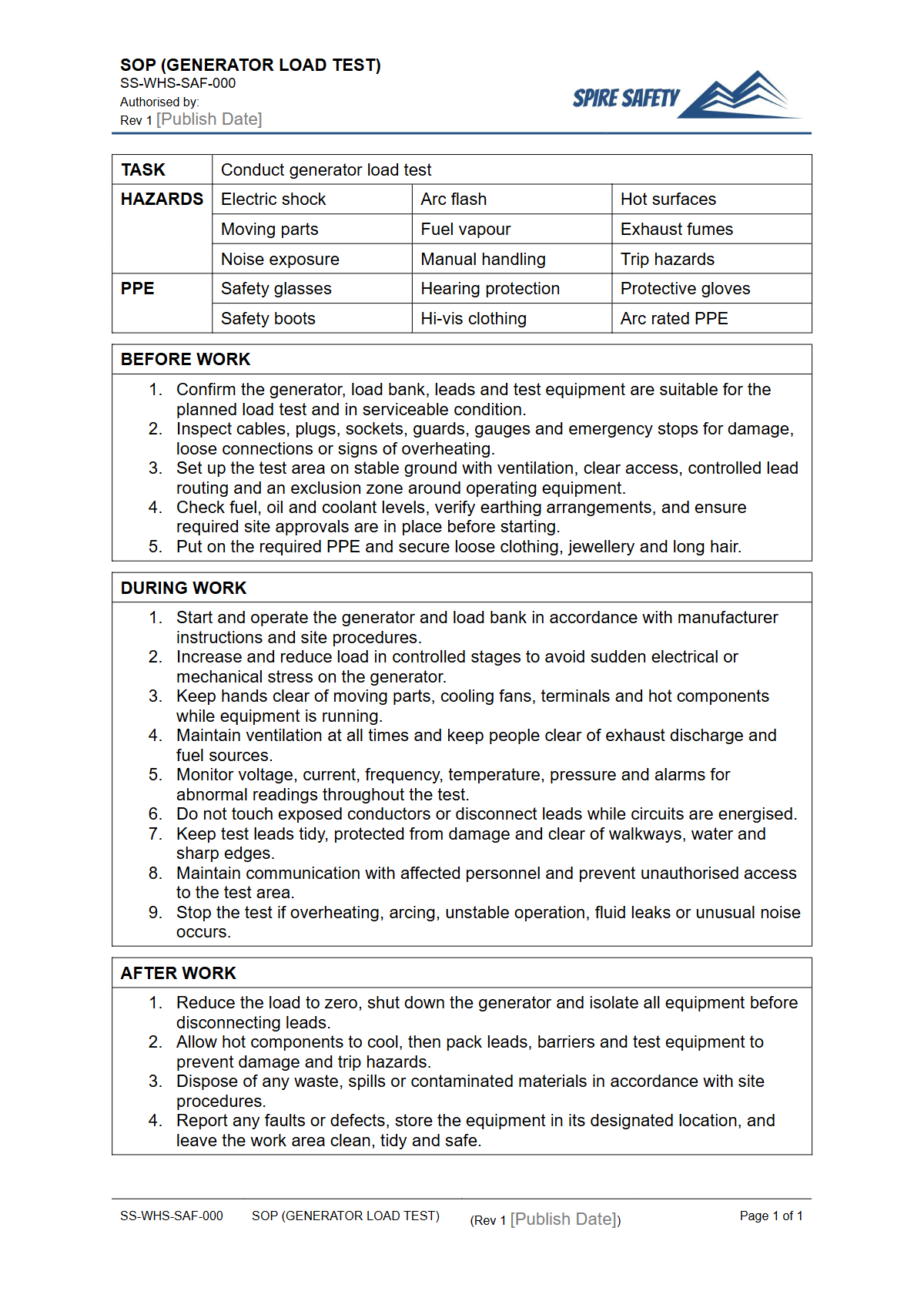
Outline the steps for safely conducting a generator load test with our free Safe Operating Procedure (SOP) template. Aligned with Australian WHS standards.
Free Safe Operating Procedure (Generator Load Test) Template
DOCX • 126 KB + PDF
Updated Oct 2026
No signup required
Purpose of the Free Safe Operating Procedure (Generator Load Test) Template
Regularly testing a generator under load is critical for ensuring it will perform as expected during a power outage. This task, however, involves significant electrical and mechanical hazards.
Our Free Safe Operating Procedure (Generator Load Test) Template provides a structured framework for businesses to document a safe, repeatable process for this essential maintenance activity. Using an SOP helps control risks such as electric shock, arc flash, burns from hot surfaces, and exposure to hazardous noise levels.
It formalises the sequence of actions, required personal protective equipment (PPE), and emergency responses, ensuring the task is performed consistently and safely every time.
A well-defined SOP is a cornerstone of effective workplace safety. It demonstrates a commitment to risk management and forms an integral part of comprehensive WHS management systems by providing clear instructions to workers and a basis for training and competency assessment.
Video walkthrough
How to use the Free Safe Operating Procedure (Generator Load Test) Template
This document is a template designed to be a starting point, not a finished document. You must customise it to reflect the specific generator models, load banks, site conditions, and personnel at your workplace.
To effectively use this Safe Operating Procedure for generator load testing, you should review each section and populate the fields with your operational details. This includes specifying the make and model of the equipment, site-specific isolation points, required PPE (e.g., arc-rated clothing, insulated gloves), and the names or roles of authorised personnel.
Important: This is a template that we have created as a starting point. You must review, edit, and customise this document to meet the specific needs of your business, the equipment you use, and your unique operational environment.
A generic procedure is not sufficient for WHS compliance.
Conducting a thorough risk assessment before finalising the SOP is essential to identify all potential hazards. This process ensures the controls documented in the procedure are relevant and effective.
The completed SOP should be reviewed and approved by a competent person, such as an electrical supervisor or safety manager. Regular reviews through processes like WHS compliance auditing ensure the procedure remains current with any changes in equipment or regulations.
When to use this Safe Operating Procedure
A Safe Operating Procedure for a generator load test should be used every time the task is performed. This ensures consistency and safety, regardless of who is conducting the test. Key times for its use include:
- Scheduled Preventative Maintenance: As part of a routine maintenance schedule (e.g., monthly, quarterly, or annually) to verify generator health and prevent issues like wet stacking.
- Commissioning New Equipment: When installing a new generator set to verify it meets performance specifications.
- Post-Repair Verification: After significant repairs or modifications to the generator, engine, or control systems to ensure it functions correctly under load.
- Annual Compliance and Certification: To meet requirements for facilities like hospitals, data centres, and emergency services that depend on reliable backup power.
Using other task-specific SOPs, such as a free Air Compressor SOP template, for ancillary maintenance activities helps build a more robust safety framework across all your plant and equipment.
Who should use this Safe Operating Procedure
Carrying out a generator load test is a high-risk activity that must only be performed by competent and authorised personnel. This typically includes:
- Licensed Electricians: Individuals with the required electrical licence and experience in working with high-voltage generating systems.
- Qualified Generator Technicians: Specialists trained in the maintenance, diagnosis, and testing of specific generator makes and models.
- Maintenance Personnel under Direct Supervision: Workers who may assist with the physical setup but are under the direct supervision of a licensed and competent person at all times.
All personnel involved must be trained on the specific procedures outlined in the SOP, understand the associated hazards, and be competent in the emergency shutdown and response actions. This includes training in other fundamental safety practices, like the safe use of a step ladder when accessing components or connection points.
For more expert guidance on developing and implementing robust safety documentation, consider engaging with a WHS consulting professional. You can also explore our complete free WHS resources library for other useful templates and guides.
Common mistakes
Common mistakes to avoid
- Failing to properly isolate the generator from the building's mains power before connecting the load bank.
- Using incorrectly sized cables for the load bank, creating a fire and electrical hazard.
- Neglecting to ensure adequate ventilation, leading to overheating of the generator or load bank.
- Skipping pre-start checks of fuel, oil, and coolant levels, which can lead to engine damage during the test.
Legal references
Legal considerations
The following legal requirements may be relevant to this type of work.
- Work Health and Safety Act (Harmonised) — Provides the primary duties for protecting workers and other people from work health and safety risks.
- Work Health and Safety Regulations (Harmonised) — Sets out requirements supporting the management of workplace hazards and risks.
The following codes may be relevant to this type of work.
- Managing WHS Risks Code of Practice — Provides practical guidance on identifying hazards, assessing risks and applying effective controls.
- Work Health and Safety Consultation, Cooperation and Coordination Code of Practice — Provides practical guidance on consulting workers and coordinating with other duty holders.
- Managing the Work Environment and Facilities Code of Practice — Provides practical guidance on safe work environments, workplace facilities and related controls.
Did you know
Wet Stacking
Regularly running a diesel generator on a light load can cause unburnt fuel and carbon to build up in the exhaust system, a condition known as 'wet stacking'. A load bank test burns this off, cleaning the engine and improving performance.
A Common Point of Failure
Studies show that a significant percentage of standby generator failures during a genuine outage are due to issues that would have been identified during a routine load test. This makes preventative testing a critical reliability practice.
FAQ
Frequently asked questions
01What is a generator load test?
02Why is a load bank used in a generator load test?
03How often should a generator be load tested in Australia?
04Is an SOP legally required for generator load testing?
Share this resource
Free Safe Operating Procedure (Generator Load Test) Template
Browse Categories
How To Use It
- 1Download and open in Word or PDF.
- 2Replace the placeholders with your business details.
- 3Get it reviewed by a WHS specialist before rollout.
Need it customised?
Our WHS consultants can adapt this template to your site, run a gap analysis, or audit what you already have in place.
Book a Free Consultation WHS consulting servicesor call 1300 156 382
Related templates
- Free Safe Operating Procedure (Glass Awning Cleaning) Template
- Free Safe Operating Procedure (Glass Balustrade Clean) Template
- Free Safe Operating Procedure (Glass Bottle Disposal) Template
- Free Safe Operating Procedure (Glass Canopy Cleaning) Template
- Free Safe Operating Procedure (Glass Crusher) Template
- Free Safe Operating Procedure (Glass Door Cleaning) Template