
Free Safe Operating Procedure (Gate Latch Repair) Template
Download our free Safe Operating Procedure (Gate Latch Repair) template.
Free Safe Operating Procedure (Gate Latch Repair) Template
DOCX • 126 KB + PDF
Updated Oct 2026
No signup required
Purpose of the Free Safe Operating Procedure (Gate Latch Repair) Template
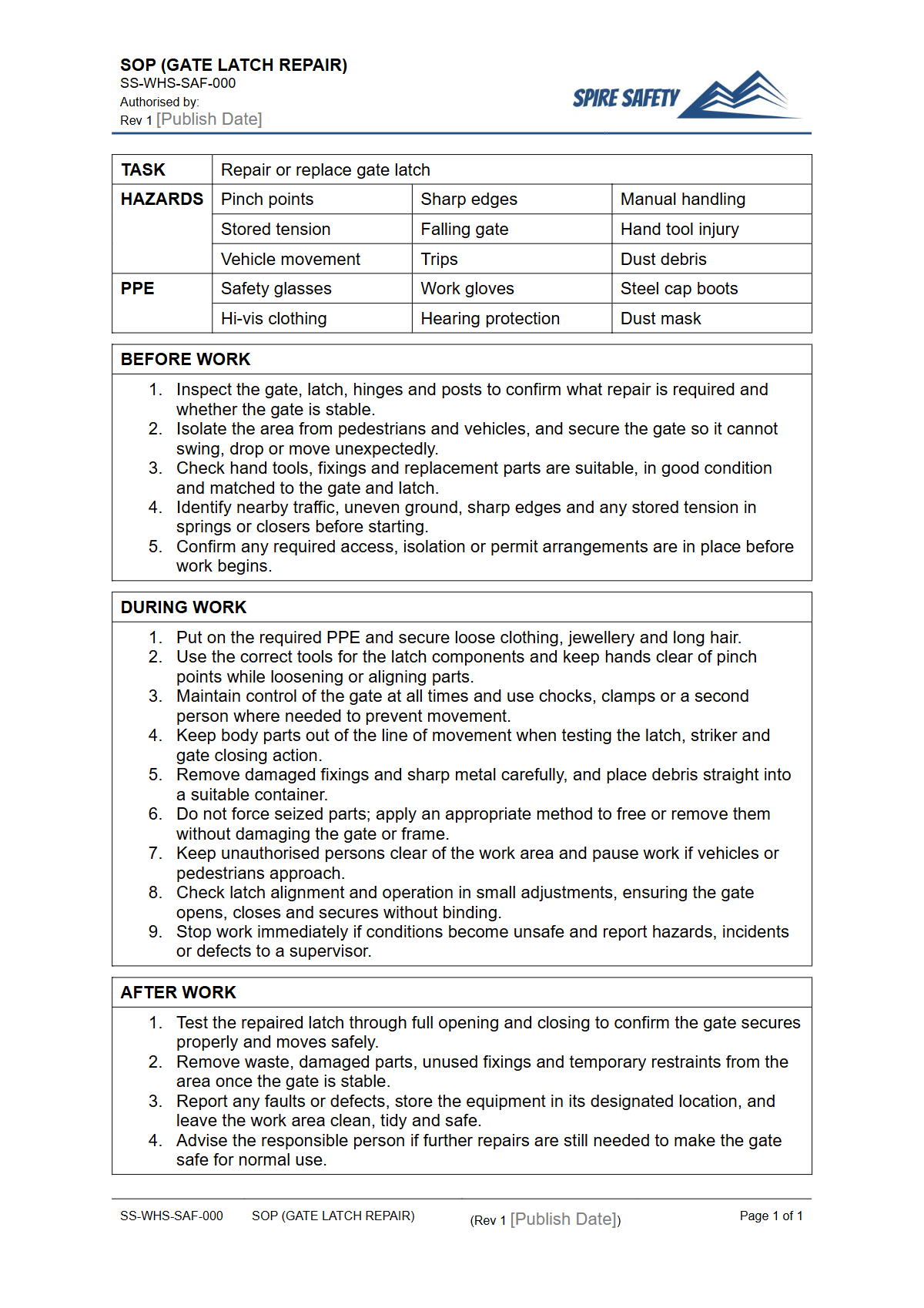
A Safe Operating Procedure (SOP) provides a clear, step-by-step guide to performing a task safely. This free Safe Operating Procedure (Gate Latch Repair) template is designed as a structured starting point for your organisation.
It helps you document the approved method for repairing faulty or broken gate latches, a common but potentially hazardous maintenance task. Properly documenting this process helps control risks such as crush injuries, cuts from sharp edges or tools, and musculoskeletal strains from awkward postures.
By establishing a formal procedure, you ensure that all workers follow a consistent, safety-focused process. This not only protects your team but also helps maintain the security and integrity of your site by ensuring gates function correctly.
A documented procedure forms a critical part of a proactive safety culture, demonstrating a commitment to managing risks for even routine tasks. This approach is consistent with procedures for other common equipment, such as those detailed in our air compressor SOP.
Video walkthrough
How to use the Free Safe Operating Procedure (Gate Latch Repair) Template
This resource is available for download as a DOCX file for easy editing or as a PDF for quick reference. To use it effectively, you must adapt it to the specific context of your workplace.
A generic procedure is not sufficient to ensure safety; site-specific details are essential.
Follow these steps to implement the SOP:
- Customise: Open the DOCX file and fill in the details relevant to your site. This includes the specific types of gates and latches, the tools and equipment to be used, the personal protective equipment (PPE) required, and your emergency procedures.
- Consult: Involve your workers in the customisation process. The people who perform the task are best placed to identify the real-world hazards and practical control measures. Consultation is a key principle of Australian WHS legislation.
- Approve: Have the finalised SOP reviewed and approved by a competent person, such as a supervisor or WHS manager.
- Train: Train all relevant personnel on the contents of the final SOP. Ensure they understand the steps, risks, and controls before undertaking any repair work.
IMPORTANT: This document is a template and must be customised to reflect the specific hazards and controls in your workplace. We are not responsible or liable for any incidents that may arise from the use of this template, especially if it has not been adequately adapted to your site-specific needs. Integrating such procedures is a cornerstone of well-structured WHS management systems.
When to use a Safe Operating Procedure for Gate Latch Repair
A Safe Operating Procedure for gate latch repair should be used consistently before any such work is performed. It is a critical tool for pre-task planning and risk management.
The SOP should be referenced during toolbox talks or pre-start meetings to refresh workers' knowledge of the risks and safety controls. It is also an essential document for training new employees or contractors tasked with maintenance duties.
Furthermore, this SOP should be integrated into your broader maintenance and inspection schedules. If a repair requires working at a minor height, for instance, it should be used in conjunction with other relevant procedures, such as a step ladder SOP. Regular reviews of the procedure, especially after an incident or near-miss, are also crucial to ensure it remains effective and relevant.
Who should use this SOP?
This SOP is intended for use by a range of personnel within an organisation. Primarily, maintenance workers, technicians, and handypersons who physically perform the repair work will use it as a direct guide.
Supervisors and team leaders are responsible for ensuring the procedures are followed correctly and that workers have the necessary training and resources. WHS managers and safety officers will use the template to develop and integrate standardised safety documentation into the company's overall safety framework.
Business owners and persons conducting a business or undertaking (PCBUs) can also use this document to help fulfil their duty of care under WHS law. For organisations needing expert help in tailoring this and other documents to their specific operational risks, engaging external WHS consulting services can provide valuable guidance and ensure a robust safety system. You can explore our entire catalogue of templates in the free WHS resources library.
Common mistakes
Common mistakes to avoid
- Failing to secure the gate from unexpected movement before starting the repair.
- Using incorrect tools for the job, leading to damaged components or injury.
- Neglecting to wear appropriate Personal Protective Equipment (PPE) like gloves and safety glasses.
- Not properly testing the latch mechanism under load after the repair is complete.
Legal references
Legal considerations
The following legal requirements may be relevant to this type of work.
- Work Health and Safety Act (Harmonised) — Provides the primary duties for protecting workers and other people from work health and safety risks.
- Work Health and Safety Regulations (Harmonised) — Sets out requirements supporting the management of workplace hazards and risks.
The following codes may be relevant to this type of work.
- Managing WHS Risks Code of Practice — Provides practical guidance on identifying hazards, assessing risks and applying effective controls.
- Work Health and Safety Consultation, Cooperation and Coordination Code of Practice — Provides practical guidance on consulting workers and coordinating with other duty holders.
- Managing the Work Environment and Facilities Code of Practice — Provides practical guidance on safe work environments, workplace facilities and related controls.
Did you know
Maintenance Risks
According to Safe Work Australia, a significant portion of workplace injuries occur during maintenance, repair, and installation activities, highlighting the need for formalised procedures for even routine tasks.
Functional Security
A properly functioning gate latch is not just a convenience; it's a critical component of site security and access control, preventing unauthorised entry and helping to manage pedestrian and vehicle flow safely.
FAQ
Frequently asked questions
01What is an SOP for gate latch repair?
02Why is a specific SOP needed for a simple task like repairing a gate latch?
03Who is responsible for creating and approving this Safe Operating Procedure?
04How often should an SOP for gate latch repair be reviewed?
Share this resource
Free Safe Operating Procedure (Gate Latch Repair) Template
Browse Categories
How To Use It
- 1Download and open in Word or PDF.
- 2Replace the placeholders with your business details.
- 3Get it reviewed by a WHS specialist before rollout.
Need it customised?
Our WHS consultants can adapt this template to your site, run a gap analysis, or audit what you already have in place.
Book a Free Consultation WHS consulting servicesor call 1300 156 382
Related templates
- Free Safe Operating Procedure (Gate Track Cleaning) Template
- Free Safe Operating Procedure (Gatehouse Check In) Template
- Free Safe Operating Procedure (Generator Load Test) Template
- Free Safe Operating Procedure (Glass Awning Cleaning) Template
- Free Safe Operating Procedure (Glass Balustrade Clean) Template
- Free Safe Operating Procedure (Glass Bottle Disposal) Template