
Free Safe Operating Procedure (Gas Detector Bump Test) Template
Download our free Safe Operating Procedure (Gas Detector Bump Test) template. This customisable DOCX and PDF helps you document safe work practices.
Free Safe Operating Procedure (Gas Detector Bump Test) Template
DOCX • 126 KB + PDF
Updated Oct 2026
No signup required
Purpose of the Free Safe Operating Procedure (Gas Detector Bump Test) Template
A portable gas detector is a critical piece of personal protective equipment (PPE) for anyone working in or near potentially hazardous atmospheres. To be effective, it must function correctly.
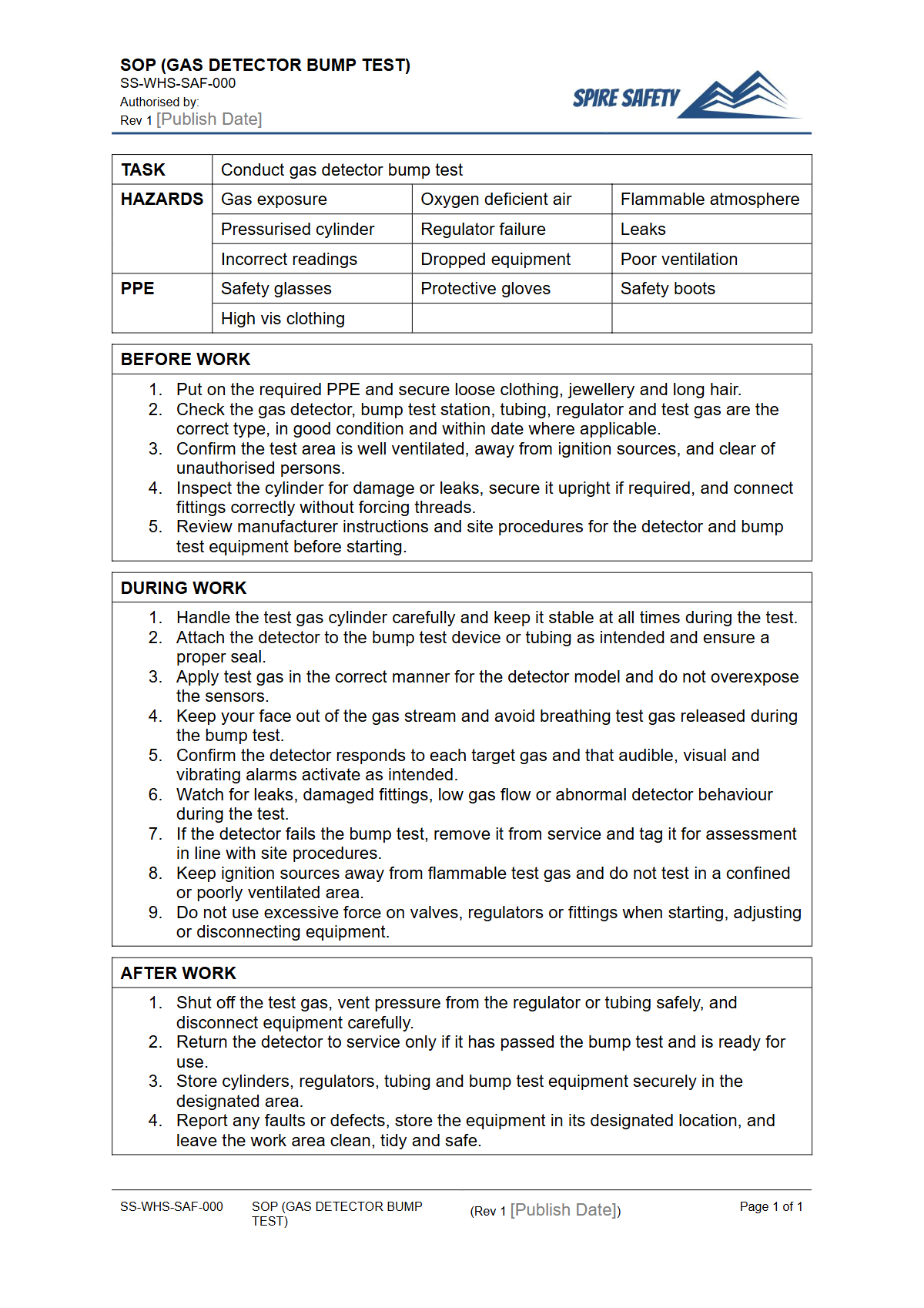
This Free Safe Operating Procedure (Gas Detector Bump Test) Template provides a structured framework for documenting the process of verifying a detector's sensor and alarm functions. A bump test exposes the device to a known concentration of target gas, ensuring it reacts and alarms as expected.
It is a vital pre-use check that confirms the detector can do its job, protecting workers from unseen dangers like toxic gases, asphyxiants, or flammable atmospheres.
Using a clear and consistent SOP ensures that every bump test is performed correctly, every time, by any trained operator. It formalises a key safety step, reduces the risk of equipment failure in the field, and provides a record of due diligence.
This template helps your organisation establish a clear, repeatable process aligned with Australian WHS principles and manufacturer recommendations. Integrating this procedure into your broader safety framework is a key part of managing workplace risks effectively. For a holistic approach, organisations often embed such procedures within comprehensive WHS management systems.
What is included in the template?
This Safe Operating Procedure template includes sections to document:
- Required Personal Protective Equipment (PPE)
- Pre-operational safety checks
- A step-by-step guide to performing the bump test
- Post-test procedures and what to do if a test fails
- Relevant hazard identification and risk controls
Video walkthrough
How to use the Free Safe Operating Procedure (Gas Detector Bump Test) Template
This document is provided in an editable DOCX format to allow for full customisation. To use the template effectively, you should first identify the specific make and model of the gas detectors used in your workplace.
The procedural steps must be adapted to align precisely with the manufacturer's instructions for that device, including the type of calibration gas required, flow rates, and the required test duration.
You must also conduct a site-specific risk assessment to identify all relevant hazards associated with the task and the environment where the detectors will be used, such as trenches or confined spaces. Many tasks involving hazardous atmospheres also require other specialised equipment.
For example, you may need procedures for equipment used nearby, such as our free Trencher SOP template, to ensure all related activities are managed safely.
Important: This template is a starting point. We have drafted it to be broadly applicable, but you must customise it to reflect the specific equipment, hazards, and control measures unique to your workplace.
Fill in the company-specific details, review every section, and adapt the content to ensure it is a practical and accurate guide for your workers.
When to use it
A gas detector bump test should be performed before each day's use. It is a quick field check to verify sensor and alarm functionality, not a replacement for a full calibration.
While a full calibration adjusts the instrument's reading to match a known standard, a bump test simply confirms it can 'see' the gas and alarm appropriately. This simple, two-minute check is one of the most effective ways to ensure the device has not failed since its last calibration.
Procedures like this are often part of the operational documentation for equipment that supports work in hazardous areas; for instance, you might pair this SOP with a free Air Compressor SOP template if using breathing apparatus.
Who should use it
This Safe Operating Procedure is designed for any person conducting work (PCBU) whose workers use portable gas detectors. This includes workers, supervisors, and WHS personnel across industries such as construction, mining, utilities, and manufacturing.
Any individual tasked with using a gas detector must be trained and deemed competent in performing a bump test according to the established SOP. Supervisors should use this document to enforce safe work practices and verify that pre-use checks are being completed. Regularly verifying that these procedures are correctly followed is a key function of internal safety reviews and formal WHS compliance auditing.
Proper documentation is a cornerstone of a strong safety culture. Having clear, accessible SOPs for all critical tasks ensures consistency and understanding across your team.
To see other examples and build out your documentation, you can browse our complete free WHS resources library for a wide range of templates and checklists.
Common mistakes
Common mistakes to avoid
- Using expired calibration gas, which can give inaccurate test results.
- Not allowing the test gas to flow for the manufacturer's recommended time.
- Skipping the test entirely to save a few minutes before starting work.
- Mistaking a successful bump test for a full calibration, leading to a false sense of accuracy.
Legal references
Legal considerations
The following legal requirements may be relevant to this type of work.
- Work Health and Safety Act (Harmonised) — Provides the primary duties for protecting workers and other people from work health and safety risks.
- Work Health and Safety Regulations (Harmonised) — Sets out requirements supporting the management of workplace hazards and risks.
The following codes may be relevant to this type of work.
- Managing WHS Risks Code of Practice — Provides practical guidance on identifying hazards, assessing risks and applying effective controls.
- Work Health and Safety Consultation, Cooperation and Coordination Code of Practice — Provides practical guidance on consulting workers and coordinating with other duty holders.
- Managing the Work Environment and Facilities Code of Practice — Provides practical guidance on safe work environments, workplace facilities and related controls.
Did you know
Sensor Drift
Gas detector sensors naturally lose sensitivity over time, a phenomenon known as 'sensor drift'. Regular bump tests and calibrations are the only way to counteract this and ensure the device remains accurate.
FAQ
Frequently asked questions
01What is the difference between a bump test and a calibration?
02How often should I bump test a gas detector?
03What should I do if a gas detector fails a bump test?
04Is a bump test legally required in Australia?
Share this resource
Free Safe Operating Procedure (Gas Detector Bump Test) Template
Browse Categories
How To Use It
- 1Download and open in Word or PDF.
- 2Replace the placeholders with your business details.
- 3Get it reviewed by a WHS specialist before rollout.
Need it customised?
Our WHS consultants can adapt this template to your site, run a gap analysis, or audit what you already have in place.
Book a Free Consultation WHS consulting servicesor call 1300 156 382
Related templates
- Free Safe Operating Procedure (Gas Detector Calibration) Template
- Free Safe Operating Procedure (Gas Heater) Template
- Free Safe Operating Procedure (Gas Regulator Change) Template
- Free Safe Operating Procedure (Gate Latch Repair) Template
- Free Safe Operating Procedure (Gate Track Cleaning) Template
- Free Safe Operating Procedure (Gatehouse Check In) Template