
Free Safe Operating Procedure (Gas Detector Calibration) Template
Need a Safe Operating Procedure for calibrating gas detectors? Download our free Gas Detector Calibration SOP Template to outline safe work methods.
Free Safe Operating Procedure (Gas Detector Calibration) Template
DOCX • 126 KB + PDF
Updated Oct 2026
No signup required
Purpose of the Free Safe Operating Procedure (Gas Detector Calibration) Template
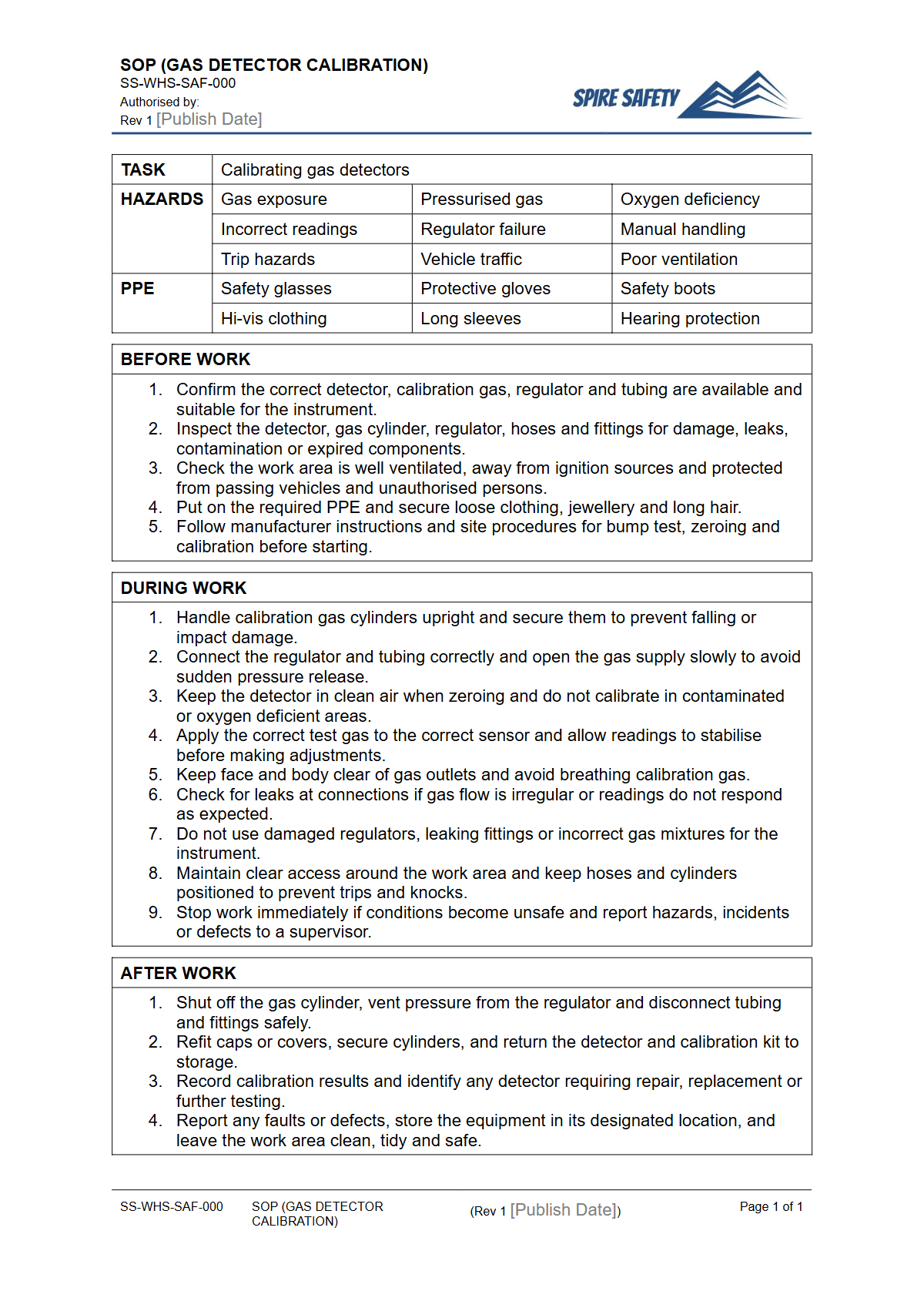
Ensuring the accuracy of gas detection equipment is critical for protecting workers from hazardous atmospheres, including flammable gases, oxygen deficiency, and toxic airborne contaminants. This Free Safe Operating Procedure (Gas Detector Calibration) Template provides a structured framework for documenting the process of calibrating portable and fixed gas detectors.
Using this SOP helps your organisation establish a consistent, safe, and reliable method for equipment maintenance, which is a cornerstone of managing atmospheric hazards in the workplace. It guides users through pre-calibration checks, the calibration process itself, and post-calibration actions, promoting a repeatable and safe system of work.
A documented procedure ensures that every calibration is performed to the same standard, regardless of who performs the task. This is vital for high-risk work environments like confined spaces, workshops, and sites with hazardous chemicals.
This template is designed as a starting point, based on the model WHS framework, to help you formalise these critical safety checks. It forms an integral part of broader WHS management systems, demonstrating proactive risk management.
Video walkthrough
How to use the Free Safe Operating Procedure (Gas Detector Calibration) Template
This Safe Operating Procedure for gas detector calibration is a fully editable Microsoft Word (DOCX) document that you can download and adapt for your specific workplace needs. It is not a complete, ready-to-use document.
To use it effectively, you must add details specific to your site, equipment, and personnel. We recommend a competent person customises this template to ensure it reflects your actual processes and the specific models of gas detectors in use.
To customise the template, you should:
- Insert your company name, ABN, and other details where indicated.
- Specify the exact make and model of the gas detectors covered by the SOP.
- List the required calibration gases, concentrations, and associated equipment (e.g., regulators, tubing).
- Define the roles and responsibilities, outlining who is authorised and competent to perform calibrations.
- Incorporate specific steps from the manufacturer’s instructions for your devices.
- Review and approve the final document through your organisation's WHS consultation process.
Proper documentation is essential for many work activities, including those involving machinery that can create hazardous atmospheres. For example, a thorough procedure for operating equipment like an air compressor should also consider the environment it's used in, which our Free Air Compressor SOP Template can help you document.
When to use a Gas Detector Calibration SOP
This Safe Operating Procedure should be followed whenever a gas detector requires calibration. The frequency of calibration depends on the manufacturer’s recommendations, your organisation's risk assessment, and the environment of use. Common triggers for calibration include:
- As part of a regular, scheduled maintenance program (e.g., monthly, quarterly, or six-monthly).
- Before first use of a new device.
- After a device has been dropped, subjected to a high-impact shock, or exposed to a high concentration of gas.
- Following the replacement of a sensor.
- If a routine bump test fails.
- As required by internal procedures or specific site entry requirements.
Consistently applying this SOP helps ensure that the equipment used to monitor air quality is always functioning within its specified tolerance. This is especially important for tasks like welding or cutting, which produce fumes and require specific safety controls, similar to those outlined in our FREE Plasma Cutter SOP Template.
Who should use this Safe Operating Procedure
This SOP is intended for personnel who are responsible for the maintenance, safety, and use of gas detection equipment. This includes:
- Competent Workers and Technicians: Individuals trained and deemed competent to perform the calibration task according to manufacturer guidelines and company procedures.
- WHS Managers and Safety Officers: Professionals responsible for developing, implementing, and overseeing safety procedures and ensuring equipment is maintained correctly.
- Supervisors and Team Leaders: Managers who must ensure their teams are using properly calibrated and functioning equipment before commencing work in potentially hazardous areas.
- Auditors: During internal or external audits, this document serves as evidence of a formal process for equipment maintenance. Thorough WHS compliance auditing will often verify that such procedures are not only documented but also correctly implemented.
Formalising procedures with SOPs is a key activity across all areas of workplace safety. You can explore a wide range of similar documents for different plant and equipment in our free WHS resources library to build out your safety management system.
Common mistakes
Common mistakes to avoid
- Using calibration gas that has passed its expiry date, leading to inaccurate adjustments.
- Performing calibration in a contaminated environment, causing incorrect zeroing or sensor readings.
- Not allowing the detector's sensors adequate time to warm up and stabilise before starting the calibration process.
- Failing to properly document the calibration results, creating gaps in maintenance records for audits.
Legal references
Legal considerations
The following legal requirements may be relevant to this type of work.
- Work Health and Safety Act (Harmonised) — Provides the primary duties for protecting workers and other people from work health and safety risks.
- Work Health and Safety Regulations (Harmonised) — Sets out requirements supporting the management of workplace hazards and risks.
The following codes may be relevant to this type of work.
- Managing WHS Risks Code of Practice — Provides practical guidance on identifying hazards, assessing risks and applying effective controls.
- Work Health and Safety Consultation, Cooperation and Coordination Code of Practice — Provides practical guidance on consulting workers and coordinating with other duty holders.
- Managing the Work Environment and Facilities Code of Practice — Provides practical guidance on safe work environments, workplace facilities and related controls.
Did you know
Sensor Drift
Gas detector sensors naturally lose sensitivity over time due to environmental factors and chemical degradation, a phenomenon known as 'sensor drift'. Regular calibration is the only way to correct this drift and ensure the device provides accurate readings.
FAQ
Frequently asked questions
01What is the difference between a bump test and a calibration?
02How often should a gas detector be calibrated?
03Who is a 'competent person' to calibrate a gas detector?
04Do I need to keep records of gas detector calibration?
Share this resource
Free Safe Operating Procedure (Gas Detector Calibration) Template
Browse Categories
How To Use It
- 1Download and open in Word or PDF.
- 2Replace the placeholders with your business details.
- 3Get it reviewed by a WHS specialist before rollout.
Need it customised?
Our WHS consultants can adapt this template to your site, run a gap analysis, or audit what you already have in place.
Book a Free Consultation WHS consulting servicesor call 1300 156 382
Related templates
- Free Safe Operating Procedure (Gas Heater) Template
- Free Safe Operating Procedure (Gas Regulator Change) Template
- Free Safe Operating Procedure (Gate Latch Repair) Template
- Free Safe Operating Procedure (Gate Track Cleaning) Template
- Free Safe Operating Procedure (Gatehouse Check In) Template
- Free Safe Operating Procedure (Generator Load Test) Template