
Free Safe Operating Procedure (Gas Cylinder Handling) Template
Download our free Safe Operating Procedure (Gas Cylinder Handling) template. This DOCX and PDF resource helps you outline safe work practices for your team.
Free Safe Operating Procedure (Gas Cylinder Handling) Template
DOCX • 126 KB + PDF
Updated Oct 2026
No signup required
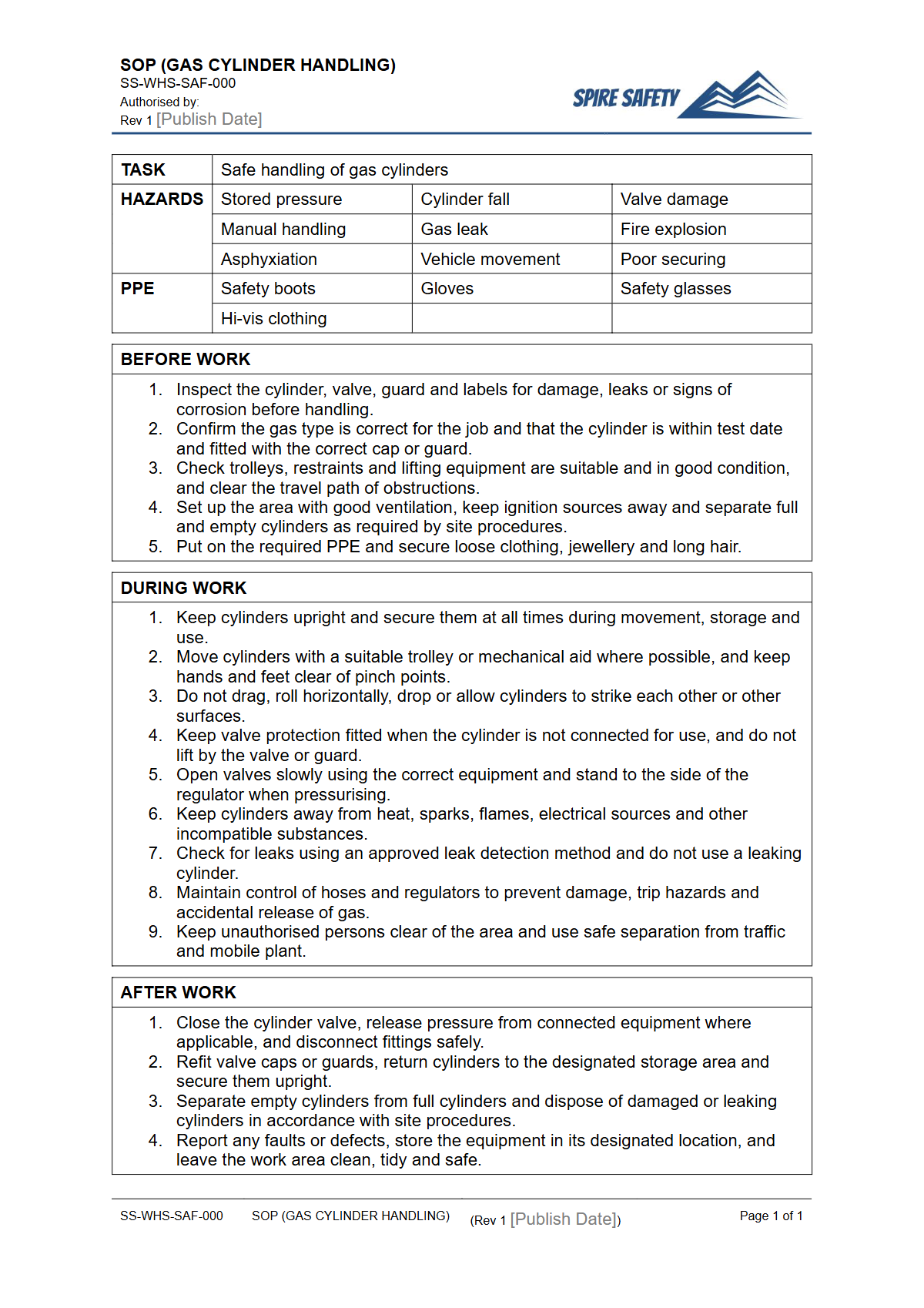
Purpose of the Free Safe Operating Procedure (Gas Cylinder Handling) Template
Effectively managing the risks associated with pressurised gas is a critical part of workplace safety. This free Safe Operating Procedure (Gas Cylinder Handling) Template provides a structured framework for documenting the required safety controls and work steps for your business.
Using this template helps you clearly define safe practices for transporting, connecting, using, and storing gas cylinders, minimising the risk of incidents such as explosions, fires, toxic exposure, or physical injuries from uncontrolled releases or manual handling.
A well-defined SOP is a fundamental component of a proactive safety culture. It serves as a clear training tool for workers and a key document within your broader WHS management systems, demonstrating your organisation's commitment to controlling known hazards.
This document helps you meet your duty of care by establishing a formal, repeatable process for a high-risk task.
Video walkthrough
How to use the Free Safe Operating Procedure (Gas Cylinder Handling) Template
This Safe Operating Procedure template is available for instant download in both DOCX and PDF formats. While the PDF is useful for immediate viewing, the DOCX file is fully editable, allowing you to tailor it to your specific operational needs.
A generic template cannot account for all variables; you must adapt the content to reflect your site's unique environment, equipment, and the specific types of gases used (e.g., Acetylene, Oxygen, LPG, Argon).
To adapt the template, consult with workers who perform the task, review your site-specific risk assessments, and incorporate details about your trolleys, restraints, and associated equipment. For example, if cylinders are used for welding or cutting, your SOP should align with other task-specific procedures, such as our free Plasma Cutter SOP. We have designed this template as a starting point; it is your responsibility to ensure the final document is comprehensive and accurately reflects the safety requirements of your workplace.
When to use a Safe Operating Procedure
An SOP for gas cylinder handling should be developed and implemented before any workers are permitted to undertake the task. It is a foundational document used for worker training, new employee inductions, and regular competency verification.
It should also be readily available in work areas where gas cylinders are handled or stored, serving as a constant reference for correct procedure.
The SOP is a live document that should be reviewed and updated whenever there is a change in equipment, processes, or the types of gases used. It also serves as a critical reference during incident investigations and safety audits.
Integrating this SOP with procedures for related equipment, such as an Air Compressor SOP, can help create a more holistic safety system for your workshop or site.
Who should use it
This template is intended for use by Persons Conducting a Business or Undertaking (PCBUs), WHS managers, supervisors, and team leaders responsible for creating and implementing safe work systems. It provides the structure needed to formalise procedures and ensure consistent application of safety controls across the workforce.
Workers who handle gas cylinders should use the finalised SOP as their primary guide for performing the task safely. Regular reviews of the SOP by supervisors help ensure that established procedures are being followed correctly.
The document also provides a clear benchmark for conducting practical assessments and can be used by safety officers during internal WHS compliance auditing to verify that practices align with documented standards.
Key Elements of Gas Cylinder Safety
A robust SOP for gas cylinder handling should address several key areas beyond just the immediate task. These include proper segregation and storage (e.g., separating oxidising agents from flammable gases), ensuring adequate ventilation in storage areas, and establishing clear protocols for leak detection.
It must also detail the correct Personal Protective Equipment (PPE), such as safety glasses, steel-capped boots, and appropriate gloves.
The procedure should explicitly forbid dangerous practices like rolling cylinders, lifting them by the valve, or using cylinders that are damaged or have illegible labels. Documenting these details ensures all aspects of the cylinder lifecycle, from receival to disposal, are managed safely.
For other workshop tasks, you can find similar templates, like our FREE Circular Saw SOP (Safe Operating Procedure) Template, which help build a comprehensive safety framework. You can explore our entire catalogue in our free WHS resources library to find documents relevant to your operations.
Common mistakes
Common mistakes to avoid
- Rolling cylinders along the ground instead of using a trolley.
- Storing incompatible gases, such as oxygen and flammable gases, side-by-side.
- Lifting a cylinder by its valve assembly or protective cap.
- Failing to secure cylinders with a chain or strap, allowing them to fall over.
Legal references
Legal considerations
The following legal requirements may be relevant to this type of work.
- Work Health and Safety Act (Harmonised) — Provides the primary duties for protecting workers and other people from work health and safety risks.
- Work Health and Safety Regulations (Harmonised) — Sets out requirements supporting the management of workplace hazards and risks.
The following codes may be relevant to this type of work.
- Managing WHS Risks Code of Practice — Provides practical guidance on identifying hazards, assessing risks and applying effective controls.
- Work Health and Safety Consultation, Cooperation and Coordination Code of Practice — Provides practical guidance on consulting workers and coordinating with other duty holders.
- Managing the Work Environment and Facilities Code of Practice — Provides practical guidance on safe work environments, workplace facilities and related controls.
Did you know
Extreme Pressure
A full industrial oxygen cylinder can be pressurised to over 15,000 kPa (2,200 PSI). If the valve is damaged or broken off, the cylinder can become a projectile with enough force to penetrate a brick wall.
Label Is Law
While Australian Standard AS 4484 specifies cylinder colours (e.g., black for Oxygen, maroon for Acetylene), the label is always the definitive source for identifying a gas. Never rely on colour alone.
FAQ
Frequently asked questions
01What should be included in a gas cylinder handling SOP?
02How often should gas cylinder SOPs be reviewed?
03Are gas cylinder trolleys mandatory in Australia?
04What are the main hazards of handling gas cylinders?
Share this resource
Free Safe Operating Procedure (Gas Cylinder Handling) Template
Browse Categories
How To Use It
- 1Download and open in Word or PDF.
- 2Replace the placeholders with your business details.
- 3Get it reviewed by a WHS specialist before rollout.
Need it customised?
Our WHS consultants can adapt this template to your site, run a gap analysis, or audit what you already have in place.
Book a Free Consultation WHS consulting servicesor call 1300 156 382
Related templates
- Free Safe Operating Procedure (Gas Detector Bump Test) Template
- Free Safe Operating Procedure (Gas Detector Calibration) Template
- Free Safe Operating Procedure (Gas Heater) Template
- Free Safe Operating Procedure (Gas Regulator Change) Template
- Free Safe Operating Procedure (Gate Latch Repair) Template
- Free Safe Operating Procedure (Gate Track Cleaning) Template