
Free Safe Operating Procedure (Gas Cutting Torch) Template
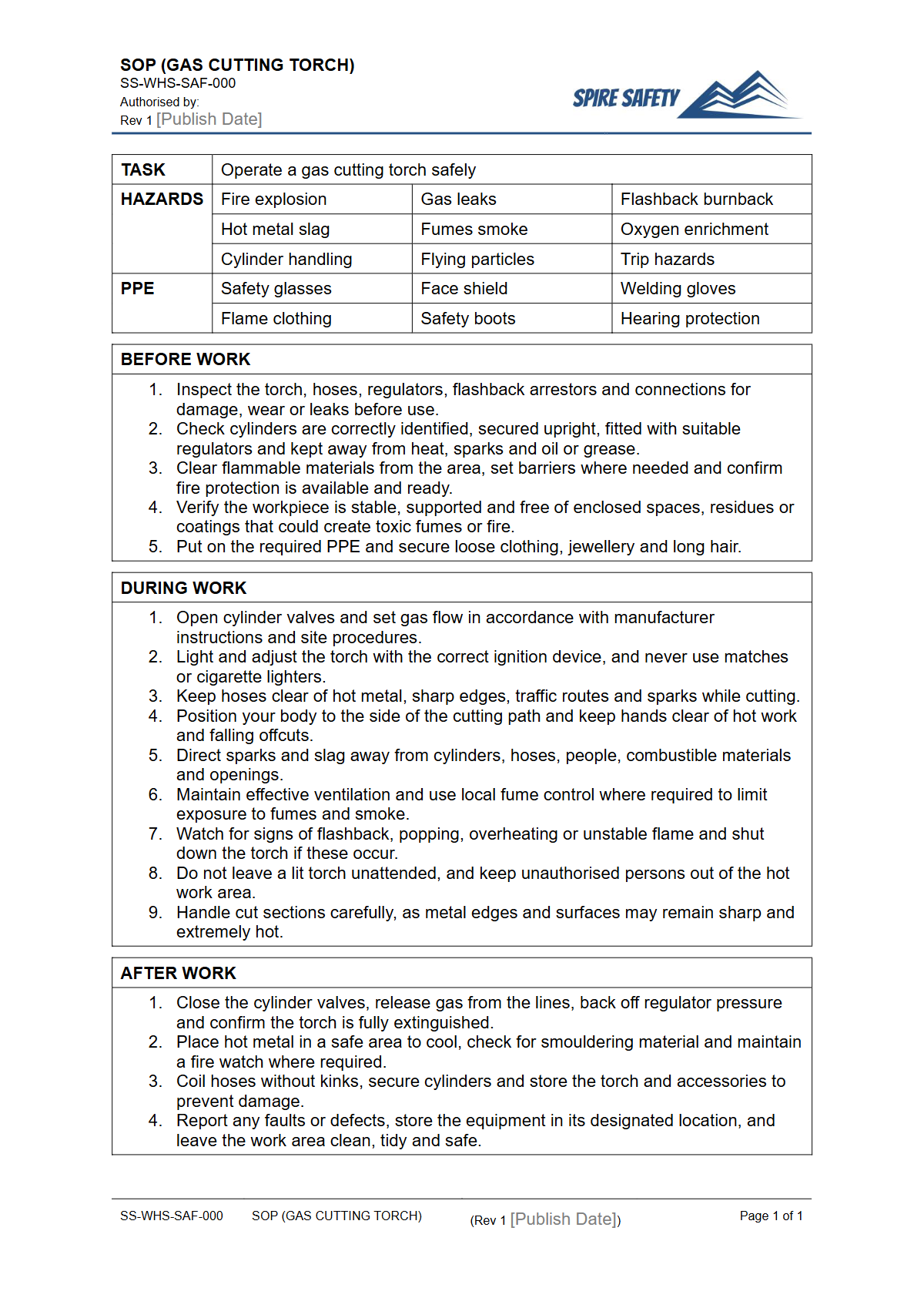
Download our free Safe Operating Procedure for Gas Cutting Torch use. This template helps you outline critical safety steps for oxy-fuel cutting.
Free Safe Operating Procedure (Gas Cutting Torch) Template
DOCX • 126 KB + PDF
Updated Oct 2026
No signup required
Purpose of the Free Safe Operating Procedure (Gas Cutting Torch) Template
This Free Safe Operating Procedure (Gas Cutting Torch) Template provides a structured framework for documenting the safety requirements for using oxy-acetylene, oxy-LPG, or other oxy-fuel cutting equipment. It is designed to assist businesses in establishing clear, step-by-step instructions to manage the significant risks associated with gas cutting, such as fire, explosion, burns, and exposure to hazardous fumes.
The template is aligned with Australian WHS principles and encourages a systematic approach to workplace safety, forming a key part of your operational risk management.
A Safe Operating Procedure (SOP) is an essential administrative control that provides workers with a consistent and safe method for performing a task. For a high-risk activity like gas cutting, having a documented procedure ensures that all operators understand the required precautions, from pre-start checks to shutdown and emergency responses.
This helps to minimise human error, protect workers from harm, and assist the PCBU (Person Conducting a Business or Undertaking) in meeting their primary duty of care. For similar hot work processes, you might also find value in our free Plasma Cutter SOP template.
Key Hazards Addressed
Using this template helps you formally address and control the specific hazards of gas cutting, including:
- Fire and Explosion: From leaking flammable gases (acetylene, LPG) in the presence of an ignition source or oxygen enrichment.
- Flashback: The recession of the flame back into the torch, hoses, or regulator, which can lead to equipment rupture or explosion. The SOP outlines the role of flashback arrestors.
- Hazardous Fumes and Gases: Inhalation of fumes from base metals, coatings (e.g., paint, zinc), and gases like ozone and nitrogen oxides.
- Burns: Contact with the flame, hot metal, sparks, or slag.
- Cylinder Hazards: Risks associated with the manual handling, storage, and transport of high-pressure gas cylinders.
- Eye Injuries: Exposure to intense ultraviolet (UV) and infrared (IR) radiation from the flame.
Video walkthrough
How to use the Free Safe Operating Procedure (Gas Cutting Torch) Template
Using this template is a straightforward process. First, download the document in your preferred format (DOCX for easy editing or PDF).
Next, systematically work through each section, customising the content to align with your specific workplace. This involves adding your company name and logo, identifying the specific gas cutting equipment used, and detailing the unique environmental conditions of your work areas.
Review the pre-filled steps for pre-operational checks, operation, and post-operational procedures. Adjust, add, or remove steps to ensure the SOP accurately reflects your processes.
It is vital that the final document is practical and easily understood by the workers who will use it. Once customised, the SOP should be used as a basis for training and competency assessments.
Should you require assistance in tailoring documents to your specific operational needs, Spire Safety offers specialist WHS consulting support to help refine your safety documentation.
Important: This document is a template and must be customised. To ensure it is effective and relevant, we recommend you adapt it to reflect the specific gas cutting equipment, site conditions, and legal requirements applicable to your workplace.
The final SOP should be reviewed and approved by a competent person before implementation.
When to use a Gas Cutting Torch SOP
A Safe Operating Procedure for gas cutting should be developed and implemented before any worker is permitted to operate the equipment. It serves as a primary reference document in several key scenarios:
- Worker Training and Induction: The SOP is a fundamental tool for training new operators, ensuring they learn the approved, safe method from the outset.
- Refresher Training: It should be used for periodic refresher training to reinforce safe work habits and introduce any updates to procedures or equipment.
- Task Planning: Supervisors and workers should review the SOP before starting a non-routine or complex cutting job to re-familiarise themselves with the required controls.
- Incident Investigation: In the event of an incident or near miss, the SOP provides a benchmark against which actual work practices can be compared.
- Audits and Inspections: The SOP serves as evidence of a documented safe system of work during internal or external safety audits. Having a clear procedure for related equipment, such as an Air Compressor SOP for workshop air supply, further demonstrates a commitment to safety.
Who should use this Safe Operating Procedure
The responsibility for using and maintaining this SOP is shared across different roles within an organisation. It is a critical document for anyone involved in the lifecycle of gas cutting tasks.
Workers/Operators: Must be trained on and follow the steps outlined in the finalised SOP every time they use gas cutting equipment. They have a responsibility to work safely and report any issues with the equipment or procedure.
Supervisors and Line Managers: Are responsible for ensuring that operators are trained and competent, that the SOP is being followed correctly, and that all required safety measures (like PPE and fire watches) are in place. They often lead the customisation and review process.
PCBUs/Management: Hold the ultimate responsibility for providing a safe workplace. This includes ensuring that effective SOPs are developed, implemented, and maintained as part of broader comprehensive WHS management systems.
WHS/HSE Professionals: Often facilitate the development and review of SOPs, provide expert advice on risk controls, and integrate the documents into the overall safety framework. For those in metal fabrication, a similar approach can be applied by creating a Brake Press SOP to standardise another high-risk task.
Common mistakes
Common mistakes to avoid
- Using damaged or incorrect hoses and fittings for the specific gas type.
- Failing to purge gas lines individually before lighting the torch, creating a risk of flashback.
- Leaving gas cylinders unsecured or lying on their side during use.
- Performing cutting near flammable or combustible materials without proper clearing or fire-resistant shielding.
Legal references
Legal considerations
The following legal requirements may be relevant to this type of work.
- Work Health and Safety Act (Harmonised) — Provides the primary duties for protecting workers and other people from work health and safety risks.
- Work Health and Safety Regulations (Harmonised) — Sets out requirements supporting the management of workplace hazards and risks.
The following codes may be relevant to this type of work.
- Managing WHS Risks Code of Practice — Provides practical guidance on identifying hazards, assessing risks and applying effective controls.
- Work Health and Safety Consultation, Cooperation and Coordination Code of Practice — Provides practical guidance on consulting workers and coordinating with other duty holders.
- Managing the Work Environment and Facilities Code of Practice — Provides practical guidance on safe work environments, workplace facilities and related controls.
Did you know
Unstable by Nature
Acetylene is highly unstable at pressures above 15 PSI (103 kPa) and can decompose explosively. To be stored safely, it is dissolved in acetone within a porous mass inside the cylinder.
Melting Point
An oxy-acetylene flame can reach temperatures exceeding 3,300°C. This is significantly hotter than the melting point of steel (around 1,500°C), allowing it to cut through thick sections with ease.
FAQ
Frequently asked questions
01What is the difference between an SOP and a SWMS for gas cutting?
02What PPE is required for gas cutting?
03How often should gas cutting equipment be inspected?
04Do I need a hot work permit for gas cutting?
Share this resource
Free Safe Operating Procedure (Gas Cutting Torch) Template
Browse Categories
How To Use It
- 1Download and open in Word or PDF.
- 2Replace the placeholders with your business details.
- 3Get it reviewed by a WHS specialist before rollout.
Need it customised?
Our WHS consultants can adapt this template to your site, run a gap analysis, or audit what you already have in place.
Book a Free Consultation WHS consulting servicesor call 1300 156 382
Related templates
- Free Safe Operating Procedure (Gas Cylinder Change) Template
- Free Safe Operating Procedure (Gas Cylinder Handling) Template
- Free Safe Operating Procedure (Gas Detector Bump Test) Template
- Free Safe Operating Procedure (Gas Detector Calibration) Template
- Free Safe Operating Procedure (Gas Heater) Template
- Free Safe Operating Procedure (Gas Regulator Change) Template