
Free Safe Operating Procedure (Garden Waste Loading) Template
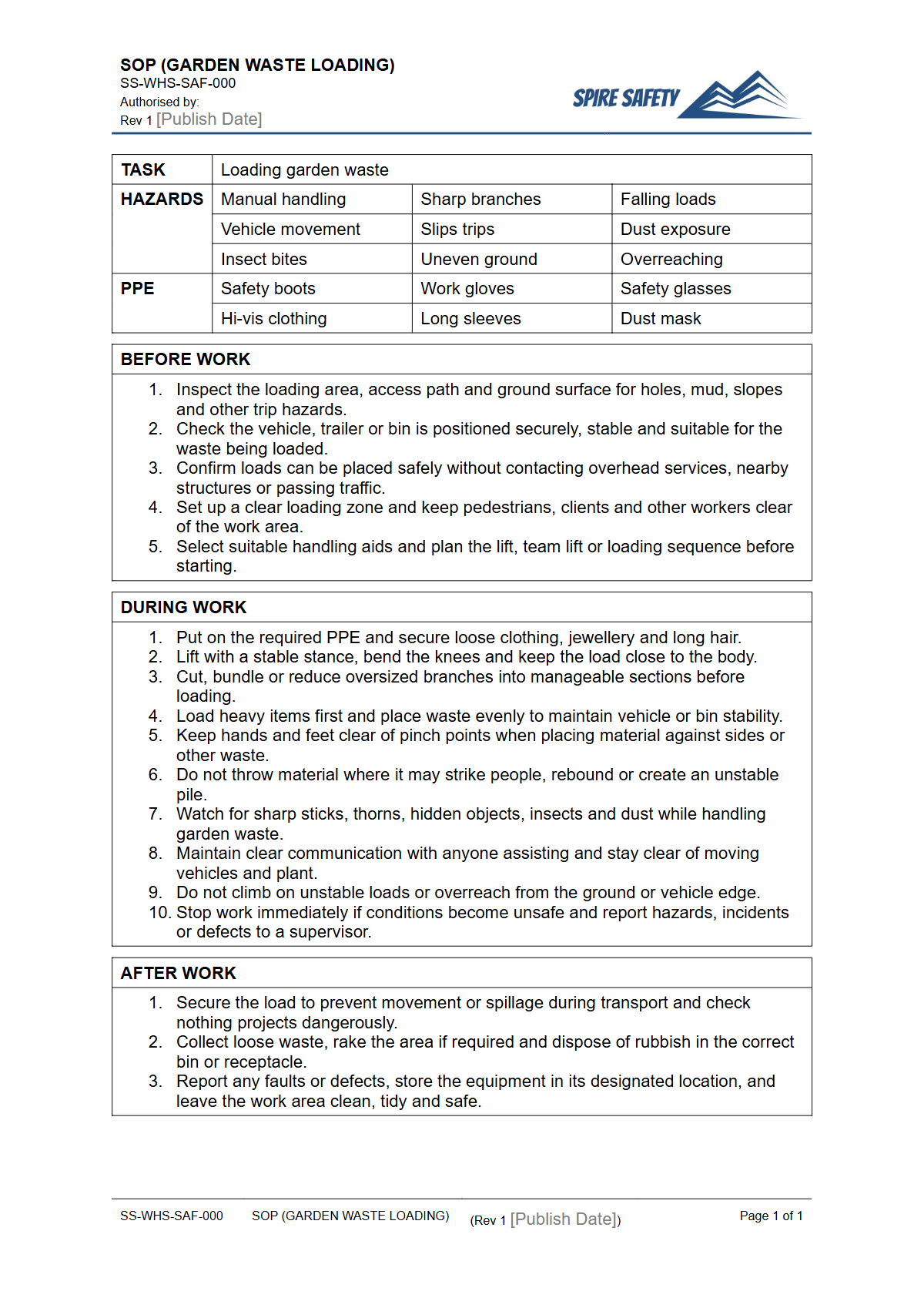
Download our free Safe Operating Procedure (Garden Waste Loading) Template. This customisable DOCX and PDF resource helps formalise safety steps for your team.
Free Safe Operating Procedure (Garden Waste Loading) Template
DOCX • 126 KB + PDF
Updated Oct 2026
No signup required
Purpose of the Free Safe Operating Procedure (Garden Waste Loading) Template
This Safe Operating Procedure (SOP) template provides a structured starting point for documenting the process of loading garden waste. Properly managing this task is crucial for preventing injuries and ensuring operational safety.
Our free Safe Operating Procedure (Garden Waste Loading) Template helps organisations in the landscaping, arboriculture, and waste management sectors to formalise controls for common hazards. These risks include manual handling injuries, contact with machinery, slips and falls, and exposure to biological agents like mould and fungi.
By outlining a step-by-step process, pre-operational checks, and required personal protective equipment (PPE), this document helps standardise safe work practices. A documented procedure is a fundamental part of a robust safety management system, ensuring that all workers understand the expected safety standards and controls.
For tasks involving specific machinery, you may also need equipment-specific procedures, such as a telehandler SOP if one is used for lifting bulk materials.
Video walkthrough
How to use the Free Safe Operating Procedure (Garden Waste Loading) Template
This template is provided in an editable DOCX format for easy customisation. To use it effectively, you must adapt its contents to reflect the specific circumstances of your workplace.
This includes identifying the exact equipment used (e.g., chippers, front-end loaders, tipper trucks), the types of waste handled, and the unique environmental conditions of your site.
Important: This is a template only. It is not a complete or ready-to-use document.
We have drafted it as a foundation, but you are responsible for adding, removing, and amending the content to ensure it is suitable for your business. The final document must reflect your specific risk assessment and control measures.
If you require assistance tailoring safety documents to your operations, consider engaging expert WHS consulting services.
Key Hazards in Garden Waste Loading
Your risk assessment should identify hazards specific to your operations. Common risks associated with loading garden waste include:
- Manual Handling: Sprains and strains from lifting, carrying, or throwing heavy or awkward items like logs, branches, and bags of clippings.
- Slips, Trips, and Falls: Uneven ground, wet surfaces, and scattered debris create a significant fall risk.
- Struck-by Hazards: Contact with moving vehicles like trucks or loaders, or being hit by falling objects from a pile or during loading.
- Biological Hazards: Inhaling dust, mould spores, or bacteria from decomposing organic matter. Contact with soil can also pose a tetanus risk.
- Mechanical Hazards: Entanglement, cuts, or crush injuries from equipment like wood chippers or conveyors.
- Noise: Hazardous noise levels from machinery can lead to permanent hearing damage if not properly controlled.
When to use this Safe Operating Procedure
An SOP for garden waste loading should be used as a primary reference tool for workers and supervisors. It should be consulted during worker training and inductions to establish a baseline for safe performance.
It also serves as a critical document for pre-start meetings or toolbox talks before the task begins. Furthermore, the SOP is an essential reference document during incident investigations and regular safety audits to ensure procedures are being followed correctly.
It can be used alongside other task-specific documents, like a circular saw SOP, if waste requires processing before being loaded.
Who should use this Safe Operating Procedure
This document is designed for any person conducting a business or undertaking (PCBU) whose workers are involved in loading garden waste. This includes:
- Landscaping businesses
- Arborists and tree removal services
- Local councils and parks maintenance crews
- Waste transfer stations and recycling facilities
- Horticultural and agricultural operations
Specific roles that will benefit from this SOP include machinery operators, groundskeepers, supervisors who oversee the work, and WHS managers responsible for developing and implementing WHS management systems. It provides clarity on responsibilities and ensures a consistent approach to safety across the organisation.
Integrating the SOP into Your Safety System
A document alone does not create a safe workplace. To be effective, this SOP must be fully integrated into your daily operations.
This involves training all relevant workers on its contents and verifying they understand the procedures. Supervisors must be empowered to enforce the SOP and stop work if conditions become unsafe.
The procedure should be readily accessible to workers at the location where the task is performed. Regular reviews, especially after an incident or when a new process is introduced, are vital to keep the document relevant and effective. The effectiveness of its implementation can be verified through periodic WHS compliance audits.
This document is just one of many resources available to help you build a safer workplace. For more templates and guides, browse our complete free WHS resources library.
Common mistakes
Common mistakes to avoid
- Failing to customise the template with site-specific hazards and equipment details.
- Neglecting to train workers on the finished SOP and verify their understanding.
- Not making the SOP easily accessible to workers at the job site.
- Treating the SOP as a one-time task instead of a living document that requires regular review and updates.
Legal references
Legal considerations
The following legal requirements may be relevant to this type of work.
- Work Health and Safety Act (Harmonised) — Provides the primary duties for protecting workers and other people from work health and safety risks.
- Work Health and Safety Regulations (Harmonised) — Sets out requirements supporting the management of workplace hazards and risks.
The following codes may be relevant to this type of work.
- Managing WHS Risks Code of Practice — Provides practical guidance on identifying hazards, assessing risks and applying effective controls.
- Work Health and Safety Consultation, Cooperation and Coordination Code of Practice — Provides practical guidance on consulting workers and coordinating with other duty holders.
- Managing the Work Environment and Facilities Code of Practice — Provides practical guidance on safe work environments, workplace facilities and related controls.
Did you know
Manual Handling Risk
According to Safe Work Australia, body stressing, which includes hazardous manual tasks, accounts for 37% of all serious workers' compensation claims. Loading garden waste is a key source of such risks.
Hidden Dangers
Green waste isn't just wood and leaves. It can contain hidden hazards like pesticides, sharp objects, animal waste, and allergenic pollens or fungi, making appropriate PPE essential for worker safety.
FAQ
Frequently asked questions
01What should be included in a Safe Operating Procedure for garden waste loading?
02Is a specific licence required to load garden waste?
03How often should an SOP for garden waste loading be reviewed?
04Can this template be used for commercial composting facilities?
Share this resource
Free Safe Operating Procedure (Garden Waste Loading) Template
Browse Categories
How To Use It
- 1Download and open in Word or PDF.
- 2Replace the placeholders with your business details.
- 3Get it reviewed by a WHS specialist before rollout.
Need it customised?
Our WHS consultants can adapt this template to your site, run a gap analysis, or audit what you already have in place.
Book a Free Consultation WHS consulting servicesor call 1300 156 382
Related templates
- Free Safe Operating Procedure (Garden Waste Removal) Template
- Free Safe Operating Procedure (Garden Watering) Template
- Free Safe Operating Procedure (Garment Steamer) Template
- Free Safe Operating Procedure (Gas Bottle Storage) Template
- Free Safe Operating Procedure (Gas Bottle Trolley) Template
- Free Safe Operating Procedure (Gas Cooktop) Template