
Free Safe Operating Procedure (Garden Waste Removal) Template
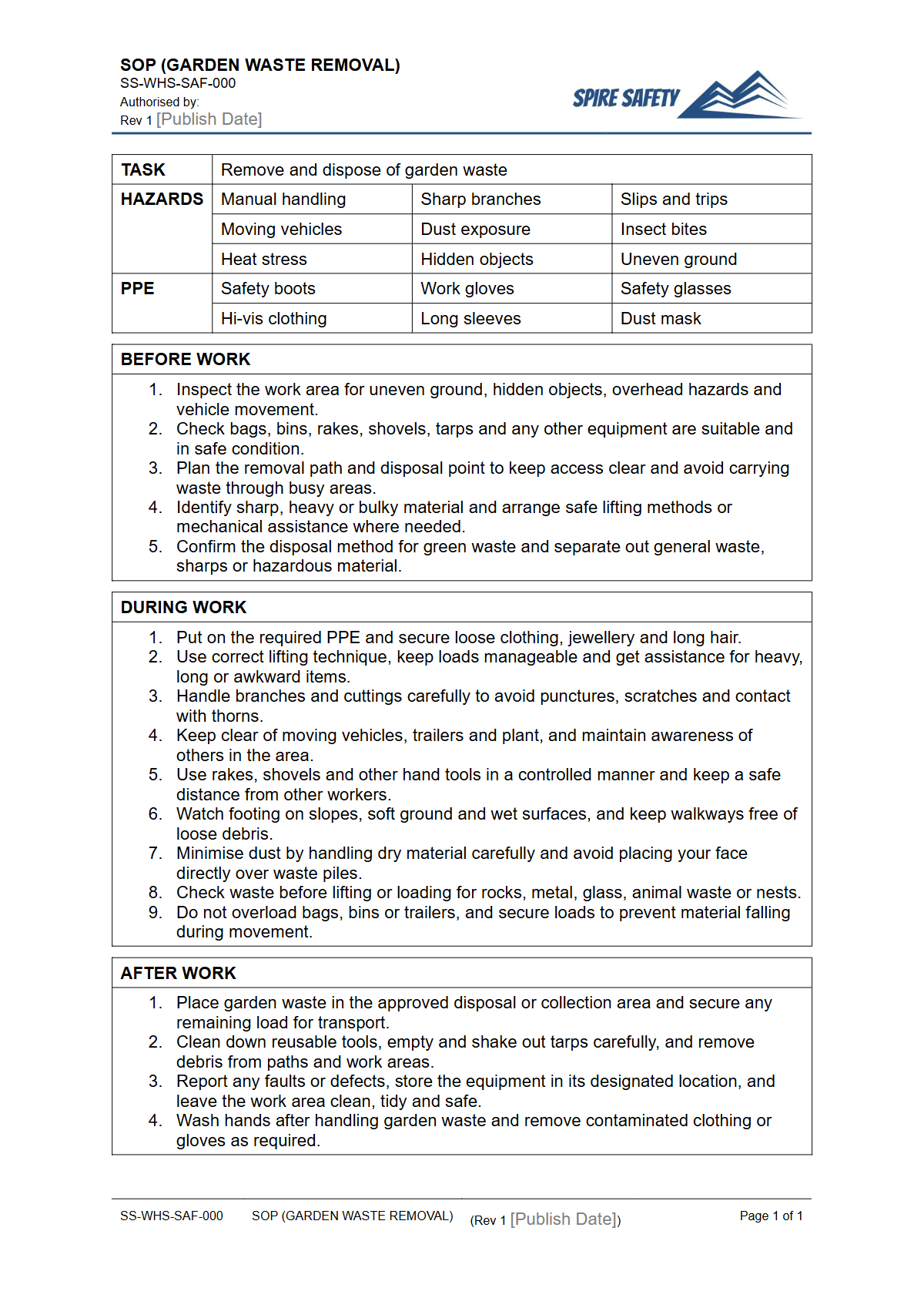
Download our Free Safe Operating Procedure (Garden Waste Removal) Template to document safe work practices for clearing and disposing of green waste.
Free Safe Operating Procedure (Garden Waste Removal) Template
DOCX • 126 KB + PDF
Updated Oct 2026
No signup required
Purpose of the Free Safe Operating Procedure (Garden Waste Removal) Template
This Free Safe Operating Procedure (Garden Waste Removal) Template provides a structured framework for documenting the hazards and control measures associated with collecting, handling, and disposing of green waste. It guides businesses in outlining a safe system of work to minimise risks like manual handling injuries, cuts from tools, and exposure to biological hazards.
Properly developed, this document forms a critical part of your broader WHS management systems, ensuring tasks are performed consistently and safely by all personnel.
The template is designed to be a comprehensive starting point, aligned with Australian WHS principles. It prompts you to consider every stage of the task, from pre-start checks and site assessment to the use of specific equipment, personal protective equipment (PPE) requirements, and waste disposal protocols.
Using a formalised SOP helps demonstrate due diligence and a commitment to protecting your workers' health and safety.
Video walkthrough
How to use the Free Safe Operating Procedure (Garden Waste Removal) Template
To use the Safe Operating Procedure for Garden Waste Removal, download the file in your preferred format (DOCX for easy editing or PDF). The core task is to adapt the document to the specific context of your workplace.
An SOP is not a 'one size fits all' document; its effectiveness depends entirely on its relevance to your unique operational environment.
Note: This template provides a foundational structure. We strongly advise that you consult with your workers and customise every section to reflect the specific machinery, tools, site conditions, and personnel at your workplace.
Your procedure must account for the actual risks your team faces.
Work through each section, including:
- Hazard Identification: List all potential hazards (e.g., heavy lifting, sharp branches, noisy machinery, uneven ground, snakes/spiders).
- Risk Control Measures: Detail the specific controls for each hazard (e.g., team lifting, use of gloves and eye protection, regular breaks, pre-inspection of the area).
- Required PPE: Specify non-negotiable PPE such as steel-capped boots, high-visibility clothing, hearing protection, and safety glasses.
- Step-by-Step Procedure: Break down the task into a logical sequence of safe actions, from site setup to final clean-up.
When to use it
A Safe Operating Procedure for garden waste removal should be used as a primary reference document before, during, and after the task. It is a vital tool for worker induction and training, ensuring new employees understand the established safe method from day one.
It should also be a key part of pre-start meetings or toolbox talks to refresh awareness of hazards and controls before work commences. Furthermore, the SOP serves as a benchmark for workplace inspections and a reference point during incident investigations to determine if prescribed procedures were followed.
For businesses needing support to integrate these documents effectively, our WHS consulting services can provide tailored guidance.
Who should use it
This SOP should be used by anyone involved in the garden waste removal process. This includes landscapers, gardeners, groundskeepers, property maintenance workers, and arborists.
Supervisors and managers have a responsibility to ensure the SOP is available, understood, and followed by their teams. The development and review of the SOP should be a consultative process, involving the workers who actually perform the task, as their direct experience is invaluable for identifying practical risks and effective controls.
For tasks involving specific equipment, workers must also be trained on the relevant SOPs for that machinery. For example, if tree limbs are being cut, workers must be familiar with the procedures outlined in a resource like our FREE Circular Saw SOP (Safe Operating Procedure) Template. Similarly, if pruning requires working off the ground, a procedure for safe access is critical, which can be detailed using a FREE Step Ladder SOP (Safe Operating Procedure) Template.
In large-scale land clearing operations that go beyond simple garden maintenance, heavy machinery may be involved. In these cases, operators must be competent and follow machine-specific procedures, which can be documented using resources like a FREE Dozer SOP (Safe Operating Procedure) Template.
By creating clear, task-specific procedures, your organisation can build a robust safety culture where everyone understands their role in preventing workplace incidents. Explore our complete free WHS resources library for more templates to support your safety management system.
Common mistakes
Common mistakes to avoid
- Failing to customise the template for specific site conditions, tools, and equipment.
- Neglecting to specify correct PPE for tasks like handling thorny plants or using powered tools.
- Using the SOP as a one-time 'tick-box' document instead of for ongoing training and supervision.
- Overlooking risks from biological hazards or vermin concealed within the waste pile.
Legal references
Legal considerations
The following legal requirements may be relevant to this type of work.
- Work Health and Safety Act (Harmonised) — Provides the primary duties for protecting workers and other people from work health and safety risks.
- Work Health and Safety Regulations (Harmonised) — Sets out requirements supporting the management of workplace hazards and risks.
The following codes may be relevant to this type of work.
- Managing WHS Risks Code of Practice — Provides practical guidance on identifying hazards, assessing risks and applying effective controls.
- Work Health and Safety Consultation, Cooperation and Coordination Code of Practice — Provides practical guidance on consulting workers and coordinating with other duty holders.
- Managing the Work Environment and Facilities Code of Practice — Provides practical guidance on safe work environments, workplace facilities and related controls.
Did you know
Manual Handling Risk
Musculoskeletal disorders from hazardous manual tasks are a leading cause of serious workers' compensation claims in Australia. Garden waste removal often involves repetitive lifting, bending, and carrying heavy loads.
Hidden Green Waste Hazards
Beyond physical risks, green waste can harbour allergens, mould spores, and pests like funnel-web spiders or snakes, making appropriate PPE and site inspection crucial.
FAQ
Frequently asked questions
01What hazards are involved in garden waste removal?
02Is a Safe Operating Procedure a legal requirement for garden waste removal?
03How often should an SOP for garden waste be reviewed?
04Can I use this template for commercial landscaping services?
Share this resource
Free Safe Operating Procedure (Garden Waste Removal) Template
Browse Categories
How To Use It
- 1Download and open in Word or PDF.
- 2Replace the placeholders with your business details.
- 3Get it reviewed by a WHS specialist before rollout.
Need it customised?
Our WHS consultants can adapt this template to your site, run a gap analysis, or audit what you already have in place.
Book a Free Consultation WHS consulting servicesor call 1300 156 382
Related templates
- Free Safe Operating Procedure (Garden Watering) Template
- Free Safe Operating Procedure (Garment Steamer) Template
- Free Safe Operating Procedure (Gas Bottle Storage) Template
- Free Safe Operating Procedure (Gas Bottle Trolley) Template
- Free Safe Operating Procedure (Gas Cooktop) Template
- Free Safe Operating Procedure (Gas Cutting Torch) Template