
Free Safe Operating Procedure (Gas Bottle Storage) Template
Download our free Safe Operating Procedure (Gas Bottle Storage) Template. This customisable DOCX and PDF resource helps you outline safe handling and storage.
Free Safe Operating Procedure (Gas Bottle Storage) Template
DOCX • 126 KB + PDF
Updated Oct 2026
No signup required
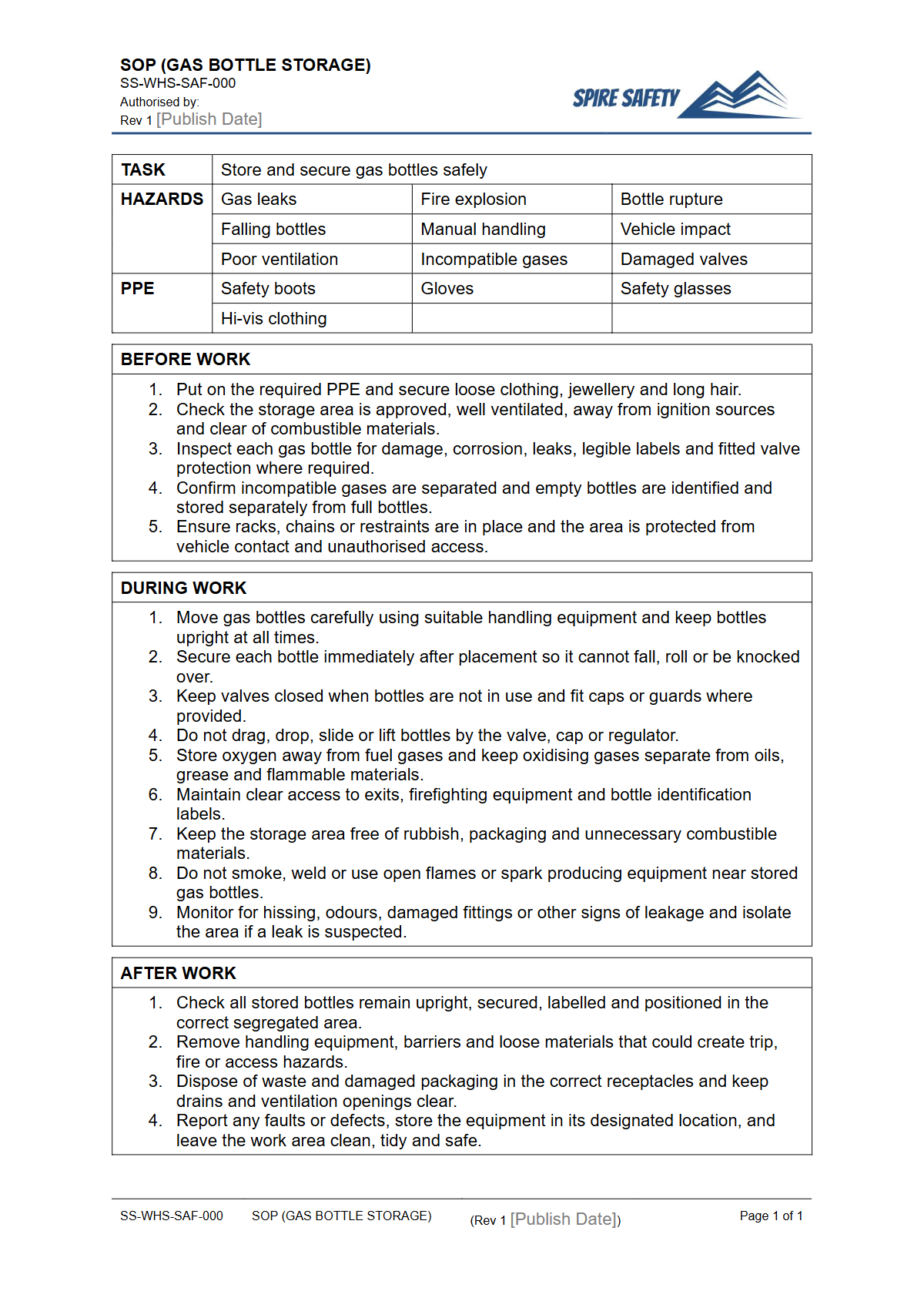
Purpose of the Free Safe Operating Procedure (Gas Bottle Storage) Template
Managing the risks associated with gas cylinders is a critical part of workplace safety. Our Free Safe Operating Procedure (Gas Bottle Storage) Template provides a structured starting point for documenting the required safety measures for handling and storing gas cylinders in your workplace.
This Safe Operating Procedure (SOP) helps you formalise protocols to prevent incidents such as fires, explosions, or exposure to hazardous substances. By clearly defining steps for storage, handling, and emergency response, this template helps your organisation meet its duty of care under Australian WHS laws.
Using a standardised procedure ensures that all workers understand the hazards and the correct methods for managing them. This is particularly important for high-risk items like gas cylinders, which can be flammable, oxidising, toxic, or simply present a hazard due to their high pressure.
Properly documented procedures are fundamental to a safe system of work, similar to the protocols outlined in our Free Plasma Cutter SOP (Safe Operating Procedure) Template, which often involves the use of compressed gases.
Video walkthrough
How to use the Free Safe Operating Procedure (Gas Bottle Storage) Template
This document is a template and is not a complete safety solution on its own. It is essential that you customise it to reflect the specific circumstances and hazards of your workplace.
To effectively use this SOP, download the DOCX file and consult with your team, including workers who directly handle the gas cylinders and their supervisors.
Follow these steps:
- Identify Specifics: Detail the types of gases used at your site (e.g., LPG, acetylene, oxygen, argon), their specific storage requirements, and the locations of storage areas.
- Site-Specific Procedures: Add details about your workplace layout, including designated storage cages, ventilation systems, and the location of emergency equipment like fire extinguishers and safety showers.
- Consult and Review: Engage with your workers to ensure the procedures are practical and understood. Incorporate their feedback to improve the document's effectiveness.
- Training and Implementation: Once finalised, use the SOP as a training tool for all relevant personnel. Ensure it is readily accessible in storage areas and integrated into your broader WHS management systems.
Important: We have developed this template as a guide. You must adapt it to your specific equipment, chemicals, and operational environment to ensure it is relevant and effective for your business.
When to use it
A Safe Operating Procedure for gas bottle storage should be implemented in any workplace where gas cylinders are used, handled, or stored. This applies across a vast range of industries, including construction, manufacturing, hospitality (for BBQ gas or post-mix systems), automotive workshops, laboratories, and agricultural operations.
The SOP is a live document that should be used for initial worker training, refresher training, and as a reference during day-to-day operations. It should also be reviewed and updated whenever there is a change in the types of gases used, storage arrangements, or following any related incident or near-miss.
Who should use it
This SOP is intended for use by multiple roles within an organisation. Workers and contractors who handle gas cylinders must be trained on and follow the procedures to ensure their own safety and that of others.
Supervisors and team leaders are responsible for enforcing the SOP, providing adequate supervision, and ensuring all controls are in place and functional. WHS Managers and Business Owners (PCBUs) should use this template to establish and formalise safe work practices, demonstrating due diligence in managing known workplace hazards.
The document serves as a critical tool for inducting new employees and verifying competency. For more complex safety challenges, seeking general WHS consulting can provide expert guidance.
Key Elements of Gas Bottle Storage Safety
A robust SOP for gas bottle storage should address several key control measures. These include:
- Segregation: Keeping incompatible gases separate, such as separating flammable gases (e.g., LPG) from oxidising gases (e.g., oxygen) by a safe distance (typically at least 3 metres) or a firewall.
- Ventilation: Ensuring storage areas, whether indoors or outdoors, have adequate ventilation to prevent the accumulation of flammable or toxic gases.
- Restraint: Securing all cylinders, both full and empty, in an upright position with chains or safety straps to prevent them from falling or being knocked over. Procedures for other workshop equipment, like those in our Free Brake Press SOP, also emphasise securing unstable components.
- Signage: Displaying correct placards and safety signs that identify the types of gases stored and warn of the relevant hazards (e.g., 'Flammable Gas', 'No Smoking').
- Housekeeping: Keeping storage areas clear of combustible materials, vegetation, and ignition sources.
These elements form the basis of a safe storage system and should be detailed within your customised SOP. You can find more templates and checklists in our free WHS resources library to support your safety management efforts.
Common mistakes
Common mistakes to avoid
- Storing cylinders without proper restraints, allowing them to be knocked over.
- Failing to segregate incompatible gases like oxygen and LPG.
- Keeping cylinders in poorly ventilated spaces or near ignition sources.
- Leaving valve protection caps off when cylinders are not in use.
- Storing full and empty cylinders together without clear labelling.
Legal references
Legal considerations
The following legal requirements may be relevant to this type of work.
- Work Health and Safety Act (Harmonised) — Provides the primary duties for protecting workers and other people from work health and safety risks.
- Work Health and Safety Regulations (Harmonised) — Sets out requirements supporting the management of workplace hazards and risks.
The following codes may be relevant to this type of work.
- Managing WHS Risks Code of Practice — Provides practical guidance on identifying hazards, assessing risks and applying effective controls.
- Work Health and Safety Consultation, Cooperation and Coordination Code of Practice — Provides practical guidance on consulting workers and coordinating with other duty holders.
- Managing the Work Environment and Facilities Code of Practice — Provides practical guidance on safe work environments, workplace facilities and related controls.
Did you know
Projectile Risk
A large, full gas cylinder pressurised to 200 bar can become a projectile with enough force to penetrate a brick wall if the valve is sheared off. This is why valve protection caps are critical during transport and storage.
Standardised Colours
In Australia, gas cylinder shoulder colours are standardised by AS 4484 to help identify the gas properties. For example, maroon indicates a Class 2.1 Flammable Gas, while light blue signifies a Class 2.2 Oxidising Gas.
FAQ
Frequently asked questions
01What should be included in a gas bottle storage SOP?
02Do gas bottles need to be stored outside?
03How far apart should different types of gas bottles be stored?
04Is this template suitable for all types of gas cylinders?
Share this resource
Free Safe Operating Procedure (Gas Bottle Storage) Template
Browse Categories
How To Use It
- 1Download and open in Word or PDF.
- 2Replace the placeholders with your business details.
- 3Get it reviewed by a WHS specialist before rollout.
Need it customised?
Our WHS consultants can adapt this template to your site, run a gap analysis, or audit what you already have in place.
Book a Free Consultation WHS consulting servicesor call 1300 156 382
Related templates
- Free Safe Operating Procedure (Gas Bottle Trolley) Template
- Free Safe Operating Procedure (Gas Cooktop) Template
- Free Safe Operating Procedure (Gas Cutting Torch) Template
- Free Safe Operating Procedure (Gas Cylinder Change) Template
- Free Safe Operating Procedure (Gas Cylinder Handling) Template
- Free Safe Operating Procedure (Gas Detector Bump Test) Template