
Free Safe Operating Procedure (Garden Watering) Template
Streamline your safety processes with our free Safe Operating Procedure (Garden Watering) Template. Aligned with Australian WHS standards.
Free Safe Operating Procedure (Garden Watering) Template
DOCX • 126 KB + PDF
Updated Oct 2026
No signup required
Purpose of the Free Safe Operating Procedure (Garden Watering) Template
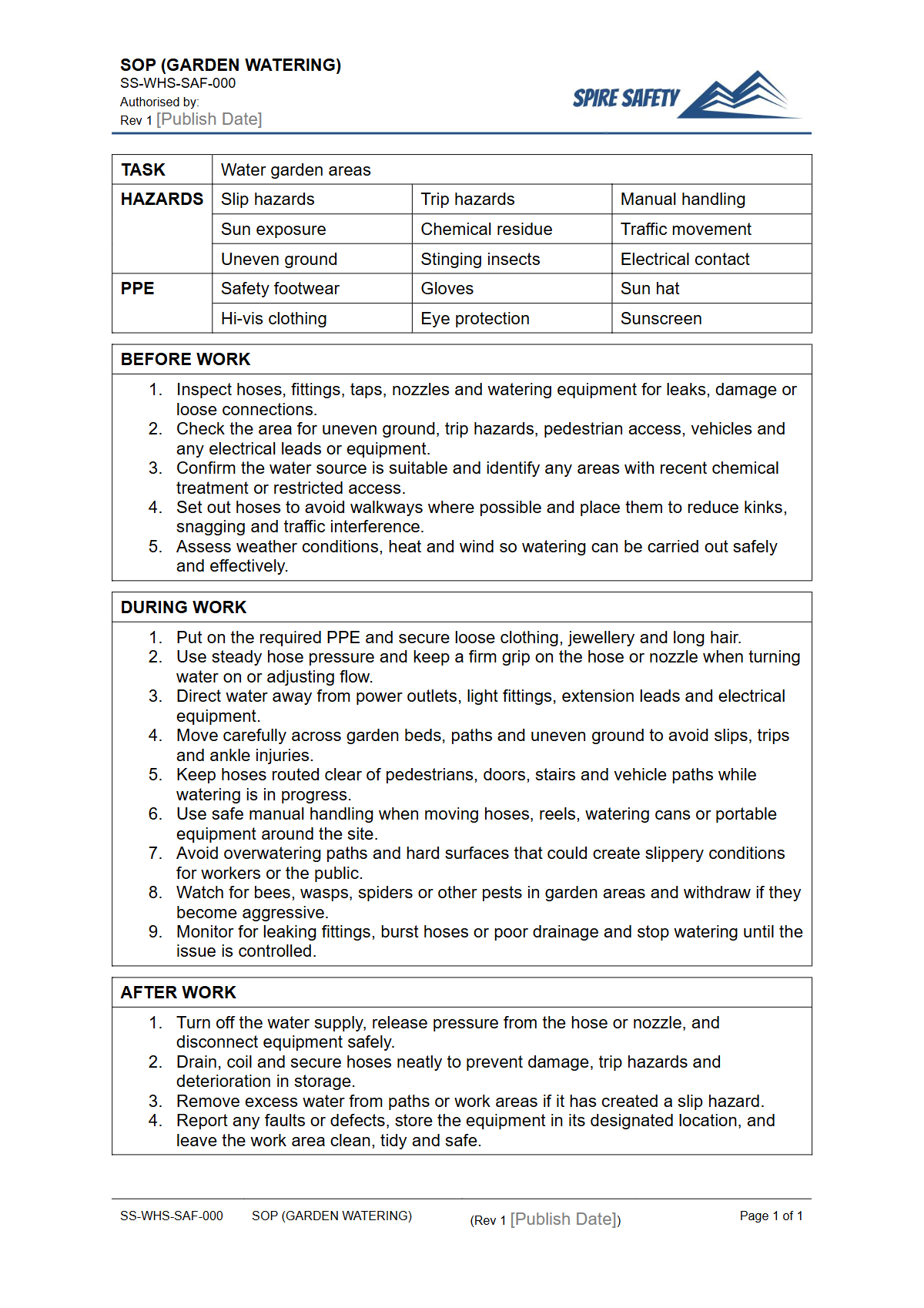
This Free Safe Operating Procedure (Garden Watering) Template provides a structured framework for outlining the risks and required controls for watering tasks in commercial or public settings. While often seen as a simple task, garden watering introduces hazards like slips on wet surfaces, trips over hoses, and manual handling strains from equipment.
This document helps a Person Conducting a Business or Undertaking (PCBU) meet their primary duty of care by establishing a safe system of work. It is designed to be adapted for various environments, including council parks, commercial landscaping projects, and large residential estates, ensuring workers have clear, step-by-step instructions to perform their duties safely.
Implementing a formal procedure demonstrates a commitment to proactive risk management. It guides workers on pre-start checks, safe work steps, and post-task clean-up, minimising the likelihood of incidents.
This SOP serves as a critical component of your broader WHS management systems, integrating seamlessly with risk assessments and worker training programs. By documenting the process, you create a consistent standard for all employees, which is essential for maintaining a safe working environment.
Video walkthrough
How to use the Free Safe Operating Procedure (Garden Watering) Template
This template is a comprehensive starting point, designed for easy customisation. To make it effective, you must adapt it to the specific conditions of your workplace.
Open the DOCX file and replace the placeholder text with details relevant to your site, equipment, and personnel. This includes identifying the specific types of watering equipment used (e.g., hose reels, sprinklers, watering cans), outlining the exact locations where watering occurs, and listing any site-specific hazards like uneven ground or public access areas.
Important: This is a template only. For it to be useful, we strongly recommend you customise it to reflect the unique risks and operational realities of your business and worksite.
You should consult with your workers during this process to ensure the procedure is practical and effective. Generic procedures often fail to control specific risks, so detailed customisation is key to ensuring worker safety and supporting your WHS duties.
When to use a Safe Operating Procedure
A Safe Operating Procedure for garden watering should be used whenever the task is performed as part of a commercial or organisational activity. It is particularly important for routine tasks that, despite being low-risk individually, can lead to injury over time or through complacency.
It should be a reference point during worker induction and regular toolbox talks, reinforcing safe behaviour. The SOP is also a vital tool following any changes to the work environment, such as the introduction of new watering systems or changes to the landscape layout.
It forms the basis of task-specific training and is a key document reviewed during safety inspections.
In addition to routine use, this document is essential for organisations aiming for a high standard of safety management. Systematically managing even low-risk tasks contributes to a stronger safety culture.
For groundskeeping teams that perform a variety of maintenance tasks, this SOP can sit alongside other procedures, like our Free Step Ladder SOP Template, to build a comprehensive safety manual for your operations.
Who should use this document
This Safe Operating Procedure template is designed for use by anyone responsible for workplace safety. This includes WHS managers, supervisors, team leaders, and business owners in sectors like landscaping, horticulture, local government, and property management.
It provides them with a tool to document and communicate safe work practices clearly. Frontline workers and groundskeepers are the end-users who will follow the procedure daily to complete their tasks safely.
Involving these workers in the customisation and review process is crucial for ensuring the SOP is practical and addresses the real-world challenges they face.
Organisations undergoing safety evaluations will also find this documented procedure valuable. It provides clear evidence of a systematic approach to hazard management, which is a key focus of any WHS compliance auditing process.
Whether you are managing a small team or a large department, this template provides a solid foundation for documenting your safety commitments. For more templates covering different types of equipment and tasks, you can browse our complete free WHS resources library.
For tasks that go beyond simple watering and involve more complex tools, having specific SOPs is vital. For example, maintenance work around a property might require the use of power tools.
You can ensure consistency in your safety documentation by using structured templates like our FREE Circular Saw SOP (Safe Operating Procedure) Template for other common activities.
Maintaining tools and equipment is also a critical part of a safe system of work. For workshops and maintenance sheds, processes should be clearly defined for all equipment.
A document like the Free Air Compressor SOP (Safe Operating Procedure) Template can help standardise procedures for tool cleaning and other related tasks, ensuring a holistic approach to safety across all operational areas.
Common mistakes
Common mistakes to avoid
- Using a generic template without adding site-specific hazards and controls.
- Failing to properly train workers on the finalised SOP and confirm their understanding.
- Leaving hoses across pathways or access routes, creating a significant trip hazard.
- Not reviewing or updating the SOP after an incident or when new equipment is introduced.
Legal references
Legal considerations
The following legal requirements may be relevant to this type of work.
- Work Health and Safety Act (Harmonised) — Provides the primary duties for protecting workers and other people from work health and safety risks.
- Work Health and Safety Regulations (Harmonised) — Sets out requirements supporting the management of workplace hazards and risks.
The following codes may be relevant to this type of work.
- Managing WHS Risks Code of Practice — Provides practical guidance on identifying hazards, assessing risks and applying effective controls.
- Work Health and Safety Consultation, Cooperation and Coordination Code of Practice — Provides practical guidance on consulting workers and coordinating with other duty holders.
- Managing the Work Environment and Facilities Code of Practice — Provides practical guidance on safe work environments, workplace facilities and related controls.
Did you know
Slips, Trips, and Falls
Slips, trips, and falls are a leading cause of serious injuries in Australian workplaces, accounting for a significant portion of workers' compensation claims each year. Poor hose management is a common and preventable cause.
Water Weight
A standard 25-metre garden hose full of water can weigh over 10kg, while a 9-litre watering can weighs over 9kg. Repetitive or awkward lifting of this weight poses a genuine risk of manual handling injury.
FAQ
Frequently asked questions
01What are the main hazards to include in a garden watering SOP?
02Is a Safe Operating Procedure legally required for garden watering in Australia?
03Who is responsible for developing and implementing this SOP?
04How often should a Safe Operating Procedure for garden watering be reviewed?
Share this resource
Free Safe Operating Procedure (Garden Watering) Template
Browse Categories
How To Use It
- 1Download and open in Word or PDF.
- 2Replace the placeholders with your business details.
- 3Get it reviewed by a WHS specialist before rollout.
Need it customised?
Our WHS consultants can adapt this template to your site, run a gap analysis, or audit what you already have in place.
Book a Free Consultation WHS consulting servicesor call 1300 156 382
Related templates
- Free Safe Operating Procedure (Garment Steamer) Template
- Free Safe Operating Procedure (Gas Bottle Storage) Template
- Free Safe Operating Procedure (Gas Bottle Trolley) Template
- Free Safe Operating Procedure (Gas Cooktop) Template
- Free Safe Operating Procedure (Gas Cutting Torch) Template
- Free Safe Operating Procedure (Gas Cylinder Change) Template