
Free Safe Operating Procedure (Garden Bed Weeding) Template
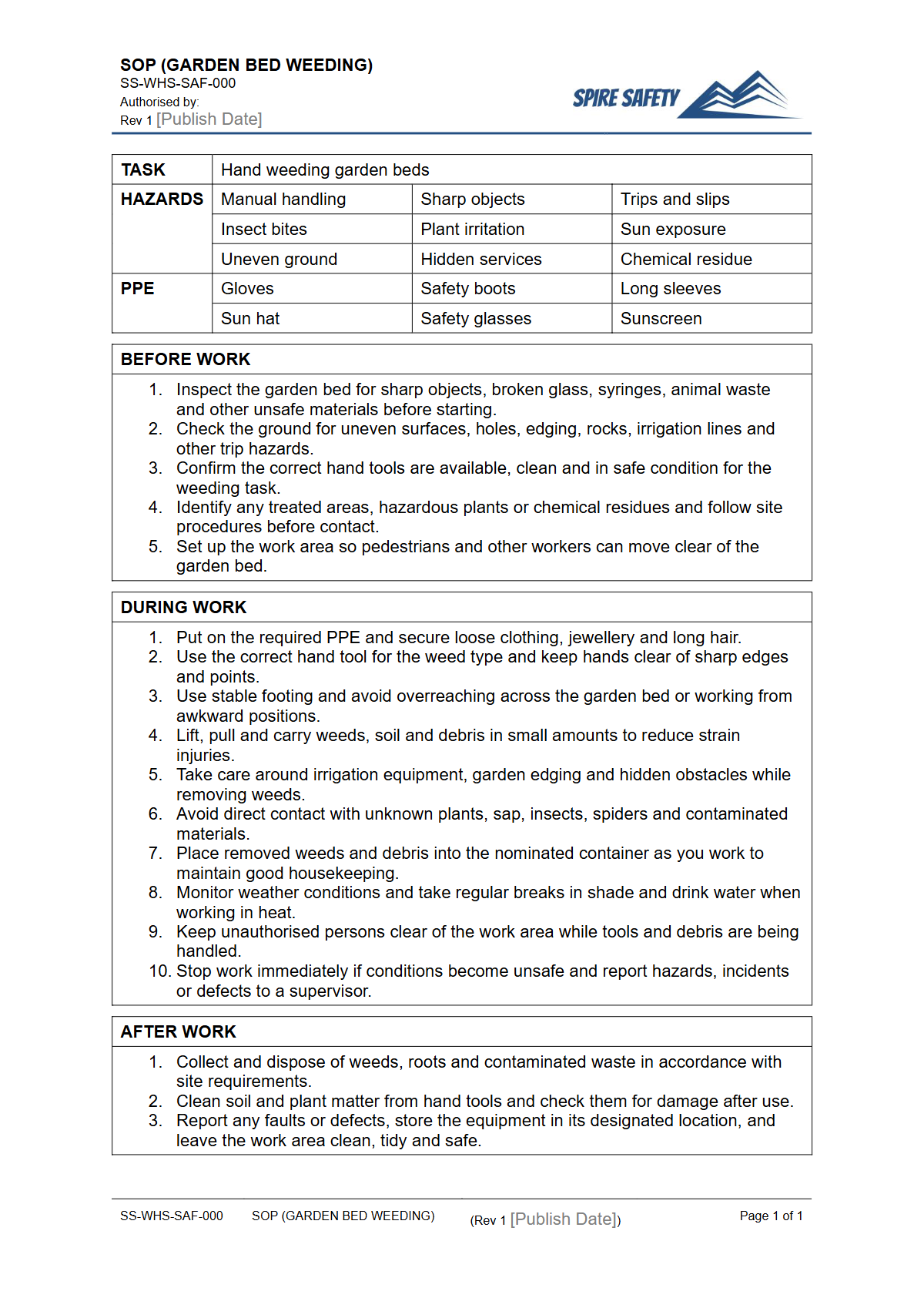
Download our free Safe Operating Procedure for garden bed weeding. This template helps outline risks and controls for manual weeding tasks.
Free Safe Operating Procedure (Garden Bed Weeding) Template
DOCX • 126 KB + PDF
Updated Oct 2026
No signup required
Purpose of the Free Safe Operating Procedure (Garden Bed Weeding) Template
This free Safe Operating Procedure (Garden Bed Weeding) Template provides a structured framework for documenting the risks and controls associated with manual weeding tasks in landscaping, horticulture, and property maintenance. A well-developed Safe Operating Procedure (SOP) is a critical tool for ensuring workers understand how to perform their duties safely, minimising the risk of injury from ergonomic strain, biological hazards, and environmental factors.
This document is an excellent starting point, designed to be adapted to the specific conditions of your workplace.
The primary purpose of this SOP is to establish a clear, documented process for weeding garden beds safely. It helps persons conducting a business or undertaking (PCBUs) fulfil their duty of care by identifying foreseeable hazards and implementing effective control measures.
By standardising the procedure, you can ensure consistent safety practices across all workers, reduce incident rates, and provide a clear reference for training and supervision. Integrating such procedures is a fundamental component of robust WHS management systems.
Video walkthrough
How to use the Free Safe Operating Procedure (Garden Bed Weeding) Template
Download the template in your preferred format (DOCX for easy editing or PDF) and begin customising it to fit your operational context. The document is pre-filled with common hazards and controls relevant to weeding, but it requires your specific input to be effective.
You must consult with your workers and conduct a site-specific risk assessment to identify all relevant hazards.
Important Note: This is a template, not a finished document. We cannot guarantee it will meet all your specific legal obligations.
You must edit the template to include your company details, specific site locations, the types of tools used (e.g., hand trowels, hoes), and the emergency procedures relevant to your organisation.
When to use this Safe Operating Procedure
This Safe Operating Procedure should be used before any worker undertakes manual weeding tasks. It is particularly important for new or inexperienced workers who require clear instruction.
It also serves as a valuable refresher for experienced staff and should be readily accessible in the work area or on a company's digital system. Use it as a basis for toolbox talks, pre-start meetings, and worker competency training. Regularly reviewing your SOPs is a key part of maintaining safety standards, a process that can be verified through a WHS compliance audit.
Who should use it
This SOP is intended for workers, supervisors, and managers in industries such as landscaping, horticulture, agriculture, groundskeeping, and local government parks and gardens teams. Supervisors should use it to train workers and monitor their safe work behaviour.
Workers should use it to understand the approved, safe method for completing the task. While this document covers manual weeding, tasks involving mechanised ground preparation may require a separate procedure, such as our FREE Trencher SOP Template.
Key Hazards and Control Measures
When customising this template, pay close attention to the following common hazards associated with garden bed weeding:
Ergonomic Hazards
Repetitive bending, prolonged kneeling, twisting, and forceful pulling can lead to musculoskeletal disorders (MSDs). Controls include:
- Providing ergonomic tools with long handles to minimise bending.
- Encouraging regular breaks and task rotation to avoid sustained postures.
- Training workers in correct manual handling techniques, such as keeping the back straight and bending at the knees.
- Providing knee pads or kneeling mats.
Biological Hazards
Garden beds can harbour various biological hazards. Controls involve:
- Inspecting the work area for spiders, snakes, wasps, and ants before starting work.
- Wearing thick, puncture-resistant gloves and enclosed, sturdy footwear.
- Training workers to recognise and avoid hazardous plants or fungi.
- Ensuring access to first aid kits and personnel trained to handle bites and stings.
Environmental Hazards
Outdoor work exposes workers to weather-related risks. Key hazards are sun exposure and heat stress. Controls should include:
- Scheduling weeding for cooler parts of the day where practical.
- Providing access to shade and clean drinking water.
- Implementing a policy for sun protection, including wide-brimmed hats, UV-rated clothing, and sunscreen.
These environmental controls are crucial for all outdoor work, including tasks that may involve working at heights, as covered in our FREE Step Ladder SOP Template.
Tool-Related and Foreign Object Hazards
The soil itself can conceal sharp objects like broken glass, metal, or rocks, and hand tools can cause cuts or punctures. Controls should focus on:
- Wearing appropriate gloves to protect hands.
- Visually inspecting the area before starting and proceeding with caution.
- Ensuring all hand tools are well-maintained, free from damage, and fit for purpose.
In broader agricultural settings, different equipment-specific procedures are vital, such as our FREE Grain Drill SOP (Safe Operating Procedure) Template, which addresses a different set of machinery-related risks.
By implementing a comprehensive and customised Safe Operating Procedure, your organisation can demonstrate a proactive approach to managing health and safety. This not only protects your workers but also strengthens your overall safety culture. For more templates and safety guides, explore our complete free WHS resources library.
Common mistakes
Common mistakes to avoid
- Forgetting to inspect the area for hidden hazards like sharps, pests, or uneven ground before starting.
- Using poor manual handling techniques, such as twisting while lifting or bending from the back instead of the knees.
- Failing to provide or use appropriate personal protective equipment (PPE) like gloves and sun protection.
- Treating the SOP template as a final document without customising it for specific site conditions, tools, and workers.
Legal references
Legal considerations
The following legal requirements may be relevant to this type of work.
- Work Health and Safety Act (Harmonised) — Provides the primary duties for protecting workers and other people from work health and safety risks.
- Work Health and Safety Regulations (Harmonised) — Sets out requirements supporting the management of workplace hazards and risks.
The following codes may be relevant to this type of work.
- Managing WHS Risks Code of Practice — Provides practical guidance on identifying hazards, assessing risks and applying effective controls.
- Work Health and Safety Consultation, Cooperation and Coordination Code of Practice — Provides practical guidance on consulting workers and coordinating with other duty holders.
- Managing the Work Environment and Facilities Code of Practice — Provides practical guidance on safe work environments, workplace facilities and related controls.
Did you know
Ergonomic Risk
Repetitive bending, kneeling, and pulling associated with weeding are leading causes of musculoskeletal injuries among horticultural and landscaping workers in Australia.
Hidden Hazards
Soil can conceal sharp objects like glass, metal, or even venomous spiders and snakes, making a pre-work inspection and appropriate glove use critical control measures.
FAQ
Frequently asked questions
01What hazards should an SOP for garden bed weeding cover?
02How often should a Safe Operating Procedure for weeding be reviewed?
03Is a Safe Operating Procedure legally required for simple tasks like weeding?
04What PPE is generally recommended for garden bed weeding?
Share this resource
Free Safe Operating Procedure (Garden Bed Weeding) Template
Browse Categories
How To Use It
- 1Download and open in Word or PDF.
- 2Replace the placeholders with your business details.
- 3Get it reviewed by a WHS specialist before rollout.
Need it customised?
Our WHS consultants can adapt this template to your site, run a gap analysis, or audit what you already have in place.
Book a Free Consultation WHS consulting servicesor call 1300 156 382
Related templates
- Free Safe Operating Procedure (Garden Path Cleaning) Template
- Free Safe Operating Procedure (Garden Tool Cleaning) Template
- Free Safe Operating Procedure (Garden Waste Loading) Template
- Free Safe Operating Procedure (Garden Waste Removal) Template
- Free Safe Operating Procedure (Garden Watering) Template
- Free Safe Operating Procedure (Garment Steamer) Template