
Free Safe Operating Procedure (Garage Door Service) Template
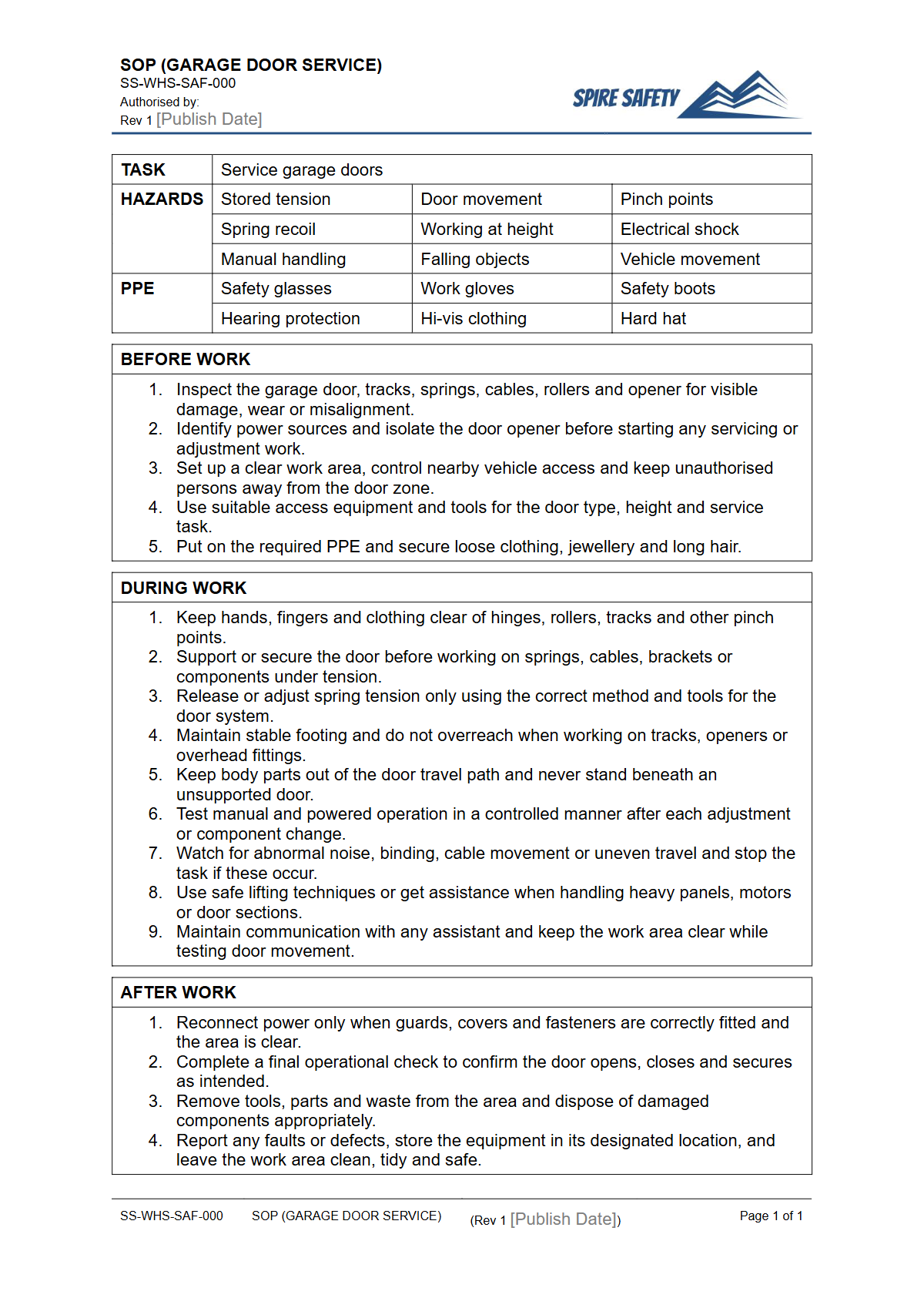
Download our free Safe Operating Procedure (Garage Door Service) template.
Free Safe Operating Procedure (Garage Door Service) Template
DOCX • 126 KB + PDF
Updated Oct 2026
No signup required
Purpose of the Free Safe Operating Procedure (Garage Door Service) Template
Servicing and repairing garage doors involves significant risks, from high-tension springs and electrical components to heavy moving parts. This Free Safe Operating Procedure (Garage Door Service) Template provides a structured foundation for documenting a safe, step-by-step process for these tasks.
Formalising your procedures helps standardise work methods, reduce the likelihood of incidents, and demonstrate a commitment to health and safety.
A well-defined Safe Operating Procedure is a critical administrative control measure and a key component of effective WHS management systems. It acts as a primary training tool for new technicians and a vital reference for experienced workers, ensuring that safety-critical steps are never overlooked. This template is designed to guide you in capturing your organisation's specific processes for garage door installation, maintenance, and repair.
Key Hazards Addressed
While not exhaustive, the template prompts you to consider and document controls for common hazards associated with garage door servicing, including:
- Stored Mechanical Energy (torsion and extension springs)
- Electrical Hazards (live components, faulty wiring)
- Crushing and Pinch Points (moving doors, rails, and mechanisms)
- Manual Handling (lifting heavy doors, motors, and tools)
- Working at Heights (use of ladders)
- Hazardous Substances (lubricants, cleaners, solvents)
- Slips, Trips, and Falls
Video walkthrough
How to use the Free Safe Operating Procedure (Garage Door Service) Template
This downloadable document is a template, not a finished, ready-to-use procedure. To be effective and align with your WHS duties, it must be customised to reflect the specific equipment, environment, and tasks performed by your workers.
Important: We strongly recommend you consult with your workers—the technicians who perform the tasks—and other relevant parties when customising this document. Their direct experience is invaluable for identifying all potential hazards and developing practical, effective control measures.
Follow these steps to implement this Safe Operating Procedure:
- Download the DOCX or PDF file.
- Review the contents and identify sections that need specific details about your workplace.
- Add information about the specific types of garage doors, motors, and tools your team uses.
- Incorporate details from the Safety Data Sheets (SDS) for any chemicals used.
- Document your site-specific emergency procedures, including contact information.
- Have the final document reviewed and approved by a competent person (e.g., a manager or WHS officer).
- Train all relevant workers on the finalised SOP and ensure they have easy access to it.
When to use it
A Safe Operating Procedure for garage door service should be used as a primary reference document for all related work. It is not a document to be filed away and forgotten. Use it during:
- Training and Onboarding: Ensure all new employees are trained on the established safe procedures before they begin work.
- Pre-Task Planning: Workers should review the SOP before starting a job, especially for non-routine or complex repairs.
- Toolbox Talks: Use the SOP as a basis for regular safety meetings to reinforce correct procedures and discuss any near misses.
- Incident Investigations: If an incident occurs, the SOP serves as a benchmark to assess whether procedures were followed and if they need to be updated.
Many commercial garage door systems use pneumatic operators, which introduces another layer of risk. Ensure your procedures also cover the safe use of related equipment by referring to a specific air compressor SOP where applicable.
Who should use it
This Safe Operating Procedure is intended for all personnel involved in the lifecycle of garage door servicing. This includes:
- Garage Door Technicians: The primary users who must follow the procedure to perform their work safely.
- Supervisors and Managers: Responsible for ensuring technicians are trained on and adhere to the SOP.
- WHS Representatives and Officers: Use the SOP to conduct risk assessments, workplace inspections, and audits.
- Persons Conducting a Business or Undertaking (PCBUs): Responsible for providing and maintaining a safe system of work, which includes developing and implementing SOPs.
Technicians often use a variety of tools and access equipment. It's vital they are competent in the use of all equipment, which may require separate procedures.
For example, any work at height must be planned, and workers should follow a Safe Operating Procedure for step ladders. For major custom installations that require structural modifications, separate procedures for tools like power saws must also be in place, such as a circular saw SOP. If you need assistance developing a comprehensive safety framework, our team offers expert WHS consulting services tailored to your industry. You can also explore our extensive free WHS resources library for more templates and safety guides.
Common mistakes
Common mistakes to avoid
- Using the template 'as-is' without customising it for specific workplace equipment and risks.
- Failing to properly de-energise and lock out electrical power and stored mechanical energy (springs) before starting work.
- Not consulting with the technicians who actually perform the work when developing or reviewing the procedure.
- Neglecting to specify the required Personal Protective Equipment (PPE), such as safety glasses, gloves, and appropriate footwear.
Legal references
Legal considerations
The following legal requirements may be relevant to this type of work.
- Work Health and Safety Act (Harmonised) — Provides the primary duties for protecting workers and other people from work health and safety risks.
- Work Health and Safety Regulations (Harmonised) — Sets out requirements supporting the management of workplace hazards and risks.
The following codes may be relevant to this type of work.
- Managing WHS Risks Code of Practice — Provides practical guidance on identifying hazards, assessing risks and applying effective controls.
- Work Health and Safety Consultation, Cooperation and Coordination Code of Practice — Provides practical guidance on consulting workers and coordinating with other duty holders.
- Managing the Work Environment and Facilities Code of Practice — Provides practical guidance on safe work environments, workplace facilities and related controls.
Did you know
Torsion Spring Force
A standard garage door torsion spring, when wound, contains enough kinetic energy to lift over 100 kilograms. Uncontrolled release of this energy is one of the most severe hazards a technician faces.
PCBU Duties
Under model WHS law, a Person Conducting a Business or Undertaking (PCBU) has a primary duty of care to ensure the provision and maintenance of safe systems of work, which includes developing documents like SOPs.
FAQ
Frequently asked questions
01What is a Safe Operating Procedure for garage door servicing?
02Is this garage door service SOP template compliant with Australian WHS laws?
03What are the biggest hazards when servicing a garage door?
04How often should a Safe Operating Procedure be reviewed?
Share this resource
Free Safe Operating Procedure (Garage Door Service) Template
Browse Categories
How To Use It
- 1Download and open in Word or PDF.
- 2Replace the placeholders with your business details.
- 3Get it reviewed by a WHS specialist before rollout.
Need it customised?
Our WHS consultants can adapt this template to your site, run a gap analysis, or audit what you already have in place.
Book a Free Consultation WHS consulting servicesor call 1300 156 382
Related templates
- Free Safe Operating Procedure (Garden Bed Edging) Template
- Free Safe Operating Procedure (Garden Bed Mulching) Template
- Free Safe Operating Procedure (Garden Bed Weeding) Template
- Free Safe Operating Procedure (Garden Path Cleaning) Template
- Free Safe Operating Procedure (Garden Tool Cleaning) Template
- Free Safe Operating Procedure (Garden Waste Loading) Template