
Free Safe Operating Procedure (Garden Bed Edging) Template
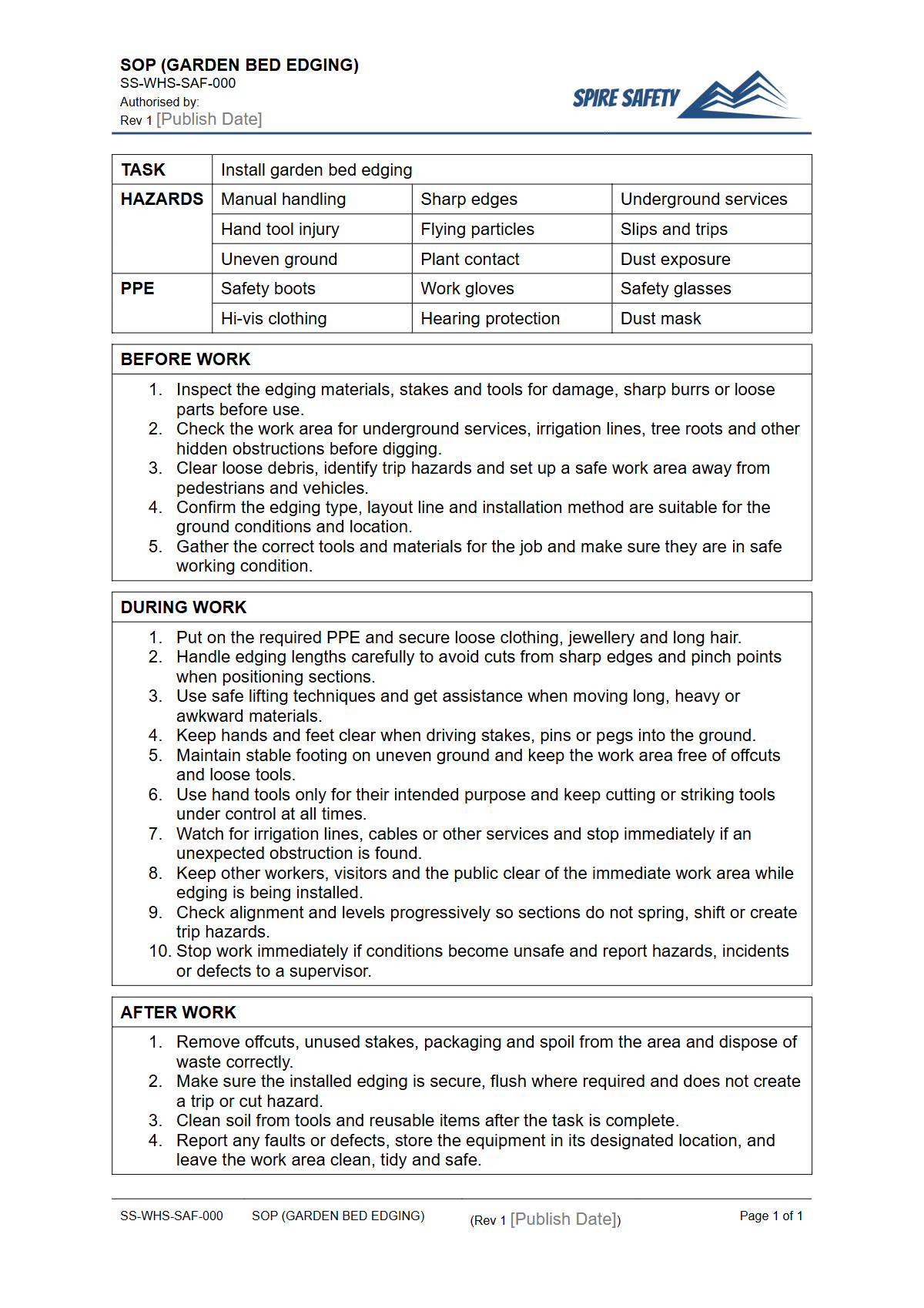
Download a free Safe Operating Procedure (Garden Bed Edging) template. This DOCX and PDF helps formalise safety protocols for landscaping. Download yours now.
Free Safe Operating Procedure (Garden Bed Edging) Template
DOCX • 126 KB + PDF
Updated Oct 2026
No signup required
Purpose of the Free Safe Operating Procedure (Garden Bed Edging) Template
Establishing clear safety guidelines is essential for any task involving tools and equipment, including landscaping work like garden bed edging. Our Free Safe Operating Procedure (Garden Bed Edging) Template provides a structured framework to document the hazards, risks, and control measures specific to this activity.
This downloadable DOCX and PDF resource helps businesses formalise their processes, train workers effectively, and demonstrate a commitment to workplace health and safety.
A documented Safe Operating Procedure (SOP) is a practical tool for meeting your duties under Australian WHS legislation. It helps identify potential hazards such as manual handling of heavy materials (steel, concrete, or timber edging), use of power tools like angle grinders or saws, exposure to soil contaminants, and slip, trip, and fall risks on uneven ground.
By defining a safe, step-by-step method for the task, this SOP helps standardise safe work behaviour across your team. It also serves as a critical training document for new employees and a reference for experienced workers, ensuring everyone understands the expected safety standards.
A well-developed SOP easily integrates into your broader WHS management systems to ensure a cohesive approach to safety.
Video walkthrough
How to use the Free Safe Operating Procedure (Garden Bed Edging) Template
This template is provided in both DOCX and PDF formats for your convenience. The DOCX version is fully editable, allowing for comprehensive customisation.
The key to an effective SOP is ensuring it reflects the reality of your workplace. It is not a one-size-fits-all solution.
Please note: This template is a starting point. We have developed it to align with Australian WHS principles, but it is not a complete, ready-to-use document.
You must customise it with your specific site details, equipment models, materials used, local hazards, and organisational procedures to ensure it is effective for your workplace.
Follow these steps to implement the SOP:
- Download: Get the template in your preferred format.
- Consult: Engage with the workers who perform garden bed edging. Their direct experience is invaluable for identifying practical hazards and effective controls.
- Customise: Edit the document to include site-specific information. Detail the exact types of edging materials, tools used (brand/model), required Personal Protective Equipment (PPE), and emergency procedures. This process follows best practice for documenting procedures for other equipment, such as when using our FREE Trencher SOP Template.
- Approve: Have a competent person, such as a supervisor or WHS manager, review and approve the finalised SOP.
- Train: Ensure all relevant workers are trained on the contents of the SOP. Keep training records to document this process.
- Review: The process and controls can be verified as part of a regular WHS compliance auditing schedule. The SOP should also be reviewed and updated after any incident or when work practices change.
When to use it
An SOP for garden bed edging should be developed and implemented before any related work begins. It is a proactive tool used to manage risk, not a reactive one.
Use it during project planning to ensure safety is considered from the outset, particularly when assessing ground conditions and material logistics. It should be a central part of worker inductions and task-specific training sessions, ensuring competency before an employee is cleared to perform the work independently.
The SOP should also be readily available at the worksite as a reference for workers and supervisors. Furthermore, it is a critical document to review following any near miss or incident, helping the team understand what went wrong and how to prevent a recurrence. It should also be updated whenever new equipment, materials (e.g., a new type of composite edging), or processes are introduced that could affect the safe execution of the task, such as the safe use of power tools detailed in resources like our FREE Circular Saw SOP (Safe Operating Procedure) Template.
Who should use it
This Safe Operating Procedure template is designed for use by several key roles within an organisation. WHS Managers and Safety Advisors will use it to standardise procedures and ensure a baseline of documented safety management across the business.
Team Leaders, Site Foremen, and Supervisors are responsible for implementing the SOP on the ground, using it for pre-start meetings, toolbox talks, and direct supervision of work crews.
Business owners, especially in small to medium-sized landscaping, gardening, or construction companies, can use this template to fulfil their primary duty of care as a Person Conducting a Business or Undertaking (PCBU). It provides a tangible way to manage risks and demonstrate diligence. The workers themselves are end-users of the SOP, relying on it for guidance on how to perform their tasks safely, including understanding the risks of working on uneven ground or reaching over obstacles, which share principles with the guidance in a FREE Step Ladder SOP Template. For more documentation to support your safety framework, browse our complete free WHS resources library.
Common mistakes
Common mistakes to avoid
- Using a generic template without customising it for specific site conditions and equipment.
- Failing to consult with the workers who actually perform the task when drafting the procedure.
- Not providing adequate training on the finalised SOP before work commences.
- Forgetting to review and update the SOP after an incident or when processes change.
Legal references
Legal considerations
The following legal requirements may be relevant to this type of work.
- Work Health and Safety Act (Harmonised) — Provides the primary duties for protecting workers and other people from work health and safety risks.
- Work Health and Safety Regulations (Harmonised) — Sets out requirements supporting the management of workplace hazards and risks.
The following codes may be relevant to this type of work.
- Managing WHS Risks Code of Practice — Provides practical guidance on identifying hazards, assessing risks and applying effective controls.
- Work Health and Safety Consultation, Cooperation and Coordination Code of Practice — Provides practical guidance on consulting workers and coordinating with other duty holders.
- Managing the Work Environment and Facilities Code of Practice — Provides practical guidance on safe work environments, workplace facilities and related controls.
Did you know
Hidden Hazards in Soil
Soil can contain more than just dirt. Landscapers should be aware of potential contaminants like asbestos fragments in older properties, fungal spores, and bacteria like Legionella, especially when disturbing soil.
Manual Task Risks
Lifting heavy edging materials, repetitive bending, and awkward postures are leading causes of musculoskeletal injuries in the landscaping industry. A well-designed SOP helps manage these common manual task risks.
FAQ
Frequently asked questions
01What should be included in a Safe Operating Procedure for garden bed edging?
02Is a Safe Operating Procedure a legal requirement in Australia?
03How often should our Garden Bed Edging SOP be reviewed?
04Can this template be used for different types of garden edging materials?
Share this resource
Free Safe Operating Procedure (Garden Bed Edging) Template
Browse Categories
How To Use It
- 1Download and open in Word or PDF.
- 2Replace the placeholders with your business details.
- 3Get it reviewed by a WHS specialist before rollout.
Need it customised?
Our WHS consultants can adapt this template to your site, run a gap analysis, or audit what you already have in place.
Book a Free Consultation WHS consulting servicesor call 1300 156 382
Related templates
- Free Safe Operating Procedure (Garden Bed Mulching) Template
- Free Safe Operating Procedure (Garden Bed Weeding) Template
- Free Safe Operating Procedure (Garden Path Cleaning) Template
- Free Safe Operating Procedure (Garden Tool Cleaning) Template
- Free Safe Operating Procedure (Garden Waste Loading) Template
- Free Safe Operating Procedure (Garden Waste Removal) Template