
Free Safe Operating Procedure (Garage Door Reset) Template
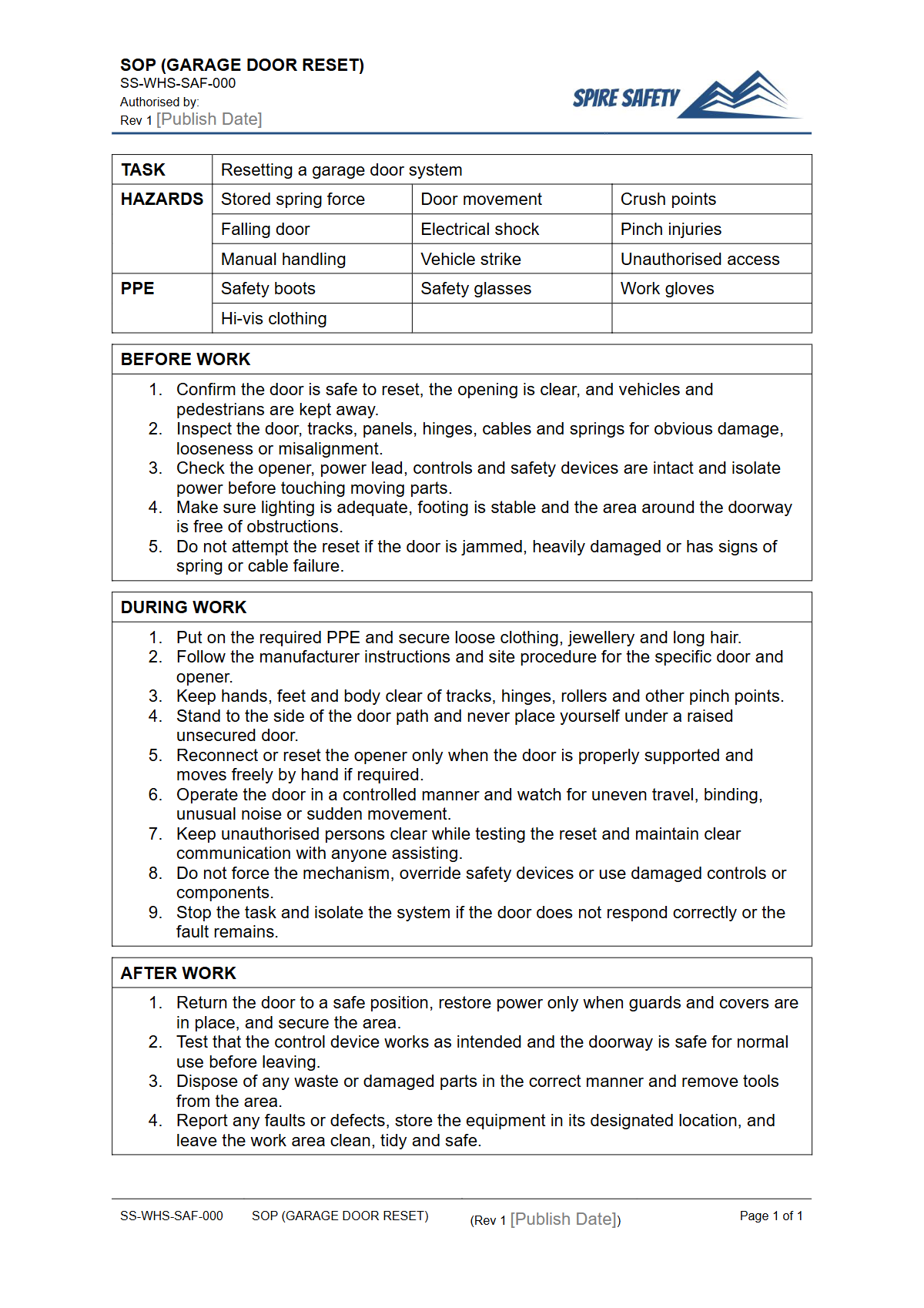
Download our free Safe Operating Procedure (Garage Door Reset) template.
Free Safe Operating Procedure (Garage Door Reset) Template
DOCX • 126 KB + PDF
Updated Oct 2026
No signup required
Purpose of the Free Safe Operating Procedure (Garage Door Reset) Template
This Safe Operating Procedure template provides a structured framework for documenting the step-by-step process for resetting commercial and industrial garage doors. While a reset may seem like a simple task, it can introduce significant hazards if performed incorrectly.
These risks include electrical shock from control panels, unexpected door movement leading to impact or crush injuries, and falls from height if ladders are needed to access reset mechanisms. A formalised SOP ensures all workers follow a consistent, tested procedure every time, minimising risk and standardising training and competency requirements.
Documenting these routine but hazardous tasks is a fundamental part of demonstrating proactive risk management. A comprehensive suite of SOPs for plant and equipment forms a critical pillar of your organisation's overall WHS management systems. This template helps you create a clear, actionable document aligned with Australian WHS best practices, providing a solid foundation for worker instruction and supervision.
Video walkthrough
How to use the Free Safe Operating Procedure (Garage Door Reset) Template
Download the template in your preferred format (DOCX for easy editing or PDF for reference) and adapt it to your specific operational context. This document is a starting point designed to be customised.
We have pre-filled sections with common steps and safety considerations, but you must review and modify every part to ensure it accurately reflects your workplace.
Important: This template provides a general structure. We have pre-filled sections based on common practice, but you MUST customise it to reflect your specific garage door models (e.g., roller door, sectional door), site conditions, personnel competency, and the unique risks at your workplace.
Always consult the manufacturer's specific instructions for the equipment in question. Key areas to customise include the exact sequence for disengaging and re-engaging the motor, lockout-tagout procedures, required Personal Protective Equipment (PPE), and site-specific emergency contacts.
If the reset procedure requires workers to access controls at height, your process must incorporate safe work practices for that task. This may involve referencing other procedures, such as those detailed in our FREE Step Ladder SOP Template, to ensure all associated risks are controlled.
When to use it
This Safe Operating Procedure should be used by workers before performing a routine reset of a garage door system. Common scenarios include resets after a power outage, after an obstruction has been safely cleared, or when a safety sensor (photo-eye) has been tripped and realigned.
It provides a controlled sequence of actions to return the door to normal operation safely.
This document is NOT intended for major repairs, servicing, installations, or troubleshooting complex faults. Those activities involve different risks (such as interacting with high-tension springs or complex wiring) and typically require a licensed technician and a more detailed risk assessment, potentially documented in a Safe Work Method Statement (SWMS).
The effectiveness of these safety documents and procedures should be confirmed periodically, a process often integrated into a formal WHS compliance auditing program.
Who should use it
This SOP is designed for any person required to reset a garage door as part of their duties. This includes facility maintenance staff, warehouse workers, supervisors, and building managers in environments with automated door systems, such as loading docks, car parks, manufacturing facilities, and strata properties.
Crucially, the procedure should only be performed by workers who have been specifically trained on the garage door model in use and are deemed competent by their supervisor.
This document is an essential tool for supervisors to deliver consistent training and verify worker understanding of the procedure and its associated risks. For organisations that manage a wide range of plant and equipment, developing a comprehensive library of SOPs can be a significant undertaking.
Spire Safety offers expert WHS consulting to help businesses establish practical and effective safety documentation. You can also explore our free WHS resources library for other templates to support your safety system.
Common mistakes
Common mistakes to avoid
- Assuming the reset procedure is identical for different door makes and models.
- Failing to isolate and lock out the power source before starting any manual override.
- Attempting to adjust or disengage high-tension springs without specialist training and tools.
- Forgetting to test the auto-reverse safety features after the reset is complete.
Legal references
Legal considerations
The following legal requirements may be relevant to this type of work.
- Work Health and Safety Act (Harmonised) — Provides the primary duties for protecting workers and other people from work health and safety risks.
- Work Health and Safety Regulations (Harmonised) — Sets out requirements supporting the management of workplace hazards and risks.
The following codes may be relevant to this type of work.
- Managing WHS Risks Code of Practice — Provides practical guidance on identifying hazards, assessing risks and applying effective controls.
- Work Health and Safety Consultation, Cooperation and Coordination Code of Practice — Provides practical guidance on consulting workers and coordinating with other duty holders.
- Managing the Work Environment and Facilities Code of Practice — Provides practical guidance on safe work environments, workplace facilities and related controls.
Did you know
Stored Energy Hazard
The torsion or extension springs that counterbalance a garage door's weight are under immense tension. An uncontrolled release can be powerful enough to cause serious injury or death, which is why procedures must strictly forbid any interaction with them.
The Reversal Test
A critical step after any reset or maintenance is testing the door's safety reversal system. A common method is placing a block of wood (about 40mm high) on the floor in the door's path to ensure it automatically reverses upon contact.
FAQ
Frequently asked questions
01What's the difference between an SOP and a SWMS for a garage door?
02Does this garage door reset template cover all door types?
03Who is considered 'competent' to perform a garage door reset?
04How often should our garage door reset SOP be reviewed?
Share this resource
Free Safe Operating Procedure (Garage Door Reset) Template
Browse Categories
How To Use It
- 1Download and open in Word or PDF.
- 2Replace the placeholders with your business details.
- 3Get it reviewed by a WHS specialist before rollout.
Need it customised?
Our WHS consultants can adapt this template to your site, run a gap analysis, or audit what you already have in place.
Book a Free Consultation WHS consulting servicesor call 1300 156 382
Related templates
- Free Safe Operating Procedure (Garage Door Service) Template
- Free Safe Operating Procedure (Garden Bed Edging) Template
- Free Safe Operating Procedure (Garden Bed Mulching) Template
- Free Safe Operating Procedure (Garden Bed Weeding) Template
- Free Safe Operating Procedure (Garden Path Cleaning) Template
- Free Safe Operating Procedure (Garden Tool Cleaning) Template