
Free Safe Operating Procedure (Gang Saw) Template
Download our Free Safe Operating Procedure (Gang Saw) Template. This customisable DOCX & PDF provides a solid foundation for your WHS documentation.
Free Safe Operating Procedure (Gang Saw) Template
DOCX • 126 KB + PDF
Updated Oct 2026
No signup required
Purpose of the Free Safe Operating Procedure (Gang Saw) Template
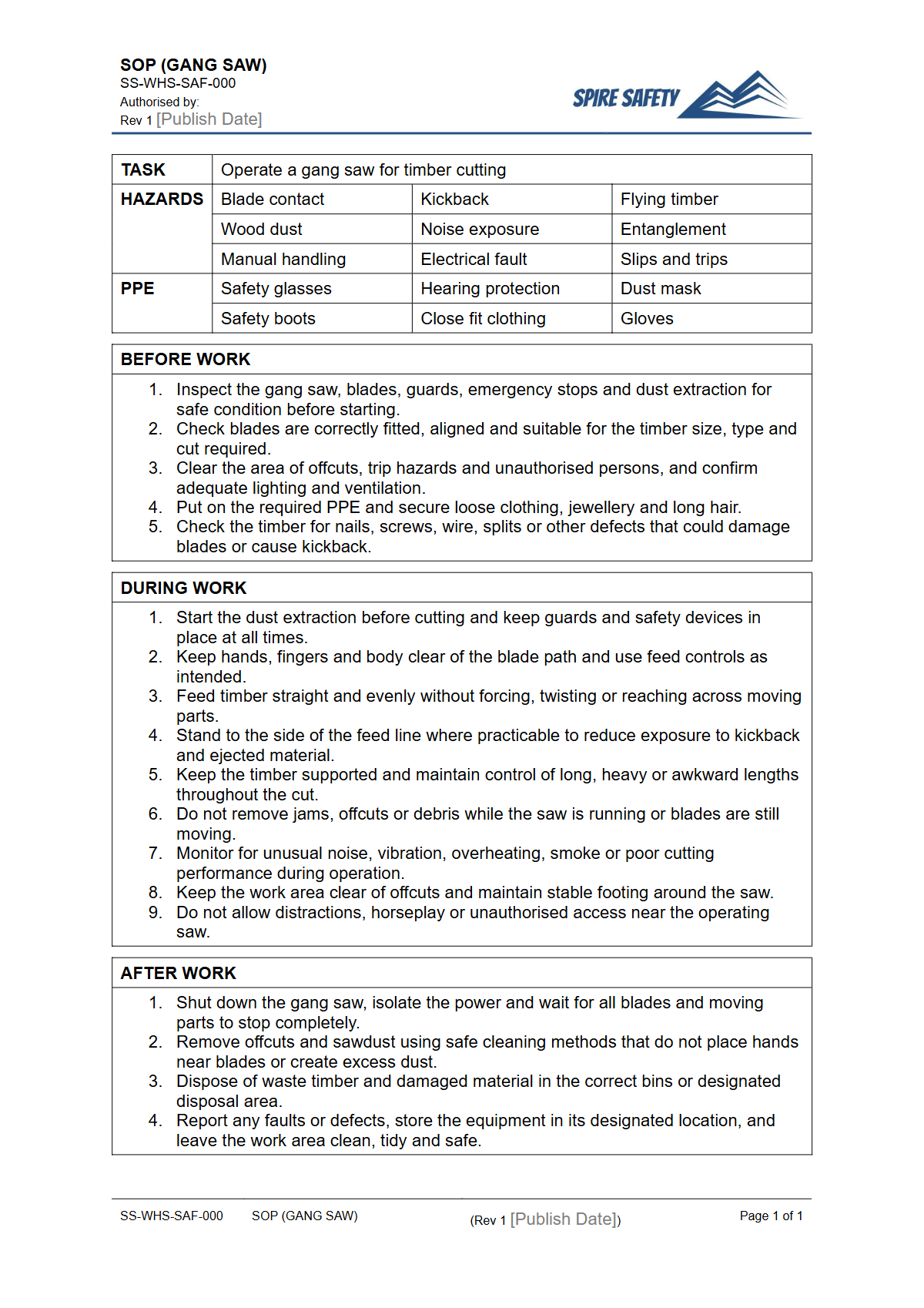
Operating a gang saw involves significant risks, including severe cuts, entanglement, noise exposure, and airborne dust. This Free Safe Operating Procedure (Gang Saw) Template provides a structured starting point for documenting the required steps to operate this machinery safely.
A well-developed Safe Operating Procedure (SOP) is a key administrative control that helps your organisation meet its duties under WHS legislation. It serves as a practical guide for workers, outlining pre-operational checks, safe operational steps, and shutdown procedures to minimise the risk of injury.
This template is designed to be adapted to your specific operational context. It helps formalise safe work practices and acts as a critical tool for worker training, induction, and ongoing competency management.
By clearly defining the expected safe behaviours and sequences, an SOP helps standardise processes and reduce the likelihood of incidents caused by human error or procedural deviation. For other cutting equipment, you might find our plasma cutter SOP template a useful reference for comparison.
Video walkthrough
How to use the Free Safe Operating Procedure (Gang Saw) Template
Using this template is straightforward. Simply download the document in your preferred format (DOCX for easy editing or PDF for stable distribution) and begin customising it to your workplace.
It is formatted to capture essential information, including hazard identification, personal protective equipment (PPE) requirements, and emergency procedures.
It is crucial to remember that this is a template, not a finished document. We have provided a structured starting point, but you must adapt it to the specific make and model of gang saw used in your workplace, the materials being cut, and the unique environmental conditions of your site.
Conduct a site-specific risk assessment to ensure all potential hazards are identified and controlled. A customised SOP should form part of your broader WHS management systems, ensuring it integrates seamlessly with your overall safety framework.
Key Sections to Customise
- Plant & Equipment Details: List the specific make, model, and identification number of the gang saw(s) the SOP applies to.
- Risk Assessment: Detail the findings of your risk assessment, listing all identified hazards (e.g., rotating blades, kickback, electrical hazards, noise, dust) and the control measures implemented.
- Personal Protective Equipment (PPE): Specify the exact PPE required for operators, such as safety glasses, hearing protection, respiratory protection, and appropriate gloves.
- Training and Competency: Outline the training requirements for operators, including any necessary qualifications or verification of competency.
- Step-by-Step Procedures: Detail the pre-start checks, sequence of operations, and shutdown procedures. This should be clear, concise, and easy for an operator to follow. This section may also include procedures for blade changes or routine maintenance where access might require specific controls, such as those outlined in a step ladder SOP.
When to use a Gang Saw Safe Operating Procedure
A Gang Saw SOP should be a living document, used consistently throughout the plant's lifecycle. It is required before any worker is permitted to operate the machinery for the first time.
It forms a fundamental part of a worker's induction and specific equipment training. The SOP should also be reviewed and referenced whenever a new gang saw is commissioned, when modifications are made to existing equipment, or when the materials being processed change significantly.
Following any incident, near miss, or audit finding, the SOP must be reviewed to identify any gaps or areas for improvement. If you need assistance integrating these procedures, consider engaging expert WHS consulting services.
Who should use this template
This template is designed for use by Persons Conducting a Business or Undertaking (PCBUs), WHS managers, supervisors, and health and safety representatives (HSRs). The primary responsibility for developing, implementing, and reviewing the SOP lies with management.
Supervisors are then responsible for ensuring operators are trained on the SOP and adhere to it during daily operations. Operators themselves use the SOP as their guide to performing the task safely. Regular checks can be conducted to verify that the procedures are being followed correctly as part of routine WHS compliance auditing.
While this document focuses on gang saws, the principles of creating task-specific procedures apply to all high-risk plant. For example, similar diligence is required when creating a circular saw SOP template for portable cutting tools.
You can find this and many other templates in our free WHS resources library, which offers a wide range of documents to support your safety management system.
Common mistakes
Common mistakes to avoid
- Failing to customise the template for the specific make and model of the saw.
- Neglecting to conduct a site-specific risk assessment to identify all unique hazards.
- Providing inadequate training on the finalised SOP before allowing operators to use the equipment.
- Not including clear procedures for blade changes, clearing jams, or routine maintenance.
Legal references
Legal considerations
The following legal requirements may be relevant to this type of work.
- Work Health and Safety Act (Harmonised) — Provides the primary duties for protecting workers and other people from work health and safety risks.
- Work Health and Safety Regulations (Harmonised) — Sets out requirements supporting the management of workplace hazards and risks.
The following codes may be relevant to this type of work.
- Managing WHS Risks Code of Practice — Provides practical guidance on identifying hazards, assessing risks and applying effective controls.
- Work Health and Safety Consultation, Cooperation and Coordination Code of Practice — Provides practical guidance on consulting workers and coordinating with other duty holders.
- Managing the Work Environment and Facilities Code of Practice — Provides practical guidance on safe work environments, workplace facilities and related controls.
Did you know
Mechanical Saws
The first circular saw was reportedly invented in the late 18th century, but gang saws, which use multiple parallel blades, have been documented in sawmill designs as far back as the 13th century in Europe.
Noise Hazards
A typical gang saw can operate at noise levels well above 85 dB(A), the exposure standard over an 8-hour period. Without proper hearing protection, this can lead to permanent hearing loss.
FAQ
Frequently asked questions
01What essential information should be included in a Gang Saw SOP?
02How often should a Safe Operating Procedure for a gang saw be reviewed?
03Is training required after implementing a Gang Saw SOP?
04Can a generic SOP be used for all types of gang saws?
Share this resource
Free Safe Operating Procedure (Gang Saw) Template
Browse Categories
How To Use It
- 1Download and open in Word or PDF.
- 2Replace the placeholders with your business details.
- 3Get it reviewed by a WHS specialist before rollout.
Need it customised?
Our WHS consultants can adapt this template to your site, run a gap analysis, or audit what you already have in place.
Book a Free Consultation WHS consulting servicesor call 1300 156 382
Related templates
- Free Safe Operating Procedure (Gangway Inspection) Template
- Free Safe Operating Procedure (Gangway Use) Template
- Free Safe Operating Procedure (Gantry Crane) Template
- Free Safe Operating Procedure (Garage Door Reset) Template
- Free Safe Operating Procedure (Garage Door Service) Template
- Free Safe Operating Procedure (Garden Bed Edging) Template