
Free Safe Operating Procedure (Gangway Use) Template
Download our free Safe Operating Procedure (Gangway Use) template. A structured starting point for documenting safe access to vessels or between structures.
Free Safe Operating Procedure (Gangway Use) Template
DOCX • 126 KB + PDF
Updated Oct 2026
No signup required
Purpose of the Free Safe Operating Procedure (Gangway Use) Template
A gangway or accommodation ladder provides critical access between a vessel and the shore, between two vessels, or across gaps on a worksite. Using one without a documented procedure introduces serious risks, including falls from height, slips and trips, and structural failure.
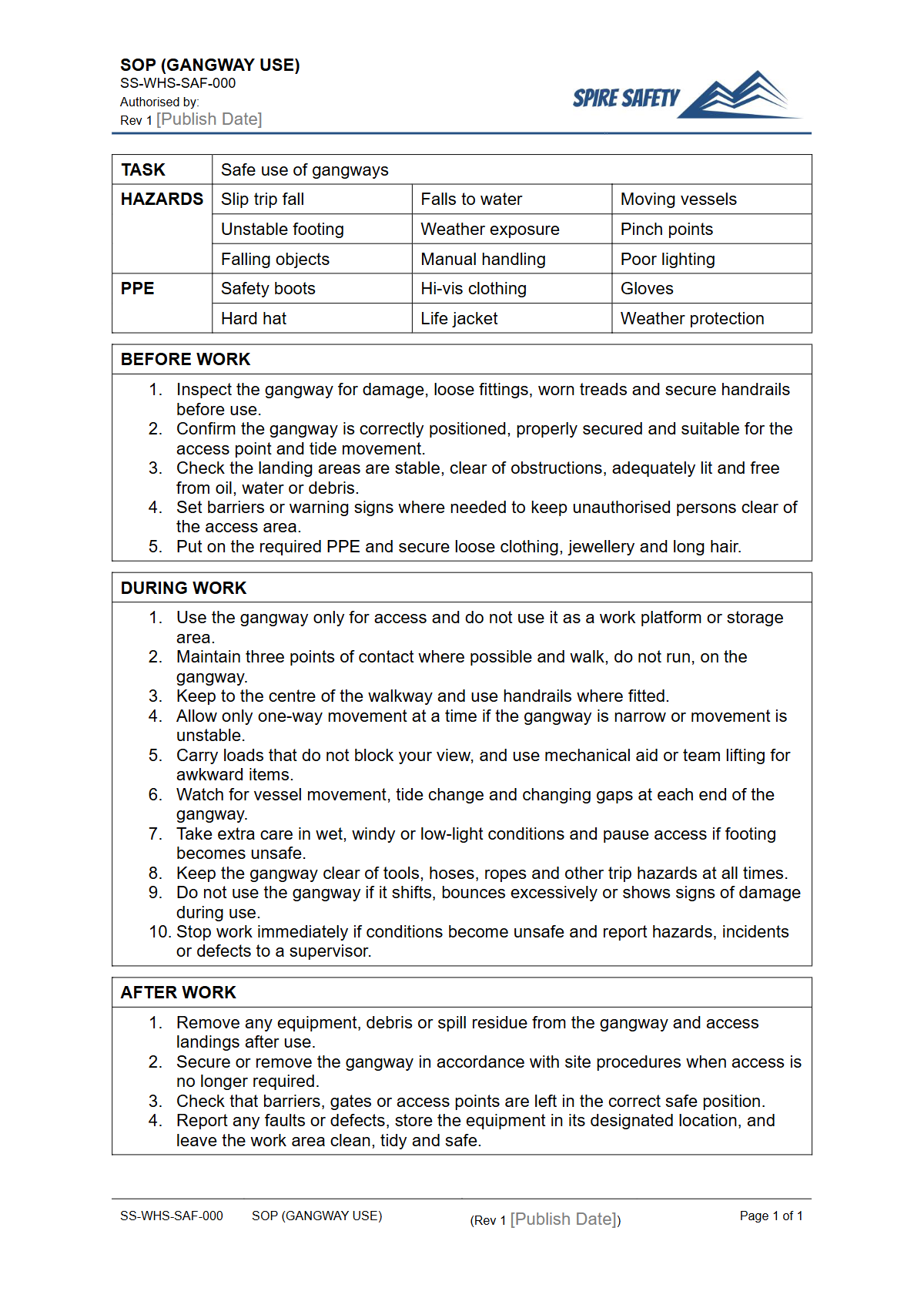
This Safe Operating Procedure for Gangway Use provides a framework for outlining the required steps to ensure this task is performed safely and consistently, helping you manage your WHS obligations.
This template is designed to be integrated into your broader safety framework. A well-documented SOP is a key component of effective WHS management systems, providing a clear source of truth for worker training, inductions, and operational planning.
It helps formalise your organisation's approach to managing high-risk activities, ensuring every worker understands the required controls.
Video walkthrough
How to use the Free Safe Operating Procedure (Gangway Use) Template
This template is provided in both DOCX and PDF formats for your convenience. The DOCX file is fully editable, allowing you to tailor the content to your specific operational needs.
A comprehensive SOP should detail the pre-use checks, setup procedures, usage rules, and pack-down requirements for the specific gangways used at your site.
Important: This document provides a foundational structure. To be effective, you must customise it.
We recommend a competent person adapts the content to reflect the unique conditions of your workplace, including the types of gangways, vessel or structure characteristics, environmental factors (like tide and weather), and specific tasks being performed. Just as a dozer SOP must be specific to the model and site, this procedure must be made specific to your context to be useful.
When to use a Safe Operating Procedure for Gangway Use
This SOP should be implemented and followed whenever a gangway is used to provide temporary access for personnel. This includes common scenarios in maritime, construction, and industrial environments, such as boarding a ship from a wharf, crossing between two moored vessels, or bridging a gap on a construction site.
The procedure establishes the baseline for safe routine use, maintenance access, and emergency response.
The principles within this document are particularly vital where a risk of fall exists. Controlling the hazards associated with gangways shares common principles with other work-at-heights equipment, as detailed in documents like our step ladder SOP. Formalising these controls is a key step in preventing serious incidents.
Who should use it
This template is intended for use by WHS managers, site supervisors, maritime personnel (such as a vessel's Master or Chief Officer), and anyone tasked with developing and implementing workplace safety documents. It provides a structured guide to ensure all necessary components of a robust procedure are considered.
Once customised, the final SOP is a critical tool for all workers who use or supervise the use of gangways. It forms the basis of their training and a reference for safe work practices.
Its implementation can be verified through inspections and WHS compliance auditing to ensure the documented procedures are being followed correctly on site.
Key Components of a Gangway SOP
A thorough SOP for gangway use should cover several critical areas to effectively manage risk. The template prompts you to detail these sections, which typically include:
- Risk Assessment: Identification of hazards (e.g., slipping, falling from height, manual handling, crushing) and the control measures to mitigate them.
- PPE Requirements: Specifying necessary Personal Protective Equipment, such as non-slip footwear, high-visibility clothing, and personal flotation devices (PFDs) when working over water.
- Pre-Operational Checks: A checklist of items to inspect before each use, such as the condition of the walking surface, handrails, stanchions, and securing points. This process is similar to the pre-start checks required in a telehandler SOP.
- Safe Setup and Securement: Clear instructions on how to position, secure, and adjust the gangway, including maximum permissible angles and ensuring it is properly landed.
- Operational Rules: Guidelines for use, including load capacity limits, rules against running, and procedures for transporting tools or equipment across.
- Monitoring and Adjustment: Requirements for monitoring the gangway during use, especially in environments with changing tides or weather.
- Emergency Procedures: Steps to take in the event of an incident, such as a person falling or the gangway becoming unstable.
Integrating the SOP into Your Safety System
A document alone does not create a safe workplace. This SOP is most effective when it is part of a live, functioning safety system.
This involves communicating the procedure to all relevant personnel through training and toolbox talks, ensuring adequate supervision is in place, and scheduling regular reviews of the SOP to ensure it remains current and effective.
If you need assistance developing or implementing a comprehensive safety management system that incorporates task-specific procedures like this one, consider engaging professional WHS consulting services. An expert can help ensure your safety documentation is practical, relevant, and aligned with your operational risks.
Common mistakes
Common mistakes to avoid
- Failing to properly secure the gangway at both ends, allowing it to shift or slip.
- Neglecting to install safety nets underneath where there is a significant risk of falling.
- Using a gangway with a damaged, wet, or slippery walking surface without implementing controls.
- Exceeding the specified maximum load capacity by allowing too many people or heavy equipment on it at once.
Legal references
Legal considerations
The following legal requirements may be relevant to this type of work.
- Work Health and Safety Act (Harmonised) — Provides the primary duties for protecting workers and other people from work health and safety risks.
- Work Health and Safety Regulations (Harmonised) — Sets out requirements supporting the management of workplace hazards and risks.
The following codes may be relevant to this type of work.
- Managing WHS Risks Code of Practice — Provides practical guidance on identifying hazards, assessing risks and applying effective controls.
- Work Health and Safety Consultation, Cooperation and Coordination Code of Practice — Provides practical guidance on consulting workers and coordinating with other duty holders.
- Managing the Work Environment and Facilities Code of Practice — Provides practical guidance on safe work environments, workplace facilities and related controls.
Did you know
Dynamic Loads
The load on a gangway is not just static. The movement of people, equipment, and the shifting of a vessel due to tide or waves creates dynamic loads that must be accounted for in its design and safe working load (SWL).
Angle of Repose
The angle of a gangway is critical to safety. If it is too steep, the risk of slips and falls increases dramatically. Most regulations and standards specify a maximum operating angle, often around 30 degrees from the horizontal.
FAQ
Frequently asked questions
01What is a Safe Operating Procedure for a gangway?
02Is this gangway SOP template suitable for maritime use?
03How often should a gangway SOP be reviewed?
04Do I need a specific SOP if I only use a small brow or ramp?
Share this resource
Free Safe Operating Procedure (Gangway Use) Template
Browse Categories
How To Use It
- 1Download and open in Word or PDF.
- 2Replace the placeholders with your business details.
- 3Get it reviewed by a WHS specialist before rollout.
Need it customised?
Our WHS consultants can adapt this template to your site, run a gap analysis, or audit what you already have in place.
Book a Free Consultation WHS consulting servicesor call 1300 156 382
Related templates
- Free Safe Operating Procedure (Gantry Crane) Template
- Free Safe Operating Procedure (Garage Door Reset) Template
- Free Safe Operating Procedure (Garage Door Service) Template
- Free Safe Operating Procedure (Garden Bed Edging) Template
- Free Safe Operating Procedure (Garden Bed Mulching) Template
- Free Safe Operating Procedure (Garden Bed Weeding) Template