
Free Safe Operating Procedure (Galvanising) Template
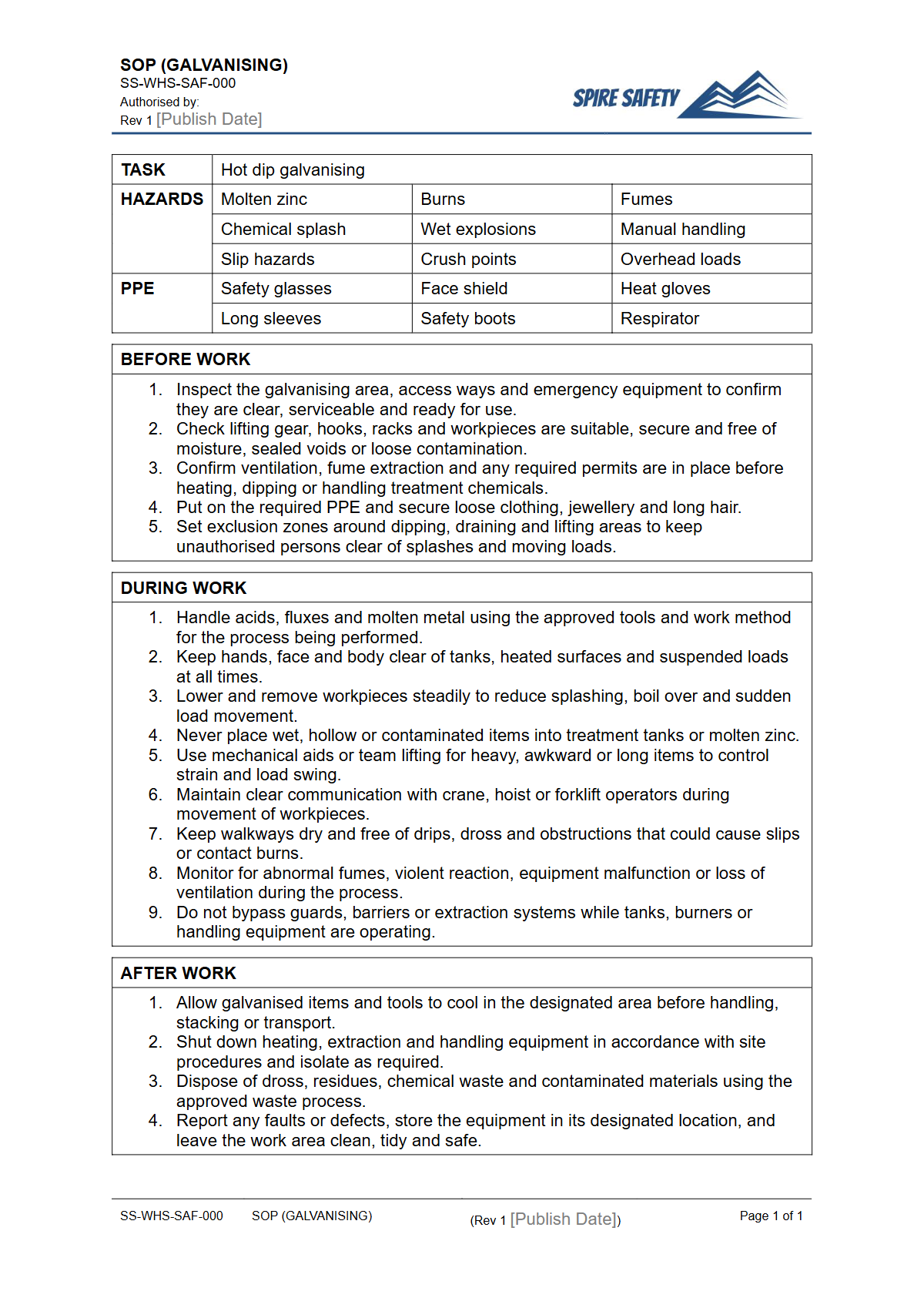
Download our free Safe Operating Procedure (Galvanising) Template. This customisable DOCX and PDF helps you outline safe work steps for galvanising tasks.
Free Safe Operating Procedure (Galvanising) Template
DOCX • 126 KB + PDF
Updated Oct 2026
No signup required
Purpose of the Free Safe Operating Procedure (Galvanising) Template
Galvanising processes involve significant risks, including exposure to molten metal, hazardous chemicals, and intense heat. A documented procedure is essential for managing these hazards effectively.
This Free Safe Operating Procedure (Galvanising) Template provides a structured framework for outlining the required steps to perform galvanising tasks safely. It is designed to assist your organisation in defining pre-operational checks, operational steps, and post-operational clean-up, aligning with Australian WHS best practices.
Using a standardised SOP helps ensure that all workers follow the same safety protocols, reducing the likelihood of incidents, injuries, or long-term health effects. It serves as a critical training tool for new employees and a reference for experienced operators, promoting a consistent safety culture.
Formalising these steps is a key component of a robust safety framework, which can be supported by broader WHS management systems that integrate procedures across all business operations.
Video walkthrough
How to use the Free Safe Operating Procedure (Galvanising) Template
This resource is available for download as a DOCX file, allowing for full customisation to suit your specific workplace environment. A PDF version is also provided for easy printing and distribution.
It is crucial to adapt this template to reflect the unique aspects of your operations, including the specific type of galvanising process (e.g., hot-dip, electrogalvanising), the plant and equipment used, and the chemicals involved.
Important: This is a template only. We cannot know the specific machinery, chemicals, layouts, or personnel at your workplace.
You must consult with your workers and other relevant stakeholders to conduct a site-specific risk assessment. Customise the document by adding details relevant to your site, such as emergency contacts, specific PPE requirements, and kettle temperatures, to ensure it is a practical and effective control measure for your business.
When to use a Galvanising SOP
A Safe Operating Procedure for galvanising should be used as a primary reference document in several key situations. It must be read, understood, and followed by any worker before they undertake a galvanising task for the first time.
The SOP is also a vital tool for conducting periodic refresher training to ensure that established safety standards are maintained over time.
Furthermore, it should be reviewed and potentially updated following any incident or near-miss related to the galvanising process. This ensures that learnings are captured and integrated into your safety system. Procedures like this are foundational, much like the process documents for other workshop equipment, such as our free Plasma Cutter SOP template.
Who should use this SOP
This Safe Operating Procedure is intended for use by a range of personnel within an organisation. Persons Conducting a Business or Undertaking (PCBUs) have a primary duty of care and can use this template to help fulfil their WHS obligations.
Managers and supervisors are responsible for implementing the procedure, ensuring workers are trained, and monitoring compliance on the floor.
Workers who perform galvanising tasks are the primary end-users; they must use the SOP to guide their work practices and understand the associated hazards and controls. Safety professionals can also use the template as a basis for developing comprehensive safety documentation.
The effectiveness of these procedures can be verified through periodic WHS compliance auditing to identify any gaps between the documented process and actual work practices.
For businesses with a variety of metalworking equipment, standardising documentation across different machines is key. You might find our Brake Press SOP template useful for maintaining consistency in your procedural documents.
Exploring our complete free WHS resources library can provide further templates to support your safety management efforts.
Common mistakes
Common mistakes to avoid
- Using a generic SOP template without customising it for site-specific plant, chemicals, and processes.
- Failing to ensure adequate ventilation and extraction systems are in place and functional, leading to fume exposure.
- Providing inadequate or incorrect PPE, particularly insufficient face and eye protection against molten metal splash.
- Not properly inspecting or preparing items before dipping, which can introduce moisture and cause a dangerous splash or 'kettle explosion'.
Legal references
Legal considerations
The following legal requirements may be relevant to this type of work.
- Work Health and Safety Act (Harmonised) — Provides the primary duties for protecting workers and other people from work health and safety risks.
- Work Health and Safety Regulations (Harmonised) — Sets out requirements supporting the management of workplace hazards and risks.
The following codes may be relevant to this type of work.
- Managing WHS Risks Code of Practice — Provides practical guidance on identifying hazards, assessing risks and applying effective controls.
- Work Health and Safety Consultation, Cooperation and Coordination Code of Practice — Provides practical guidance on consulting workers and coordinating with other duty holders.
- Managing the Work Environment and Facilities Code of Practice — Provides practical guidance on safe work environments, workplace facilities and related controls.
Did you know
Molten Metal
The hot-dip galvanising process involves immersing steel in a kettle of molten zinc at a temperature of approximately 450°C (842°F). This metallurgical reaction creates a durable, corrosion-resistant coating.
Fume Fever
Inhaling zinc oxide fumes, a common byproduct of galvanising, can cause a condition known as 'metal fume fever'. Symptoms are flu-like and include fever, chills, and muscle aches, highlighting the critical need for proper ventilation and respiratory protection.
FAQ
Frequently asked questions
01What are the main hazards in hot-dip galvanising?
02What kind of PPE is required for galvanising tasks?
03Is a Safe Work Method Statement (SWMS) the same as an SOP for galvanising?
04How often should a galvanising Safe Operating Procedure be reviewed?
Share this resource
Free Safe Operating Procedure (Galvanising) Template
Browse Categories
How To Use It
- 1Download and open in Word or PDF.
- 2Replace the placeholders with your business details.
- 3Get it reviewed by a WHS specialist before rollout.
Need it customised?
Our WHS consultants can adapt this template to your site, run a gap analysis, or audit what you already have in place.
Book a Free Consultation WHS consulting servicesor call 1300 156 382
Related templates
- Free Safe Operating Procedure (Gang Saw) Template
- Free Safe Operating Procedure (Gangway Inspection) Template
- Free Safe Operating Procedure (Gangway Use) Template
- Free Safe Operating Procedure (Gantry Crane) Template
- Free Safe Operating Procedure (Garage Door Reset) Template
- Free Safe Operating Procedure (Garage Door Service) Template