
Free Safe Operating Procedure (Fuse Puller) Template
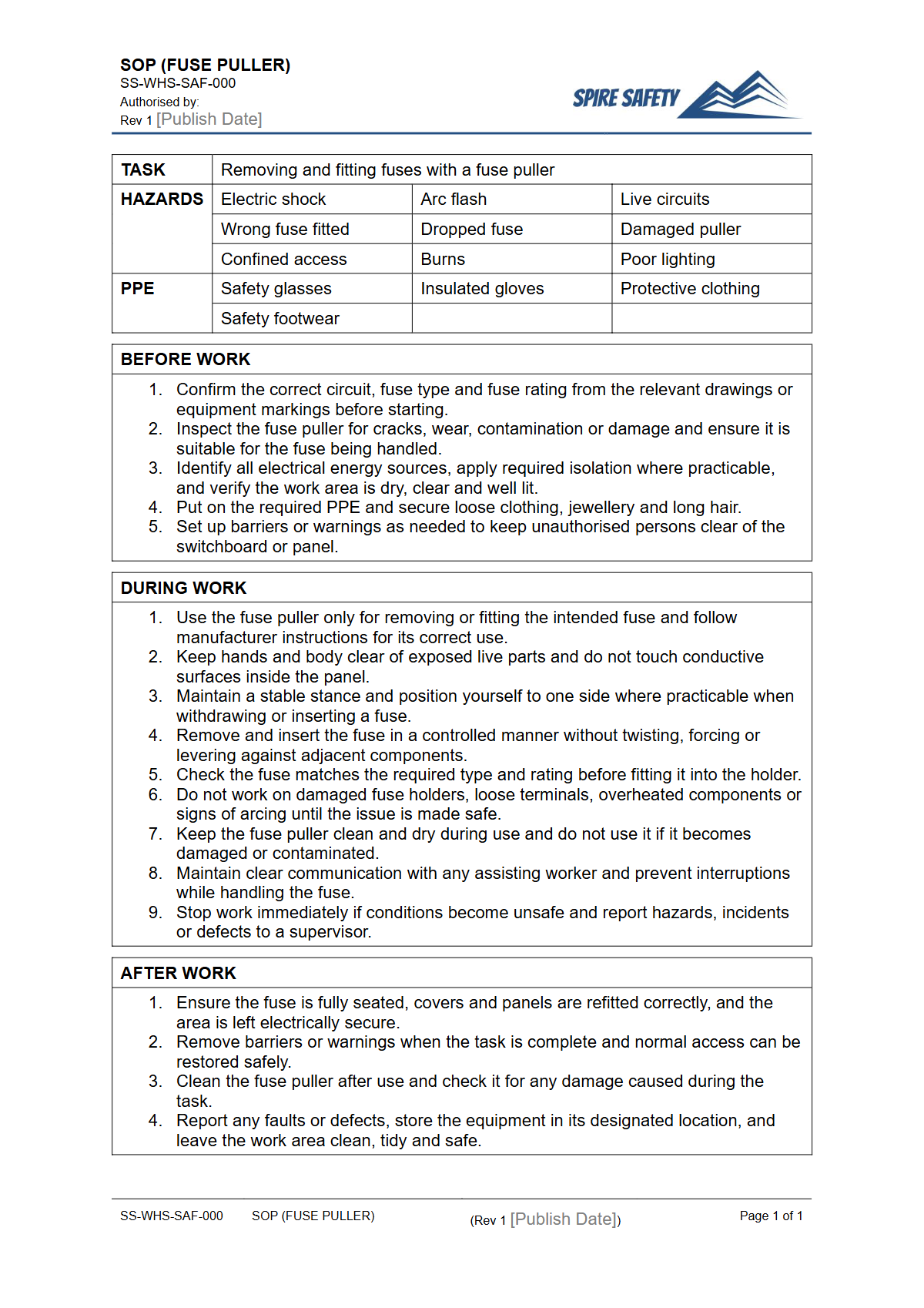
Download our free Safe Operating Procedure (Fuse Puller) Template for Australian workplaces. This customisable DOCX & PDF helps manage electrical risks.
Free Safe Operating Procedure (Fuse Puller) Template
DOCX • 126 KB + PDF
Updated Oct 2026
No signup required
Purpose of the Free Safe Operating Procedure (Fuse Puller) Template
This Free Safe Operating Procedure (Fuse Puller) Template provides a structured framework for documenting the safe use of fuse pullers in your workplace. While a seemingly simple hand tool, the task of removing and inserting fuses involves direct interaction with electrical circuits, posing significant risks of electric shock, arc flash, and equipment damage if not performed correctly.
This SOP is designed to help you outline key safety controls, from pre-operational checks to the correct handling technique, ensuring workers are protected from electrical hazards.
A documented procedure is a critical part of managing high-risk activities. It forms a key component of your risk assessment process by formalising the steps required to control identified hazards.
It also serves as a vital training tool for electricians, apprentices, and maintenance personnel. In the event of a severe electrical incident, having a clear procedure for emergency response is essential, which might include the use of equipment detailed in our Safe Operating Procedure for Defibrillator Operation.
Video walkthrough
How to use the Free Safe Operating Procedure (Fuse Puller) Template
Our template is provided in both DOCX and PDF formats for your convenience. The DOCX file is fully editable, allowing you to tailor the content to the specific equipment, environment, and electrical systems present in your workplace.
Simply download the document and modify the sections to reflect your operational requirements, including specific fuse types, voltage levels, and required personal protective equipment (PPE).
Important: This document is a template only. To be effective, you must customise it with your site-specific information, including machinery details, local hazards, and emergency procedures.
We strongly recommend consulting with competent persons, such as qualified electricians and your health and safety committee, during the customisation process. Integrating this SOP into your broader safety framework is key to its success, as it should be part of your complete WHS management system.
When to use a Fuse Puller Safe Operating Procedure
A Safe Operating Procedure for using a fuse puller should be used in several key situations. It is essential for inducting and training new employees or apprentices who will be required to perform electrical maintenance tasks.
It should also be used as a reference for pre-start meetings or toolbox talks before any fuse replacement work begins, reinforcing the required safety steps. Furthermore, the SOP serves as a benchmark during safety observations and can be a critical document for reference during an incident investigation to determine if established procedures were followed.
Regular reviews of your SOPs are also a crucial part of maintaining a safe workplace. These procedures should be re-evaluated whenever there is a change to the equipment, the process, or following a safety incident.
This proactive approach is often verified during a WHS compliance audit to ensure your safety documentation remains current and effective.
Who should use this Safe Operating Procedure
This SOP is primarily intended for use by competent and authorised personnel responsible for electrical maintenance and repair. This includes licensed electricians, electrical apprentices under direct supervision, and specifically trained maintenance staff.
Supervisors and WHS managers should also use the document to ensure they understand the risks and control measures associated with the task, enabling them to effectively oversee the work and enforce safety standards. Accessing fuse boxes or switchboards may require working at height, so workers must also be competent in the safe use of access equipment, as outlined in procedures like our free Step Ladder SOP template.
What's covered in the template?
This comprehensive template provides a clear, structured layout to guide you through documenting the entire process. It includes dedicated sections for:
- Hazard Identification (electrical, falls, manual handling)
- Required Personal Protective Equipment (PPE), including insulated gloves and eye protection
- Pre-operational Safety Checks (tool inspection, work area assessment)
- A step-by-step guide for safely removing and inserting fuses
- Post-operational Checks and housekeeping
- Emergency Procedures
The logical structure ensures all critical safety aspects are considered, similar to the format used in our SOP for other workshop equipment, such as our FREE Plasma Cutter SOP Template. You can find many more helpful documents in our complete free WHS resources library to build out your safety management system.
Common mistakes
Common mistakes to avoid
- Using a damaged fuse puller with cracks or contamination that could compromise its insulating properties.
- Attempting to pull a fuse from a circuit that has not been correctly isolated and de-energised.
- Substituting a proper fuse puller with other tools, such as metal pliers or screwdrivers.
- Failing to wear appropriate electrical PPE, particularly insulated gloves and eye protection.
Legal references
Legal considerations
The following legal requirements may be relevant to this type of work.
- Work Health and Safety Act (Harmonised) — Provides the primary duties for protecting workers and other people from work health and safety risks.
- Work Health and Safety Regulations (Harmonised) — Sets out requirements supporting the management of workplace hazards and risks.
The following codes may be relevant to this type of work.
- Managing WHS Risks Code of Practice — Provides practical guidance on identifying hazards, assessing risks and applying effective controls.
- Work Health and Safety Consultation, Cooperation and Coordination Code of Practice — Provides practical guidance on consulting workers and coordinating with other duty holders.
- Managing the Work Environment and Facilities Code of Practice — Provides practical guidance on safe work environments, workplace facilities and related controls.
Did you know
Arc Flash Danger
An arc flash, a potential hazard when working with fuses, can reach temperatures of up to 20,000°C. This is four times hotter than the surface of the sun, highlighting the critical importance of proper procedure and PPE.
Material Matters
Fuse pullers are typically made from glass-filled nylon or other high-strength, non-conductive polymers. This ensures they have high dielectric strength to prevent electrical current from passing through the tool to the user.
FAQ
Frequently asked questions
01What is a fuse puller used for?
02Is an SOP legally required for using a fuse puller in Australia?
03What PPE is typically required when using a fuse puller?
04How do I train staff using this SOP template?
Share this resource
Free Safe Operating Procedure (Fuse Puller) Template
Browse Categories
How To Use It
- 1Download and open in Word or PDF.
- 2Replace the placeholders with your business details.
- 3Get it reviewed by a WHS specialist before rollout.
Need it customised?
Our WHS consultants can adapt this template to your site, run a gap analysis, or audit what you already have in place.
Book a Free Consultation WHS consulting servicesor call 1300 156 382
Related templates
- Free Safe Operating Procedure (Galvanising) Template
- Free Safe Operating Procedure (Gang Saw) Template
- Free Safe Operating Procedure (Gangway Inspection) Template
- Free Safe Operating Procedure (Gangway Use) Template
- Free Safe Operating Procedure (Gantry Crane) Template
- Free Safe Operating Procedure (Garage Door Reset) Template