
Free Safe Operating Procedure (Fuel Transfer Pump) Template
Download our free Safe Operating Procedure for fuel transfer pumps. This template helps you document safe work methods for refuelling tasks. Get your DOCX now.
Free Safe Operating Procedure (Fuel Transfer Pump) Template
DOCX • 126 KB + PDF
Updated Oct 2026
No signup required
Purpose of the Free Safe Operating Procedure (Fuel Transfer Pump) Template
Transferring fuel is a routine but high-risk activity on many Australian worksites. Without a documented process, your organisation is exposed to significant dangers, including fire, explosion, chemical spills, and serious health hazards from vapour inhalation.
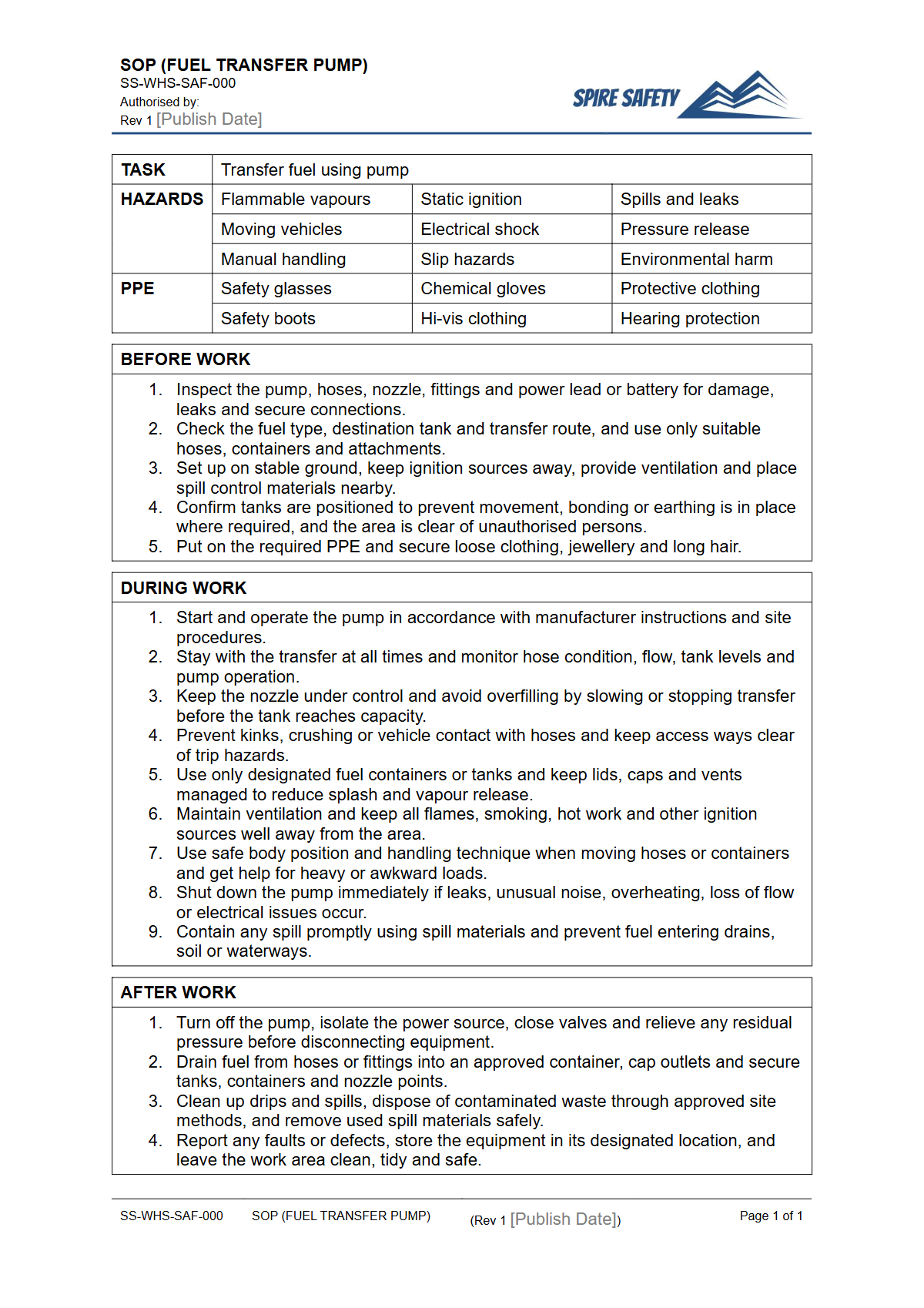
Our Free Safe Operating Procedure (Fuel Transfer Pump) Template provides a structured starting point for formalising your safety protocols. This document helps you clearly define the required steps, personal protective equipment (PPE), and emergency responses needed to manage the risks associated with fuel transfer operations.
Implementing robust SOPs is a critical component of a proactive safety culture. By documenting procedures, you provide workers with clear, consistent instructions that minimise guesswork and reduce the likelihood of incidents.
This SOP forms an essential part of your overall safety framework, demonstrating a commitment to meeting your duty of care. Integrating this procedure into your broader WHS management systems helps ensure that safety is managed systematically across all operational tasks.
Video walkthrough
How to use the Free Safe Operating Procedure (Fuel Transfer Pump) Template
This template is provided in both DOCX and PDF formats for your convenience. The DOCX version is fully editable, allowing you to tailor it to the specific pumps, fuels, equipment, and environmental conditions at your workplace.
It includes sections for outlining required PPE, pre-operational checks, the step-by-step transfer process, post-operation clean-up, and emergency procedures. The goal is to create a practical, site-specific guide that your team can easily follow.
Important: This is a template, not a finished document. You must customise it to reflect the unique hazards and control measures relevant to your specific worksite and tasks.
We are not responsible for any incidents that may occur from the use of this template. We highly recommend conducting a thorough risk assessment before finalising and implementing the procedure.
The same level of customisation should be applied when using other equipment-specific documents, such as our FREE Dozer SOP (Safe Operating Procedure) Template, to ensure they are relevant to your site.
When to use it
A Fuel Transfer Pump SOP should be used every time flammable or combustible liquids are moved using a pump. This applies to a wide range of common workplace scenarios, including refuelling mobile plant and vehicles on-site from a tanker or bulk container, decanting fuel from larger drums into smaller, more manageable containers, or transferring fuel for maintenance and testing purposes.
It is particularly crucial in field operations where environmental conditions can change and dedicated refuelling infrastructure is unavailable.
Having a documented procedure is vital for tasks involving heavy machinery that requires regular refuelling to maintain operational uptime. For instance, the process for refuelling a large earthmover is just as critical as its operation, reinforcing the need for clear guidelines similar to those found in our FREE Telehandler SOP (Safe Operating Procedure) Template.
Who should use it
This SOP is designed for several key roles within an organisation. Primarily, operators and workers who perform fuel transfer tasks must be trained in and follow the procedure meticulously.
Supervisors and line managers are responsible for ensuring their teams understand and adhere to the SOP, providing adequate resources like PPE and spill kits, and conducting regular checks to confirm compliance. WHS managers and advisors can use this template to establish a baseline standard for fuel handling across the organisation.
Supervisors play a key role in verifying that safe work methods are being followed consistently. This can involve practical observations, toolbox talks, and periodic reviews of the SOP's effectiveness.
These verification activities are an important part of internal safety assurance and can be a focus during formal WHS compliance auditing to confirm that documented procedures are being implemented correctly in the field.
Associated Equipment and Procedures
Fuel transfer pumps are often part of a larger system, frequently powered by generators or air compressors mounted on service vehicles. It is essential to ensure that all associated equipment is also operated and maintained safely.
For example, if your pump is pneumatic, having a documented procedure for the power source is equally important. You can establish this using resources like our Free Air Compressor SOP (Safe Operating Procedure) Template to cover all aspects of the job.
By adopting a comprehensive approach and ensuring you have documented procedures for all critical tasks, you build a more resilient safety system. Feel free to explore our complete free WHS resources library to find other templates that can support your safety management efforts.
Common mistakes
Common mistakes to avoid
- Using a pump or hose not specifically rated for flammable liquids.
- Failing to correctly bond the pump, container, and vehicle to prevent static electricity discharge.
- Refuelling near ignition sources such as running engines, welding activities, or heaters.
- Not having an appropriate fire extinguisher and spill kit immediately accessible at the transfer point.
Legal references
Legal considerations
The following legal requirements may be relevant to this type of work.
- Work Health and Safety Act (Harmonised) — Provides the primary duties for protecting workers and other people from work health and safety risks.
- Work Health and Safety Regulations (Harmonised) — Sets out requirements supporting the management of workplace hazards and risks.
The following codes may be relevant to this type of work.
- Managing WHS Risks Code of Practice — Provides practical guidance on identifying hazards, assessing risks and applying effective controls.
- Work Health and Safety Consultation, Cooperation and Coordination Code of Practice — Provides practical guidance on consulting workers and coordinating with other duty holders.
- Managing the Work Environment and Facilities Code of Practice — Provides practical guidance on safe work environments, workplace facilities and related controls.
Did you know
Static Electricity Risk
A person walking across a synthetic surface can generate up to 35,000 volts of static electricity, more than enough to ignite flammable fuel vapours. This is why bonding and grounding are critical during fuel transfer.
Vapour Density
Most flammable fuel vapours are heavier than air. They can accumulate in low-lying areas like pits or trenches, creating a hidden and persistent ignition risk long after a transfer or spill has occurred.
FAQ
Frequently asked questions
01What are the main hazards of fuel transfer?
02Is an SOP legally required for transferring fuel in Australia?
03What PPE is typically needed for fuel transfer?
04How often should a fuel transfer pump SOP be reviewed?
Share this resource
Free Safe Operating Procedure (Fuel Transfer Pump) Template
Browse Categories
How To Use It
- 1Download and open in Word or PDF.
- 2Replace the placeholders with your business details.
- 3Get it reviewed by a WHS specialist before rollout.
Need it customised?
Our WHS consultants can adapt this template to your site, run a gap analysis, or audit what you already have in place.
Book a Free Consultation WHS consulting servicesor call 1300 156 382
Related templates
- Free Safe Operating Procedure (Fume Cupboard) Template
- Free Safe Operating Procedure (Funeral Equipment Clean) Template
- Free Safe Operating Procedure (Funeral Flower Handling) Template
- Free Safe Operating Procedure (Funeral Vehicle Cleaning) Template
- Free Safe Operating Procedure (Furniture Steam Clean) Template
- Free Safe Operating Procedure (Fuse Puller) Template