
Free Safe Operating Procedure (Fume Cupboard) Template
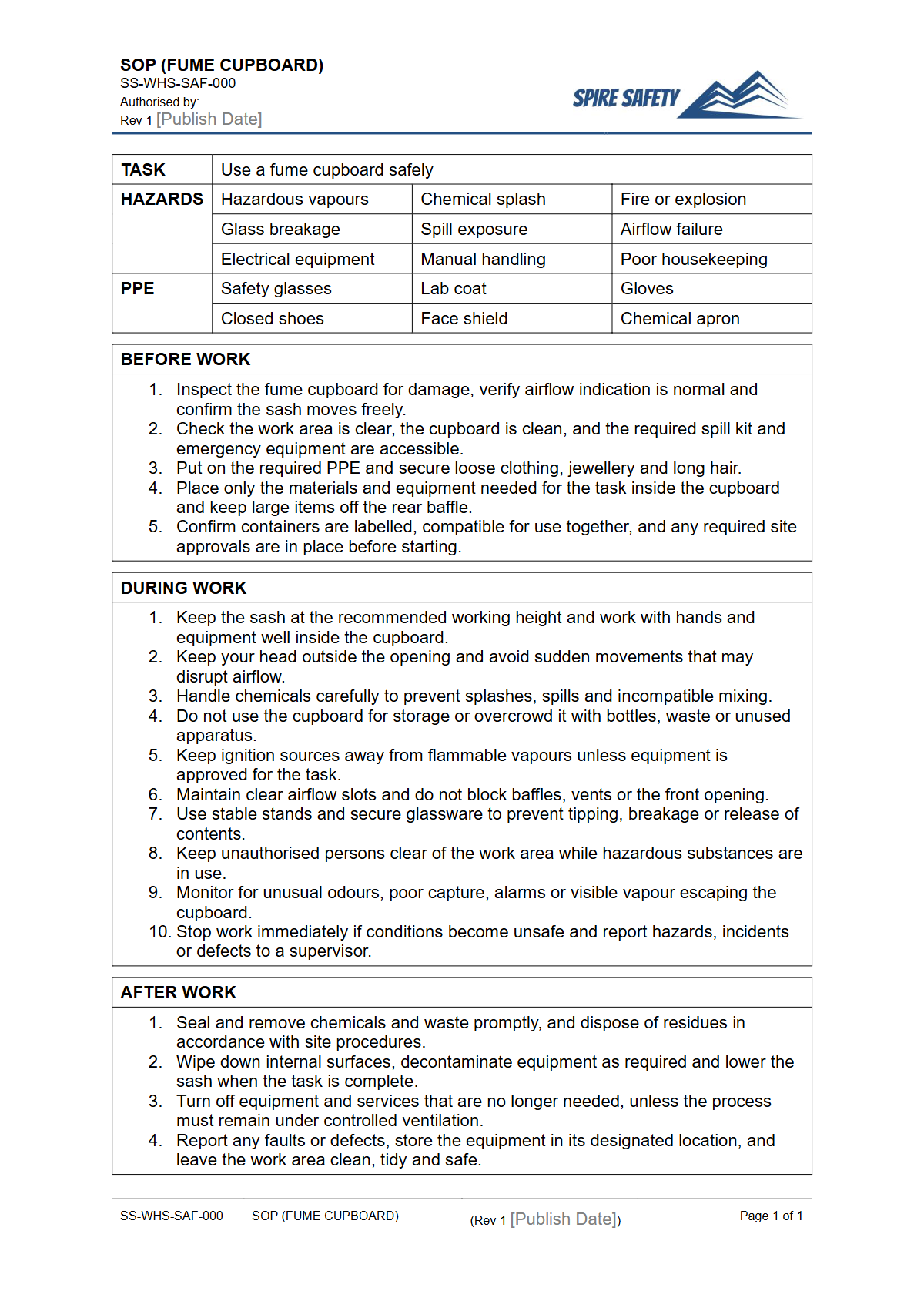
Download our free Safe Operating Procedure (Fume Cupboard) template to manage risks from hazardous fumes and vapours.
Free Safe Operating Procedure (Fume Cupboard) Template
DOCX • 126 KB + PDF
Updated Oct 2026
No signup required
Purpose of the Free Safe Operating Procedure (Fume Cupboard) Template
Effectively managing hazardous substances is a critical part of workplace safety, particularly in laboratory and industrial settings. This Free Safe Operating Procedure (Fume Cupboard) Template provides a structured framework for documenting the required steps to operate a fume cupboard safely.
Its primary purpose is to minimise worker exposure to hazardous fumes, vapours, dusts, and aerosols generated during experiments or processes. By establishing a clear, repeatable process, this SOP helps control respiratory and chemical hazards at their source, forming a key part of your risk management strategy.
A well-developed SOP ensures that all personnel understand the equipment's operational limits, pre-use checks, and emergency responses. It acts as both a training tool for new staff and a reference for experienced operators, promoting consistent and safe work practices across your organisation.
Implementing robust procedures like this is a fundamental component of a comprehensive WHS management system, demonstrating a commitment to proactive risk control.
Video walkthrough
How to use the Free Safe Operating Procedure (Fume Cupboard) Template
This template is provided as a starting point in both DOCX and PDF formats. To adapt it for your workplace, download the editable DOCX file and systematically work through each section.
It is essential to customise the content to reflect the specific types, models, and configurations of fume cupboards in use at your facility. You must also incorporate details about the specific hazardous chemicals being handled, their unique risks, and the required personal protective equipment (PPE).
Important: We have drafted this document as a template based on common Australian WHS practice. It is not a finished safety document.
You must review, edit, and customise it to suit the unique hazards, risks, equipment, and procedures of your specific workplace. You are responsible for ensuring its accuracy and suitability.
During customisation, involve the workers who actually use the equipment. Their practical knowledge is invaluable for creating a procedure that is both safe and functional.
Once finalised, the SOP should be approved by a competent person, such as a lab manager or WHS advisor, and made readily accessible to all relevant personnel. Your process could be verified during routine safety checks or a formal WHS compliance audit.
When to use a Fume Cupboard SOP
A Safe Operating Procedure for a fume cupboard should be used and referred to consistently. It is not a document to be filed away and forgotten. Key times to use the SOP include:
- Before any task involving the handling of volatile, toxic, or hazardous substances within the cupboard.
- During the induction and training of new employees, students, or contractors who will be working in the laboratory.
- As a refresher tool for existing staff to ensure practices have not drifted from the established standard.
- When planning new experiments or processes to ensure all safety aspects of fume and vapour generation are considered.
- Following an incident or near miss to review and improve existing procedures.
Integrating the SOP into daily workflows helps build a strong safety culture where correct equipment use is second nature. It should be part of a wider safety framework that might include procedures for first aid emergencies, for which our free defibrillator operation template can be a useful reference.
Who should use this Safe Operating Procedure
This SOP is intended for anyone whose work requires them to operate a fume cupboard or supervise those who do. This includes a wide range of roles:
- Laboratory Technicians and Assistants
- Research Scientists and Chemists
- University and TAFE Students
- Workshop and Manufacturing Personnel
- WHS Managers and Supervisors
Ultimately, anyone exposed to the risks associated with the tasks performed in a fume cupboard should be trained on the contents of the relevant SOP. Supervisors have a responsibility to ensure that workers are not only trained but also competent in following the procedure and can demonstrate its safe application. This principle of documented, safe use applies to all equipment where hazardous by-products are created, which is why a detailed plasma cutter SOP is equally critical for tasks that generate harmful fumes and radiation.
Essential Checks Before Use
Before any work begins, operators must perform a series of pre-use checks to confirm the fume cupboard is functioning correctly. A key step is verifying that the airflow monitor indicates a safe and sufficient face velocity, ensuring contaminants will be properly extracted.
The interior of the cupboard should be clear of clutter, especially around the rear baffles, as blockages can severely disrupt airflow patterns. This focus on pre-start checks is a universal safety principle, just as an air compressor SOP would mandate checking pressure gauges and release valves before operation.
Spire Safety offers a wide array of templates and guides to assist in building out your safety systems. You can browse our complete free WHS resources library to find other documents to support your organisation's safety goals.
Common mistakes
Common mistakes to avoid
- Storing chemicals or equipment inside the fume cupboard, which can block airflow and increase fire risk.
- Making sudden movements or opening doors near the cupboard, creating turbulence that can pull fumes out.
- Working with the sash positioned above the recommended height limit marked on the frame.
- Failing to verify adequate airflow with the built-in monitor before starting work.
Legal references
Legal considerations
The following legal requirements may be relevant to this type of work.
- Work Health and Safety Act (Harmonised) — Provides the primary duties for protecting workers and other people from work health and safety risks.
- Work Health and Safety Regulations (Harmonised) — Sets out requirements supporting the management of workplace hazards and risks.
The following codes may be relevant to this type of work.
- Managing WHS Risks Code of Practice — Provides practical guidance on identifying hazards, assessing risks and applying effective controls.
- Work Health and Safety Consultation, Cooperation and Coordination Code of Practice — Provides practical guidance on consulting workers and coordinating with other duty holders.
- Managing the Work Environment and Facilities Code of Practice — Provides practical guidance on safe work environments, workplace facilities and related controls.
Did you know
Sash Height is Critical
Operating a fume cupboard with the sash too high can reduce the capture velocity by over 50%, potentially allowing hazardous fumes to escape into the operator's breathing zone.
Baffles Control Airflow
The slots in the back of a fume cupboard, known as baffles, are engineered to create a smooth, even flow of air that captures contaminants from both the top and bottom of the chamber.
FAQ
Frequently asked questions
01What is the main purpose of a fume cupboard SOP?
02How often should I review our fume cupboard procedures?
03Is this template suitable for all types of fume cupboards?
04What other safety controls are needed when using a fume cupboard?
Share this resource
Free Safe Operating Procedure (Fume Cupboard) Template
Browse Categories
How To Use It
- 1Download and open in Word or PDF.
- 2Replace the placeholders with your business details.
- 3Get it reviewed by a WHS specialist before rollout.
Need it customised?
Our WHS consultants can adapt this template to your site, run a gap analysis, or audit what you already have in place.
Book a Free Consultation WHS consulting servicesor call 1300 156 382
Related templates
- Free Safe Operating Procedure (Funeral Equipment Clean) Template
- Free Safe Operating Procedure (Funeral Flower Handling) Template
- Free Safe Operating Procedure (Funeral Vehicle Cleaning) Template
- Free Safe Operating Procedure (Furniture Steam Clean) Template
- Free Safe Operating Procedure (Fuse Puller) Template
- Free Safe Operating Procedure (Galvanising) Template