
Free Safe Operating Procedure (Funeral Flower Handling) Template
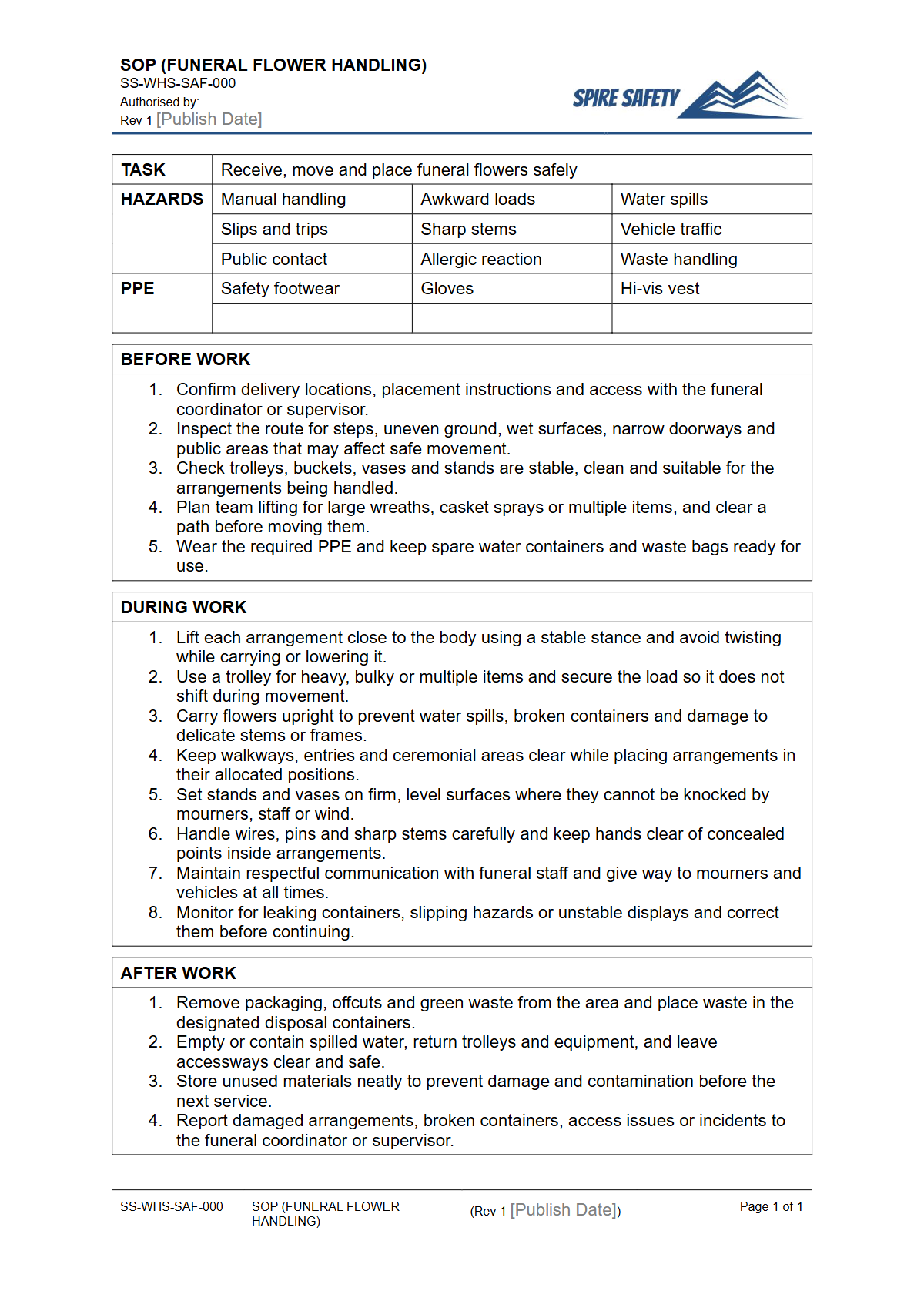
Download our free Safe Operating Procedure (Funeral Flower Handling) Template. This customisable DOCX & PDF resource helps manage WHS risks in floristry.
Free Safe Operating Procedure (Funeral Flower Handling) Template
DOCX • 126 KB + PDF
Updated Oct 2026
No signup required
Purpose of the Free Safe Operating Procedure (Funeral Flower Handling) Template
Handling floral arrangements, particularly for funerals, involves specific workplace health and safety risks that are often overlooked. Our Free Safe Operating Procedure (Funeral Flower Handling) Template provides a structured framework for documenting the safest way to perform tasks.
It guides florists, funeral home staff, and other workers through the process of preparing, handling, transporting, and setting up floral tributes, aiming to minimise the risk of injury or illness.
A Safe Operating Procedure (SOP) is a critical document that outlines step-by-step instructions to help workers carry out tasks safely. The primary purpose of this template is to help your organisation control hazards associated with funeral flower handling, such as:
- Manual Handling: Lifting, carrying, and placing heavy wreaths, casket sprays, and large vases.
- Sharps: Cuts and punctures from scissors, knives, wires, and thorns.
- Slips, Trips, and Falls: Wet floors from water spills, and tripping hazards from stems and equipment.
- Biological Hazards: Allergic reactions to pollen, skin irritation from sap, or exposure to fungi and bacteria in decaying plant matter.
- Chemical Exposure: Contact with floral preservatives, pesticides, or cleaning agents.
By formalising these procedures, you create a consistent and reliable safety standard across your team. This SOP forms a key component of effective WHS management systems, demonstrating a commitment to proactive risk management and worker safety.
Video walkthrough
How to use the Free Safe Operating Procedure (Funeral Flower Handling) Template
This document is provided in both DOCX and PDF formats for your convenience. The DOCX file is fully editable, allowing you to tailor the content to the unique environment of your funeral home or floristry business.
To use the template effectively, you should consult with your workers to identify all specific hazards and agree on the safest control measures.
Customisation is Essential
Please Note: This document is a template and is not a complete Safe Operating Procedure. It must be customised to reflect the specific equipment, chemicals, arrangements, and work environment at your site.
We bear no liability for any incidents that may occur from the use of this document. It is the responsibility of the Person Conducting a Business or Undertaking (PCBU) to ensure the procedure is suitable and sufficient for their workplace.
When customising, be sure to include details such as:
- Specific types and weights of floral arrangements handled.
- The exact names of any chemicals (e.g., floral food, preservatives) used, with references to their Safety Data Sheets (SDS).
- Clear instructions for using tools like secateurs, wire cutters, and glue guns.
- Emergency contacts and procedures relevant to your location.
- The Personal Protective Equipment (PPE) required for each task (e.g., gloves, aprons, non-slip footwear).
For more complex operations or if you require assistance in developing comprehensive safety documentation, our WHS consulting services can provide expert guidance.
When to use it
An SOP for funeral flower handling should be used as a primary reference tool in several situations. It is fundamental for inducting and training new employees, ensuring they understand the established safety protocols from day one.
It also serves as an excellent resource for refresher training and for conducting toolbox talks on specific hazards, like manual handling techniques for large casket sprays.
The SOP should be readily accessible in the work area and consulted before starting non-routine or particularly hazardous tasks, such as creating exceptionally large or complex arrangements. Furthermore, this document should be reviewed and updated after any incident or near-miss, or whenever a new process, piece of equipment, or chemical is introduced.
As part of general safety preparedness, workers should also know the location of first aid kits and be familiar with other emergency documents, such as a Safe Operating Procedure for Defibrillator Operation, if applicable to your workplace.
Who should use it
This SOP is designed for use by all individuals involved in the lifecycle of funeral flowers. This includes:
- Florists and Floral Designers: Who create the arrangements and are exposed to sharps, biological hazards, and manual handling risks.
- Funeral Home Assistants and Directors: Who are responsible for receiving, moving, and positioning the flowers within the funeral home, chapel, or at the graveside.
- Delivery Drivers and Couriers: Who transport the arrangements and need to handle them safely in and out of vehicles.
- Venue Staff: Who may assist in the setup and removal of floral tributes at memorial services.
Supervisors and managers should use this SOP to enforce safe work practices, conduct risk assessments, and provide training. Integrating this procedure with other relevant safety documents, such as a step ladder SOP for placing arrangements at height, creates a more robust safety framework. For a wider range of document templates, you can browse our complete free WHS resources library.
Common mistakes
Common mistakes to avoid
- Using the template without customising it for specific site conditions and tasks.
- Failing to adequately train all relevant workers on the finalised SOP's contents.
- Forgetting to list specific chemicals (e.g., floral preservatives) and reference their Safety Data Sheets (SDS).
- Neglecting to review and update the SOP after an incident, near-miss, or change in procedure.
Legal references
Legal considerations
The following legal requirements may be relevant to this type of work.
- Work Health and Safety Act (Harmonised) — Provides the primary duties for protecting workers and other people from work health and safety risks.
- Work Health and Safety Regulations (Harmonised) — Sets out requirements supporting the management of workplace hazards and risks.
The following codes may be relevant to this type of work.
- Managing WHS Risks Code of Practice — Provides practical guidance on identifying hazards, assessing risks and applying effective controls.
- Work Health and Safety Consultation, Cooperation and Coordination Code of Practice — Provides practical guidance on consulting workers and coordinating with other duty holders.
- Managing the Work Environment and Facilities Code of Practice — Provides practical guidance on safe work environments, workplace facilities and related controls.
Did you know
The Weight of Grief
Large floral wreaths and casket sprays can weigh over 20 kg, posing a significant manual handling risk. Your SOP should specify team lifting or the use of mechanical aids for such items.
Allergen Alert
Common funeral flowers like lilies produce pollen and scents that can cause severe allergic reactions in some people. Safe handling procedures should include assessing and controlling this risk.
FAQ
Frequently asked questions
01What are the main hazards involved in handling funeral flowers?
02Is this funeral flower handling SOP template ready to use immediately?
03Who is legally responsible for implementing a Safe Operating Procedure?
04How often should an SOP for funeral flower handling be reviewed?
Share this resource
Free Safe Operating Procedure (Funeral Flower Handling) Template
Browse Categories
How To Use It
- 1Download and open in Word or PDF.
- 2Replace the placeholders with your business details.
- 3Get it reviewed by a WHS specialist before rollout.
Need it customised?
Our WHS consultants can adapt this template to your site, run a gap analysis, or audit what you already have in place.
Book a Free Consultation WHS consulting servicesor call 1300 156 382
Related templates
- Free Safe Operating Procedure (Funeral Vehicle Cleaning) Template
- Free Safe Operating Procedure (Furniture Steam Clean) Template
- Free Safe Operating Procedure (Fuse Puller) Template
- Free Safe Operating Procedure (Galvanising) Template
- Free Safe Operating Procedure (Gang Saw) Template
- Free Safe Operating Procedure (Gangway Inspection) Template