
Free Safe Operating Procedure (Funeral Equipment Clean) Template
Download our free Safe Operating Procedure (Funeral Equipment Clean) Template.
Free Safe Operating Procedure (Funeral Equipment Clean) Template
DOCX • 126 KB + PDF
Updated Oct 2026
No signup required
Purpose of the Free Safe Operating Procedure (Funeral Equipment Clean) Template
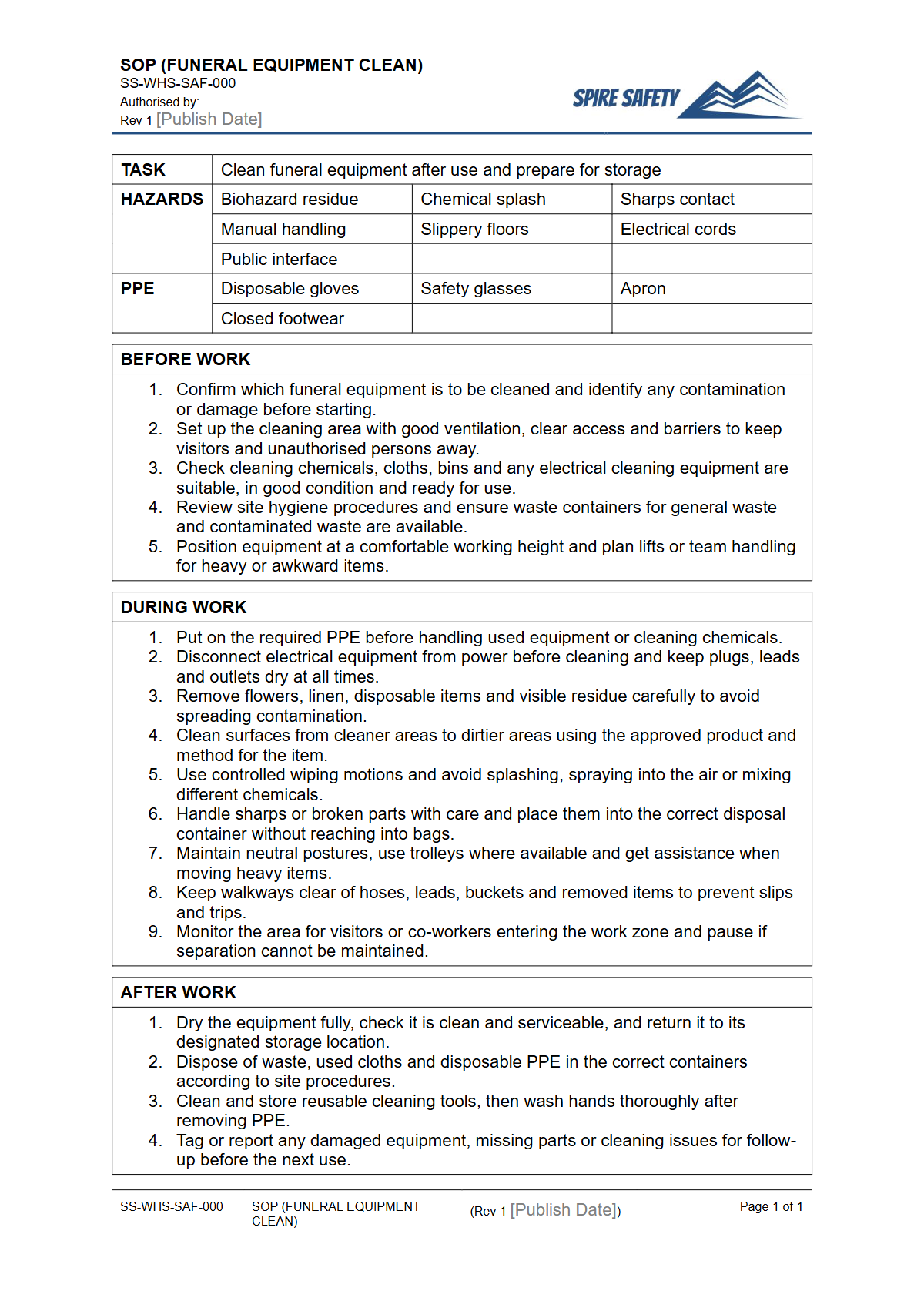
Cleaning equipment in the funeral industry presents unique health and safety challenges. This Free Safe Operating Procedure (Funeral Equipment Clean) Template provides a structured framework for managing risks associated with these tasks.
The primary purpose is to document a safe system of work to protect workers from biological hazards, chemical exposure, and ergonomic injuries. Properly cleaning and decontaminating items like embalming tables, body trays, and surgical instruments is critical for infection control and maintaining a safe work environment for everyone.
A documented procedure ensures consistency, accountability, and a clear reference for training and supervision.
This SOP helps your organisation meet its duty of care under Australian WHS laws by formalising risk control measures. It covers key stages of the process, including pre-operational checks, specific cleaning steps, and post-cleaning procedures.
Similar to our Free Safe Operating Procedure (Defibrillator Operation) template, this document focuses on the safe use and maintenance of specialised equipment, ensuring operators are aware of all necessary precautions.
Video walkthrough
How to use the Free Safe Operating Procedure (Funeral Equipment Clean) Template
This document is a template, not a finished safety document. To be effective, you must customise it to reflect the specific equipment, chemicals, and processes used in your workplace.
Start by downloading the DOCX file and engaging in consultation with workers who perform the cleaning tasks. Their direct input is invaluable for creating a practical and effective procedure.
Walk through the cleaning process step-by-step. Identify the specific types of equipment to be cleaned, the approved cleaning and disinfecting agents, required Personal Protective Equipment (PPE), and waste disposal methods.
Update the template with this site-specific information. We strongly recommend that you incorporate this customised SOP into your broader WHS management systems to ensure it is regularly reviewed and integrated with your overall safety framework.
When to use it
A Safe Operating Procedure for cleaning funeral equipment should be a living document used regularly within your organisation. It is not a 'set and forget' policy.
Its primary use is as a direct guide for employees performing the cleaning tasks, ensuring they follow the approved, safe method every time. It should be readily accessible in the work area where cleaning is performed.
Beyond daily operations, the SOP is a critical tool for training new employees and conducting refresher training for existing staff. It should also be reviewed and referenced during incident investigations, when new equipment or chemicals are introduced, or as part of scheduled safety audits.
If you need assistance integrating these procedures or reviewing your current practices, consider our general WHS consulting services for expert guidance.
Who should use it
This SOP is designed for use by several key roles within a funeral service organisation. Mortuary technicians, funeral assistants, and any other personnel directly responsible for cleaning and decontaminating equipment are the primary users.
They must be thoroughly trained on its contents and follow the prescribed steps diligently.
Managers and supervisors also have a crucial role. They must use the SOP to train staff, supervise work, and ensure the specified controls (like PPE and correct chemicals) are available and used correctly.
Work Health and Safety (WHS) representatives and committees should also use the SOP as a benchmark during workplace inspections and safety consultations. Regular checks, such as those performed during a WHS compliance auditing process, can verify that the documented procedures are being followed in practice.
By formalising procedures, you create a safer environment and a clear standard for all staff. Explore our full free WHS resources library for more templates and guides to support your safety management efforts.
Common mistakes
Common mistakes to avoid
- Using a generic template without customising it for site-specific equipment and chemicals.
- Failing to adequately train workers on the procedures documented in the final SOP.
- Not providing or maintaining the specified Personal Protective Equipment (PPE).
- Using incorrect cleaning chemical dilution rates, reducing effectiveness or increasing chemical hazards.
Legal references
Legal considerations
The following legal requirements may be relevant to this type of work.
- Work Health and Safety Act (Harmonised) — Provides the primary duties for protecting workers and other people from work health and safety risks.
- Work Health and Safety Regulations (Harmonised) — Sets out requirements supporting the management of workplace hazards and risks.
The following codes may be relevant to this type of work.
- Managing WHS Risks Code of Practice — Provides practical guidance on identifying hazards, assessing risks and applying effective controls.
- Work Health and Safety Consultation, Cooperation and Coordination Code of Practice — Provides practical guidance on consulting workers and coordinating with other duty holders.
- Managing the Work Environment and Facilities Code of Practice — Provides practical guidance on safe work environments, workplace facilities and related controls.
Did you know
Biological Hazards
Exposure to biological hazards in the workplace is a significant cause of occupational disease. Effective decontamination procedures, as outlined in an SOP, are a primary control measure to protect workers.
FAQ
Frequently asked questions
01What hazards are involved in cleaning funeral equipment?
02Is this Safe Operating Procedure template ready to use immediately?
03How often should we review our Funeral Equipment Cleaning SOP?
04What kind of PPE is required for cleaning funeral equipment?
Share this resource
Free Safe Operating Procedure (Funeral Equipment Clean) Template
Browse Categories
How To Use It
- 1Download and open in Word or PDF.
- 2Replace the placeholders with your business details.
- 3Get it reviewed by a WHS specialist before rollout.
Need it customised?
Our WHS consultants can adapt this template to your site, run a gap analysis, or audit what you already have in place.
Book a Free Consultation WHS consulting servicesor call 1300 156 382
Related templates
- Free Safe Operating Procedure (Funeral Flower Handling) Template
- Free Safe Operating Procedure (Funeral Vehicle Cleaning) Template
- Free Safe Operating Procedure (Furniture Steam Clean) Template
- Free Safe Operating Procedure (Fuse Puller) Template
- Free Safe Operating Procedure (Galvanising) Template
- Free Safe Operating Procedure (Gang Saw) Template