
Free Safe Operating Procedure (Fuel Spill Mat Setup) Template
Download our free Safe Operating Procedure (Fuel Spill Mat Setup) Template.
Free Safe Operating Procedure (Fuel Spill Mat Setup) Template
DOCX • 126 KB + PDF
Updated Oct 2026
No signup required
Purpose of the Free Safe Operating Procedure (Fuel Spill Mat Setup) Template
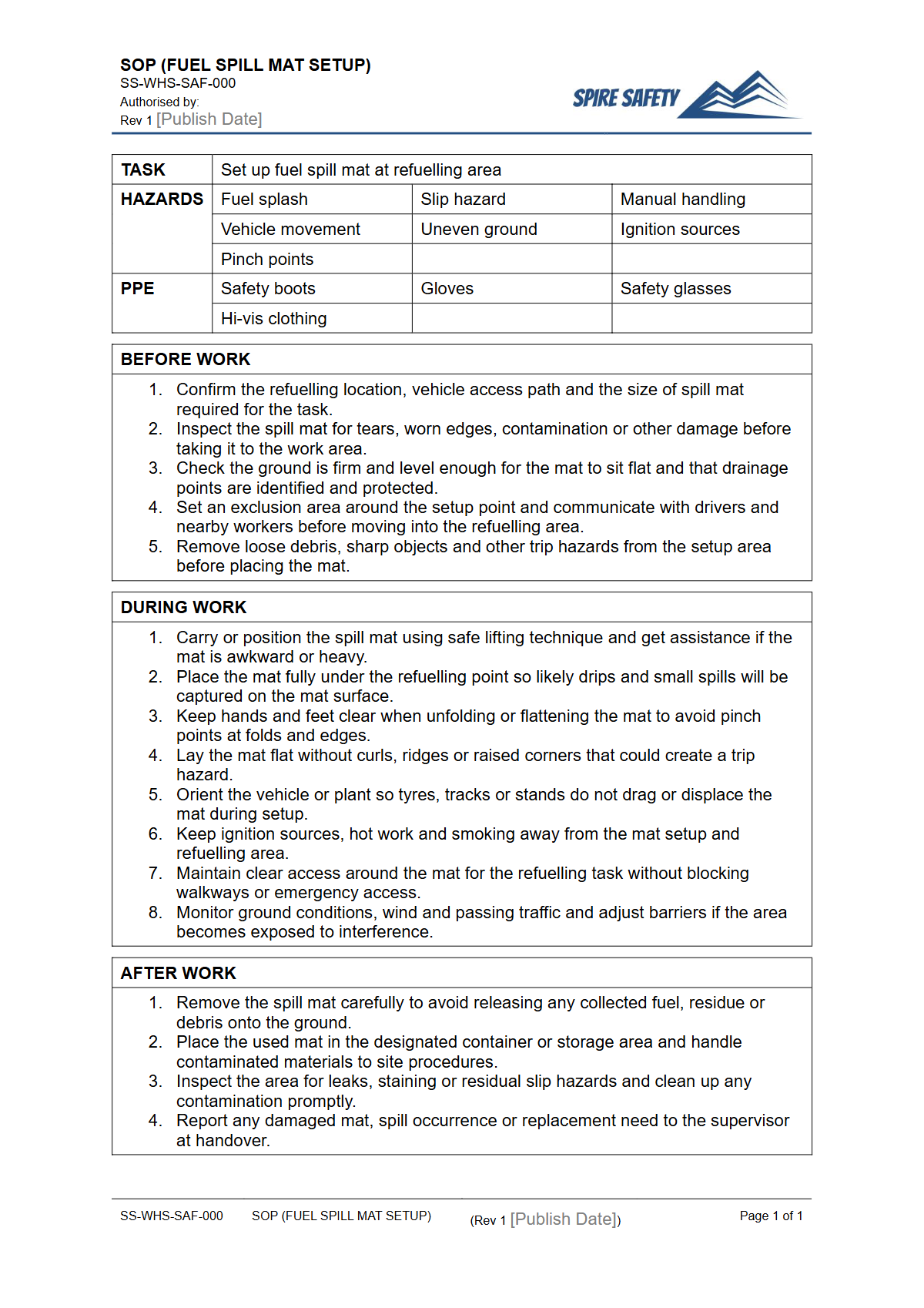
Managing fuel on site presents significant environmental and safety risks. This Free Safe Operating Procedure (Fuel Spill Mat Setup) Template provides a structured starting point for organisations to document the correct method for deploying, using, and packing up fuel spill mats.
The primary goal is to prevent fuel from contaminating soil, drains, and waterways during refuelling or fuel transfer activities. Formalising this process helps meet environmental due diligence obligations and minimises the risk of costly clean-ups and regulatory fines.
Implementing clear SOPs is a fundamental part of demonstrating a systematic approach to risk management.
Video walkthrough
How to use the Free Safe Operating Procedure (Fuel Spill Mat Setup) Template
This resource is available for immediate download in both DOCX and PDF formats. The DOCX file is fully editable, allowing you to tailor the content to your specific operational needs.
A well-drafted SOP should form part of your broader WHS management systems, integrating seamlessly with your existing safety and environmental policies.
Important: This is a template, not a finished document. You must customise it to reflect your workplace's specific hazards, equipment, types of fuel used, site layout, and emergency response plans.
We recommend a competent person reviews and approves the final document before it is issued for use.
When to use this Safe Operating Procedure
This Safe Operating Procedure should be followed whenever fuel spill mats are required as a control measure. Common scenarios include:
- Routine refuelling of mobile plant, vehicles, and equipment in areas without dedicated sealed refuelling bays.
- Setting up temporary fuel storage or decanting stations on work sites.
- Transferring fuel between bulk containers, drums, and equipment.
- Performing maintenance tasks on machinery where there is a risk of fuel or oil leakage.
Using spill mats is a critical preventative step, especially when operating machinery like that covered in our FREE Dozer SOP (Safe Operating Procedure) Template near sensitive environmental areas.
Who should use it
This SOP is intended for all personnel involved in activities with a risk of fuel spillage. This includes, but is not limited to:
- Plant and Equipment Operators
- Maintenance Fitters and Mechanics
- Site Supervisors and Forepersons
- WHS and Environmental Officers
- Workers responsible for refuelling duties
All relevant workers must be trained in this procedure to ensure they understand their responsibilities for spill prevention and response. This training should be documented and periodically refreshed.
Key Elements of a Fuel Spill Mat SOP
A comprehensive SOP for fuel spill mat setup should cover several key stages. The template guides you through documenting pre-use checks, ensuring the mat is free from tears or defects that could compromise its integrity.
It outlines the correct placement technique, which involves positioning the mat to capture potential drips from nozzles and tank inlets. The procedure should also detail how to handle the mat after use, including cleaning, drying, and correct storage to maintain its lifespan and effectiveness for future use.
For complex sites, periodic verification of these steps through a formal audit process helps ensure consistent application. A service like WHS compliance auditing can provide independent assurance that procedures are being followed correctly.
The procedure should also link to your site's broader spill response plan, clarifying what to do if a spill exceeds the capacity of the mat. Documenting these steps is crucial for any machinery use, including for equipment detailed in other resources like the FREE Telehandler SOP (Safe Operating Procedure) Template. For more guidance and templates, feel free to browse our complete free WHS resources library for Australian businesses.
Common mistakes
Common mistakes to avoid
- Using a mat that is too small for the potential spill area.
- Failing to inspect the mat for holes or damage before use.
- Incorrectly placing the mat, missing the most likely drip and spill points.
- Not having a spill kit nearby to manage spills that may overflow the mat.
Legal references
Legal considerations
The following legal requirements may be relevant to this type of work.
- Work Health and Safety Act (Harmonised) — Provides the primary duties for protecting workers and other people from work health and safety risks.
- Work Health and Safety Regulations (Harmonised) — Sets out requirements supporting the management of workplace hazards and risks.
The following codes may be relevant to this type of work.
- Managing WHS Risks Code of Practice — Provides practical guidance on identifying hazards, assessing risks and applying effective controls.
- Work Health and Safety Consultation, Cooperation and Coordination Code of Practice — Provides practical guidance on consulting workers and coordinating with other duty holders.
- Managing the Work Environment and Facilities Code of Practice — Provides practical guidance on safe work environments, workplace facilities and related controls.
Did you know
Environmental Impact
Even a small amount of fuel can have a large impact. Just one litre of oil or fuel can contaminate up to one million litres of fresh water, making prevention absolutely essential.
Cost of Non-Compliance
Australian environmental protection agencies can issue significant on-the-spot fines and pursue court-ordered penalties for pollution incidents, often costing businesses tens of thousands of dollars or more.
FAQ
Frequently asked questions
01What is a fuel spill mat and why is it important?
02Are fuel spill mats a legal requirement in Australia?
03How do I clean and maintain a fuel spill mat after use?
04Can this SOP template be used for chemical spills too?
Share this resource
Free Safe Operating Procedure (Fuel Spill Mat Setup) Template
Browse Categories
How To Use It
- 1Download and open in Word or PDF.
- 2Replace the placeholders with your business details.
- 3Get it reviewed by a WHS specialist before rollout.
Need it customised?
Our WHS consultants can adapt this template to your site, run a gap analysis, or audit what you already have in place.
Book a Free Consultation WHS consulting servicesor call 1300 156 382
Related templates
- Free Safe Operating Procedure (Fuel Tank Draining) Template
- Free Safe Operating Procedure (Fuel Transfer Pump) Template
- Free Safe Operating Procedure (Fume Cupboard) Template
- Free Safe Operating Procedure (Funeral Equipment Clean) Template
- Free Safe Operating Procedure (Funeral Flower Handling) Template
- Free Safe Operating Procedure (Funeral Vehicle Cleaning) Template