
Free Safe Operating Procedure (Fruit Picking) Template
Download our free Safe Operating Procedure (Fruit Picking) template. This customisable DOCX and PDF provides a structured framework for agricultural safety.
Free Safe Operating Procedure (Fruit Picking) Template
DOCX • 126 KB + PDF
Updated Oct 2026
No signup required
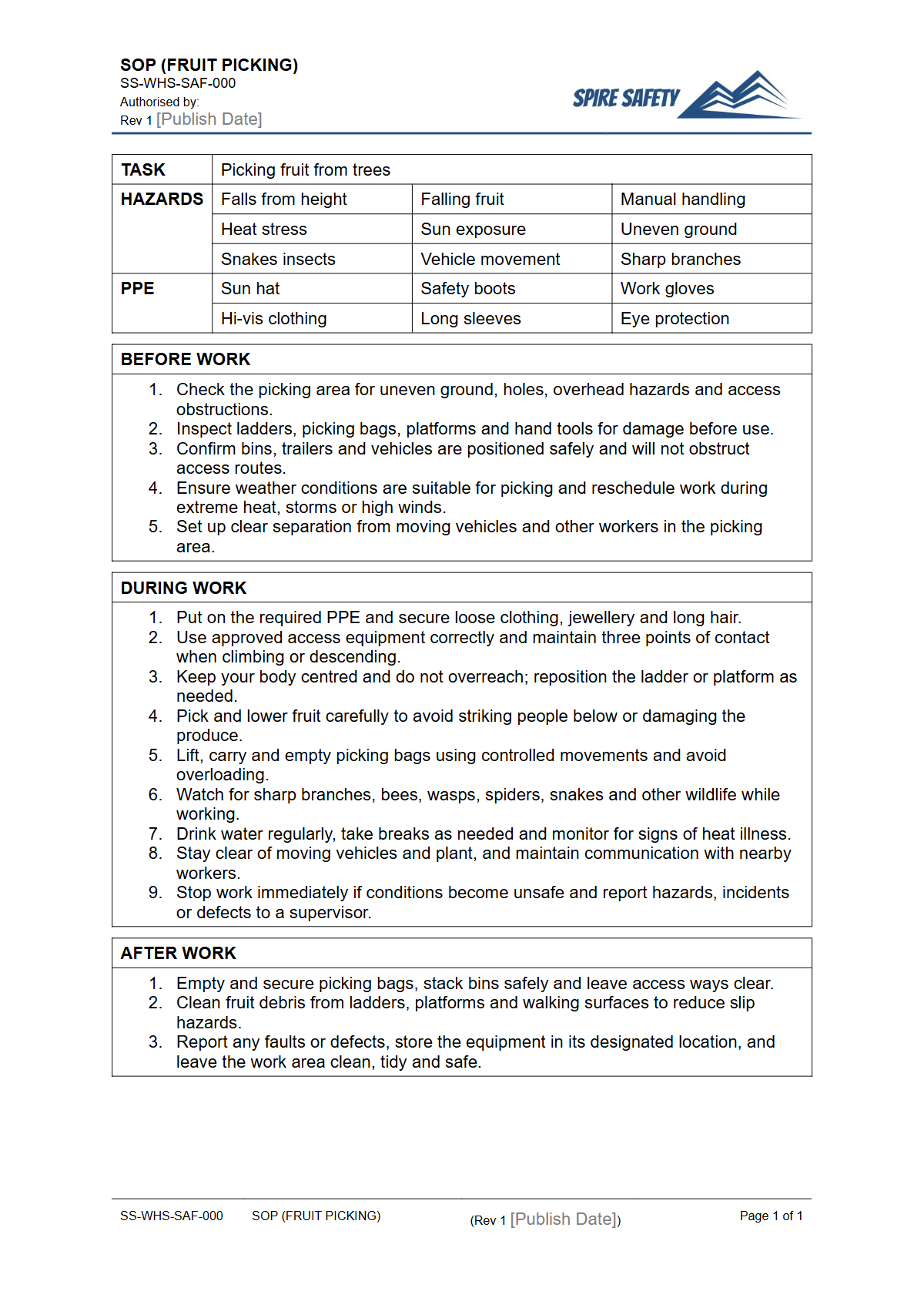
Purpose of the Free Safe Operating Procedure (Fruit Picking) Template
Fruit picking is a physically demanding task with numerous inherent risks. This free Safe Operating Procedure (Fruit Picking) template provides a structured starting point for farms and agricultural businesses to document the safest way to perform picking tasks.
An SOP is an administrative control that outlines step-by-step instructions to help workers perform their duties safely and efficiently, minimising the risk of injury. It serves as a vital tool for training, standardising work methods, and demonstrating a commitment to workplace health and safety.
Key Hazards in Fruit Picking
A comprehensive fruit picking SOP should address site-specific hazards identified through a risk assessment process. Common risks in the agricultural sector include:
- Musculoskeletal Injuries: Sprains and strains from repetitive movements (reaching, twisting, bending), awkward postures, and carrying heavy loads of fruit.
- Falls: Slips and trips on uneven, wet, or cluttered ground, as well as falls from height when using ladders or elevated work platforms to reach higher fruit.
- Environmental Exposure: Heat stress, dehydration, sunburn, and exposure to adverse weather conditions.
- Biological Hazards: Bites and stings from insects, spiders, or snakes.
- Manual Handling: Injuries from lifting, carrying, and emptying heavy picking bags or buckets.
- Equipment and Machinery: Incidents involving tractors, quad bikes, or other vehicles operating in the orchard.
Video walkthrough
How to use the Free Safe Operating Procedure (Fruit Picking) Template
This document is a template, not a finished procedure. To use it effectively, you must download the DOCX or PDF file and systematically adapt it to the specific conditions of your workplace.
This involves reviewing each section and filling in the details relevant to your fruit type, harvesting methods, equipment, and environment. For example, if your process involves ladders, you may wish to cross-reference a specific free Step Ladder SOP template to ensure comprehensive guidance is provided.
Customisation is Critical
A generic SOP is insufficient for managing your specific WHS obligations. It is essential to customise this template following a thorough risk assessment of your fruit picking operations.
Important Note: This is a template that we have created as a starting point. You MUST customise this document to reflect the unique hazards, risks, and control measures present in your specific workplace.
A generic procedure will not be sufficient to ensure safety or meet your legal duties.
Consider aspects such as the type of fruit (e.g., apples vs. berries), the terrain of the orchard, the specific models of equipment used, and the composition of your workforce.
The controls required for a Safe Operating Procedure for a grain drill will be vastly different, but the principle of customisation remains the same for all agricultural equipment and tasks.
When to use a Fruit Picking SOP
A Safe Operating Procedure for fruit picking is a dynamic document used throughout the employment lifecycle. It should be used during the induction and training of new workers, especially seasonal or temporary labour, to establish baseline safety knowledge.
It also serves as an excellent tool for refresher training for experienced staff before a new harvest season begins. Supervisors can use it for pre-start toolbox talks to remind workers of key hazards and safe practices for the day.
Integrating SOPs into your broader comprehensive WHS management systems ensures they are consistently applied and reviewed.
Who should use this Safe Operating Procedure
This SOP is designed for use by multiple people within an agricultural business. Persons Conducting a Business or Undertaking (PCBUs), such as farm owners and managers, are responsible for ensuring the procedure is developed, customised, and implemented.
Supervisors and Team Leaders must use the SOP to train, monitor, and correct workers on the job. Workers are the end-users who must understand and follow the procedure to ensure their own safety and the safety of others.
For complex operations or if you are unsure how to conduct a sufficient risk assessment, engaging professional WHS consulting services can provide expert guidance.
Review and Improvement
An SOP is not a 'set and forget' document. It should be reviewed regularly—at least annually—or whenever there is a change to the task, equipment, or environment. It must also be reviewed after any incident, near miss, or when new hazard information becomes available. Part of this review includes checking emergency preparedness plans, which might involve cross-referencing documents like an SOP for Defibrillator Operation. You can explore many other templates in our free WHS resources library to build out your safety system.
Common mistakes
Common mistakes to avoid
- Using the downloaded template without customising it for the specific farm, fruit type, and equipment.
- Failing to adequately train workers, particularly seasonal and non-English speaking staff, on the SOP's contents.
- Not reviewing or updating the SOP after an incident, near miss, or change in harvesting methods.
- Writing the procedure in overly technical language that workers cannot easily understand and follow.
Legal references
Legal considerations
The following legal requirements may be relevant to this type of work.
- Work Health and Safety Act (Harmonised) — Provides the primary duties for protecting workers and other people from work health and safety risks.
- Work Health and Safety Regulations (Harmonised) — Sets out requirements supporting the management of workplace hazards and risks.
The following codes may be relevant to this type of work.
- Managing WHS Risks Code of Practice — Provides practical guidance on identifying hazards, assessing risks and applying effective controls.
- Work Health and Safety Consultation, Cooperation and Coordination Code of Practice — Provides practical guidance on consulting workers and coordinating with other duty holders.
- Managing the Work Environment and Facilities Code of Practice — Provides practical guidance on safe work environments, workplace facilities and related controls.
Did you know
Agricultural Injury Rates
According to Safe Work Australia, the agriculture, forestry, and fishing industry has one of the highest rates of worker fatalities and serious injuries of any industry in the country.
Heat Stress Risk
Working in 33°C heat can reduce a worker's productivity by up to 50%. A well-defined SOP that includes mandatory breaks and hydration schedules is crucial for managing heat stress.
FAQ
Frequently asked questions
01What should be included in a fruit picking SOP?
02How often should a Safe Operating Procedure for fruit picking be reviewed?
03Is an SOP a legal requirement for fruit picking in Australia?
04Can a generic SOP template be used for all types of fruit picking?
Share this resource
Free Safe Operating Procedure (Fruit Picking) Template
Browse Categories
How To Use It
- 1Download and open in Word or PDF.
- 2Replace the placeholders with your business details.
- 3Get it reviewed by a WHS specialist before rollout.
Need it customised?
Our WHS consultants can adapt this template to your site, run a gap analysis, or audit what you already have in place.
Book a Free Consultation WHS consulting servicesor call 1300 156 382
Related templates
- Free Safe Operating Procedure (Fruit Sorting) Template
- Free Safe Operating Procedure (Fuel Dock Operation) Template
- Free Safe Operating Procedure (Fuel Hydrant Cart) Template
- Free Safe Operating Procedure (Fuel Line Disconnect) Template
- Free Safe Operating Procedure (Fuel Spill Mat Setup) Template
- Free Safe Operating Procedure (Fuel Tank Draining) Template