
Free Safe Operating Procedure (Fuel Dock Operation) Template
Manage risks at marinas and refuelling stations with our free Safe Operating Procedure (Fuel Dock Operation) template. Download your customisable DOCX.
Free Safe Operating Procedure (Fuel Dock Operation) Template
DOCX • 126 KB + PDF
Updated Oct 2026
No signup required
Purpose of the Free Safe Operating Procedure (Fuel Dock Operation) Template
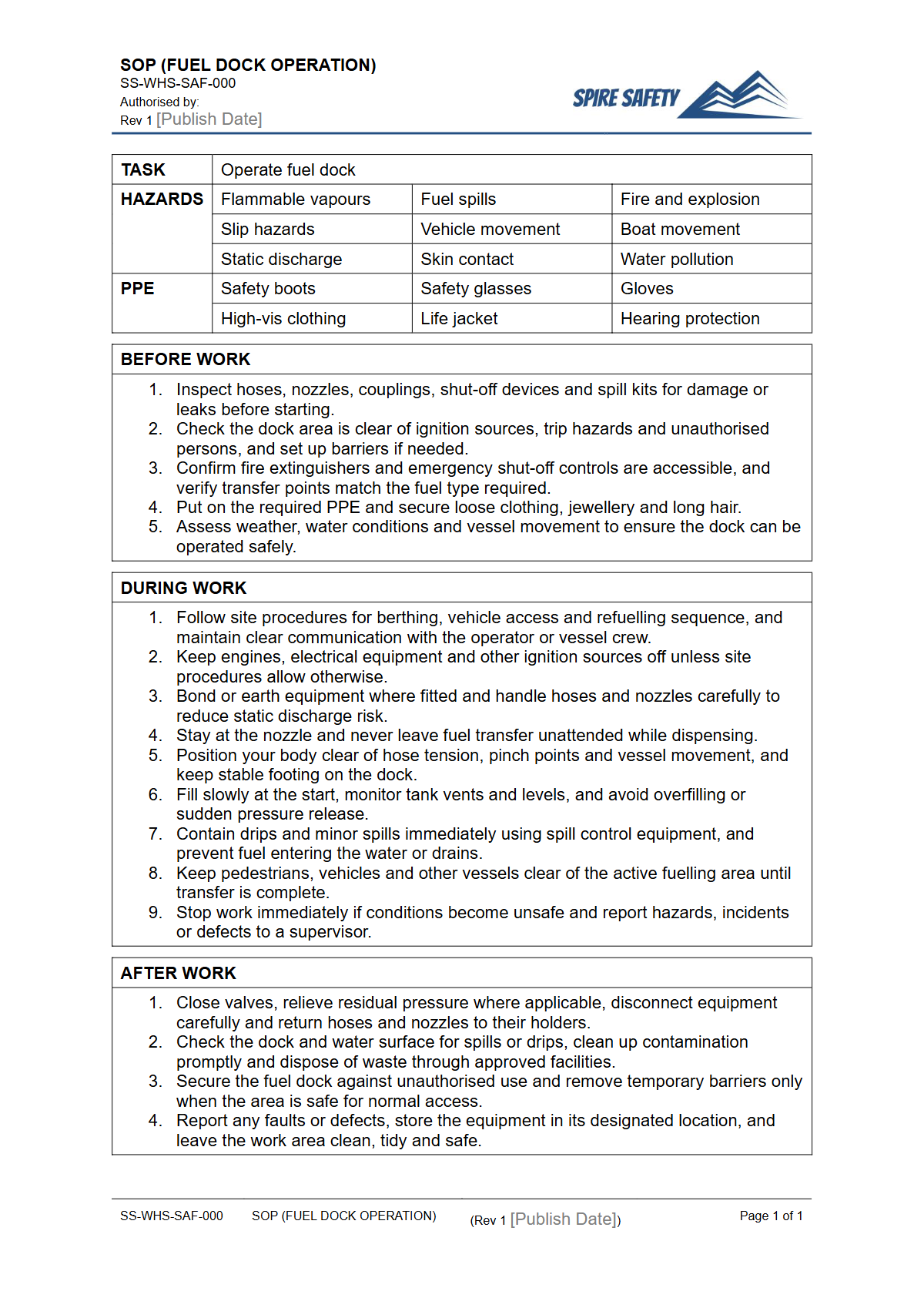
Operating a fuel dock involves significant risks, including fire, explosion, chemical spills, and environmental contamination. This Free Safe Operating Procedure (Fuel Dock Operation) Template provides a structured starting point for your organisation to document and implement critical safety controls.
It is designed to help you outline the sequential steps for safe refuelling, identify potential hazards like static discharge and fuel spills, and specify the control measures required to protect workers, the public, and the environment. Using a documented procedure helps ensure tasks are performed consistently and safely every time.
The template is aligned with Australian WHS principles and encourages a systematic approach to risk management. It prompts you to detail requirements for personal protective equipment (PPE), emergency response actions for spills or fires, and equipment maintenance checks.
Documenting these processes is a key part of demonstrating due diligence and managing your safety obligations. The controls for handling flammable liquids share principles with other hazardous substance tasks, such as those detailed in our pool chemical dosing system operation SOP.
Video walkthrough
How to use the Free Safe Operating Procedure (Fuel Dock Operation) Template
This document is a template and must be customised to suit the specific equipment, layout, and operational context of your workplace. We are not familiar with your unique site conditions, so you must consult with your team and other stakeholders to adapt this procedure.
To effectively use this template:
- Download: Select the DOCX format for easy editing.
- Consult: Involve workers who operate the fuel dock, supervisors, and any WHS representatives in the drafting process. Their practical experience is invaluable for identifying real-world hazards and effective controls.
- Customise: Walk through the refuelling task step-by-step. Update the document with your specific site details, including the types of fuel handled, emergency contact numbers, spill kit locations, and the makes and models of pumps and safety equipment.
- Review and Approve: Have a competent person, such as a manager or WHS advisor, review and approve the final SOP before it is implemented.
- Train: Ensure all relevant workers are trained on the contents of the finalised SOP. Keep records of this training.
A Safe Operating Procedure is a vital component of a larger safety framework. Integrating this SOP into your organisation's overall WHS management system ensures it works alongside other policies, risk assessments, and training programs to create a comprehensive safety culture.
When to use it
A Safe Operating Procedure for fuel dock operations should be developed and implemented before any worker is authorised to perform the task. It serves as a foundational document for training and competency assessment.
The SOP should be readily accessible at or near the fuel dock for easy reference during operations. It is a critical tool during worker inductions, refresher training, and after any significant changes to equipment or procedures.
The SOP should also be reviewed as part of any incident investigation involving the fuel dock.
It's important to recognise that a fuel dock can be part of a larger, dynamic work environment. If other high-risk activities occur nearby, they will require their own documented procedures.
For instance, any 'hot work' like welding in the vicinity of the fuelling area must be strictly controlled under a permit system and its own specific TIG welder operation SOP to prevent ignition of flammable vapours.
Who should use it
This template is designed for use by Persons Conducting a Business or Undertaking (PCBUs), managers, supervisors, and WHS professionals responsible for safety in marinas, boat yards, ports, or any facility with a fuel dock. It is a tool for management to meet their duty of care.
The finalised SOP is for the direct use of workers and operators who perform refuelling tasks. It provides them with clear, unambiguous instructions on how to work safely and respond to emergencies.
Supervisors should use the SOP to monitor compliance, conduct workplace inspections, and guide on-the-job training. The effectiveness of its implementation can be formally checked during a WHS compliance audit.
Different roles require specific procedures; for example, if heavy machinery is used for vessel maintenance nearby, a separate Telehandler SOP is essential for operators of that equipment. The fuel dock SOP should be made available to emergency services and environmental regulators upon request. If you require expert help in tailoring this document or developing a broader safety system, our WHS consulting team can provide guidance. For additional templates covering a wide range of tasks and equipment, browse our complete free WHS resources library.
Common mistakes
Common mistakes to avoid
- Using a generic template without customising it for the specific site, equipment, and types of fuel.
- Failing to adequately train all relevant workers on the finalised SOP and emergency response actions.
- Neglecting regular inspection and maintenance of safety equipment like spill kits, fire extinguishers, and emergency shut-offs.
- Not enforcing rules for customers or other untrained personnel within the fuel dock's hazard zone.
Legal references
Legal considerations
The following legal requirements may be relevant to this type of work.
- Work Health and Safety Act (Harmonised) — Provides the primary duties for protecting workers and other people from work health and safety risks.
- Work Health and Safety Regulations (Harmonised) — Sets out requirements supporting the management of workplace hazards and risks.
The following codes may be relevant to this type of work.
- Managing WHS Risks Code of Practice — Provides practical guidance on identifying hazards, assessing risks and applying effective controls.
- Work Health and Safety Consultation, Cooperation and Coordination Code of Practice — Provides practical guidance on consulting workers and coordinating with other duty holders.
- Managing the Work Environment and Facilities Code of Practice — Provides practical guidance on safe work environments, workplace facilities and related controls.
Did you know
Static Spark
A person simply walking can generate enough static electricity to create a spark capable of igniting petrol vapours. This is why bonding and grounding procedures are critical during refuelling.
Flash Points
The flash point of petrol (gasoline) can be as low as -43°C, meaning it produces enough flammable vapour to ignite even in freezing conditions. Diesel is less volatile, with a flash point around 52°C.
FAQ
Frequently asked questions
01What are the main hazards in fuel dock operation?
02Is a Safe Operating Procedure a legal requirement for fuel docks in Australia?
03What training should accompany a fuel dock SOP?
04How often should a fuel dock SOP be reviewed?
Share this resource
Free Safe Operating Procedure (Fuel Dock Operation) Template
Browse Categories
How To Use It
- 1Download and open in Word or PDF.
- 2Replace the placeholders with your business details.
- 3Get it reviewed by a WHS specialist before rollout.
Need it customised?
Our WHS consultants can adapt this template to your site, run a gap analysis, or audit what you already have in place.
Book a Free Consultation WHS consulting servicesor call 1300 156 382
Related templates
- Free Safe Operating Procedure (Fuel Hydrant Cart) Template
- Free Safe Operating Procedure (Fuel Line Disconnect) Template
- Free Safe Operating Procedure (Fuel Spill Mat Setup) Template
- Free Safe Operating Procedure (Fuel Tank Draining) Template
- Free Safe Operating Procedure (Fuel Transfer Pump) Template
- Free Safe Operating Procedure (Fume Cupboard) Template